Ode to Fall: Pappardelle with Pork Ragù

~ Pork and Tomato Ragù with Pappardelle ~

I am going to ignore that it is 90 degrees outside. It’s fall after all. For those of you who know me, it’s that time of year when I have a little rant about missing New England weather. September is the time when the air puts on a chill just like a wooly cloak, the sun lowers seductively in the horizon, winking and casting its golden light while the aroma of turning leaves fills the air. I know I shouldn’t complain while I don my sunglasses and smear on more sunscreen, but I do. As I walk about the house in shorts and flip flops, I like to pretend that I am still in northern Europe or Boston, switching out my tank tops for fluffy fleece and packing tissues in my pocket to stop a runny nose. I might need a fan right now, but I can also indulge in warming fall comfort food.

Pappardelle with Pork Ragù

If you can stand it, refrigerate the ragù overnight before serving to allow the flavors to develop. This recipe will make enough ragù to serve a family of four with enough leftover to freeze for a second meal.

2 pounds pork butt, excess fat trimmed, cut in 2 inch chunks
Salt
Freshly ground black pepper
2 tablespoons olive oil
1 large yellow onion, chopped
2 carrots, finely diced
6 cloves garlic
1 teaspoon red pepper flakes
1 cup dry white wine
2 (28 ounce) cans Italian plum tomatoes with juice
2 bay leaves
2 teaspoons dried oregano
1 teaspoon dried thyme
1/2 teaspoon ground cinnamon

1 pound pappardelle pasta, cooked until al dente
Grated Pecorino Romano cheese

Salt and pepper the pork. Heat olive oil in a large pot or dutch oven over medium-high heat until it’s shimmering. Add pork in one layer in batches, without overcrowding. Brown on all sides; transfer to a plate. Repeat with remaining pork. Pour off all but 2 tablespoons fat. Add onion, carrots, garlic and red pepper flakes. Sauté until the vegetables begin to soften, about 3 minutes. Carefully add wine (it may spatter.) Cook, stirring up the brown bits and to burn off the alcohol, about 1 minute. Add tomatoes, bay leaves, oregano, thyme, cinnamon, 1 teaspoon salt and pepper. Return pork to the pot and submerge in the sauce. Simmer, covered, over low heat until pork is very tender, about 2 hours. Remove lid and continue to simmer, skimming fat occasionally with a spoon, until sauce is thickened, 45 minutes. Add salt and pepper to taste. Serve over cooked pappardelle with grated Pecorino Romano cheese.

Linguine with Cherry Tomatoes and Breadcrumb Gremolata

~ Linguine, Cherry Tomatoes, Breadcrumb Gremolata ~

The end of summer signifies many things: Labor Day BBQ’s, back to school excitement, cooling temperatures – and lots of cherry tomatoes. Our tomato plants have chugged along this summer in a cooler-than-usual climate, and suddenly seem to have picked up steam in a last minute hurrah to the end of summer. Our bushes are heavy with red and yellow cherry tomatoes, begging to be picked. We oblige and pop them in our mouths (the best way to eat a ripe cherry tomato is straight up, warm from the vine – nature’s candy at its best). However, there are only so many that can be munched on in a day or scattered over a salad. It’s time to get creative with our bounty, and so I have a recipe, or two, for you that I will share this week. The first is this light and simple dinner that may be thrown together in less than 30 minutes.

Linguine with Cherry Tomatoes and Breadcrumb Gremolata

Serves 4.

For the Breadcrumb Gremolata:

1/2 cup breadcrumbs or panko
1/4 cup finely chopped parsley and/or basil
2 tablespoons finely grated Pecorino Romano
1 teaspoon lemon zest
1/2 teaspoon pepper
1/2 teaspoon salt

Toast the breadcrumbs in a dry skillet until light golden. Transfer to a bowl and cool completely. Add remaining ingredients and toss to combine.

For the pasta:

1 pound linguine
1 tablespoon olive oil
1 clove garlic, minced
1/2 teaspoon red pepper flakes
1 1/2 pounds cherry tomatoes

Bring a large pot of salted water to a rolling bowl. Add linguine and cook until al dente; drain. While the pasta is cooking, heat olive oil in a skillet over medium heat. Add garlic and red pepper flakes. Cook, stirring until fragrant, about 1 minute. Add tomatoes. Cook, stirring occasionally, until tomatoes begin to break down, but don’t completely dissolve, about 15 minutes. Remove from heat. Add salt and pepper and taste for seasoning. Add linguine to skillet and toss to coat. Divide among serving plates and sprinkle with the gremolata. Serve immediately.

Shrimp and Feta Salad

~ Mixed Greens, Shrimp, Feta, Tomatoes, Cured Olives ~

Shrimp and feta cheese make a perfect couple. The sharp salty cheese is a perfect complement to the briny sweet shrimp. I like to combine these two friends in rice or orzo dishes. I also enjoy baking them in a gratin with tomatoes and olives, drizzled with ouzo – which was my original intention for dinner tonight. However, time got the best of me, and for a super quick fix I tossed the shrimp in this salad instead. What would have been a simple green salad graciously accommodated sautéed shrimp and chunks of feta, transforming itself into a light and fresh main course. As for the ouzo, it was hardly bypassed, but turned into an apertif to launch our dinner. A very acceptable compromise, indeed.

Shrimp and Feta Salad

I also added red corn kernels to the salad, because I had them – and they looked so pretty with the shrimp. Serves 4.

For the vinaigrette:
1 small garlic clove, minced
2 tablespoons freshly squeezed lemon juice
1 tablespoon red wine vinegar
1/2 teaspoon salt
1/2 teaspoon freshly ground black pepper
1/2 cup extra-virgin olive oil

Whisk all of the ingredients except the oil together in a small bowl. Slowly whisk in the olive oil in a steady stream to emulsify. Set aside.

For the salad:
1 tablespoon olive oil
1/2 teaspoon crushed red pepper flakes
16 medium shrimp, shelled with tails in tact, deveined
8 cups mixed greens, such as red oak, bibb, arugula
1 1/2 cups cherry tomatoes, halved if large
1/2 red pepper, seeded, membranes removed, thinly sliced
1/2 small red onion, thinly sliced
16 black olives (brine cured or kalamata)
6 ounces feta cheese, crumbled
Italian parsley leaves

Heat the oil and red pepper flakes in a skillet over medium-high heat. Add shrimp in one layer, without overcrowding the pan. Cook, turning once, until bright pink on both sides, about 1 minute each side. Transfer shrimp to a plate. Cool.
Combine the greens, tomatoes, red pepper and onion together in a large bowl. Drizzle 1/4 cup vinaigrette over the greens and toss to coat. Divide among plates. Scatter olives and feta over the salad. Arrange shrimp on top. Drizzle with additional vinaigrette to taste. Garnish with parsley. Serve with bread or pita.

Skirt Steak with Chimichurri Sauce


~  Marinated Skirt Steak, Chimichurri Sauce and a Grill ~

I swore I was going to try to eat a little less meat. Well, I guess I shouldn’t swear. And I certainly couldn’t plan on a last minute summer trip to visit friends in the wild west earlier this month. As they say, never look a gift horse in the mouth, and when the gift is a generous invitation to visit not one family but two families at their respective homes in Wyoming and Idaho, you must seize the moment, thank the lucky stars for your friendships, and buy lots of wine as hostess gifts. And make that red wine, because, in the west, you will be eating copious quantities of delicious red meat.

~ Grand Teton National Park ~

I am convinced that the Rocky Mountains’ high altitude, dry air, and vast landscape will make anyone a carnivore. Bison, buffalo, elk and beef have a place on all menus. Prefer a whiter meat? There’s plenty of pork, chicken and turkey, too. (And no worries if you are not a meat eater. This is the land where the Snake River does it’s snaking – winding and looping its way along the border of Wyoming and Idaho, stocked full of bass and trout.). But this post is about the meat.  One day, we prepared this skirt steak recipe for our dinner. It was submerged in a marinade before we headed out for an afternoon of hiking and mountain biking. When we returned with a big appetite, sore muscles and a few bumps and bruises, all that we needed was a hot shower, a glass of some of that red wine, and to fire up the grill. Ingredients for a fresh, green chimichurri sauce were quickly blitzed in a food processor as a bright accompaniment to the meat. Then we sat and sipped our wine as we watched the sun set behind the mountains. This is living in the wild west.


~
Grilled Skirt Steak with Chimichurri Sauce

Serves 4-5

1/2 cup low sodium soy sauce
1/4 cup olive oil
3 garlic cloves, minced
1/4 cup freshly squeezed lime juice
2 tablespoons brown sugar
1 teaspoon cumin
1 teaspoon freshly ground black pepper
1/4 teaspoon cayenne
2 pounds skirt steak

Combine all of the marinade ingredients in a bowl and whisk together. Place skirt steak in a large container with lid or ziploc bag. Pour marinade over. Cover container or seal bag and refrigerate. Marinate for at least 3 hours or overnight. Remove from refrigerator 30 minutes before grilling to bring to room temperature.
Prepare grill for high heat (or preheat oven broiler). Remove meat from marinade; discard marinade. Grill over direct high heat, turning once, 3-4 minutes each side for medium-rare. (If using the oven, arrange meat on in one layer on a broiler pan. Broil, turning once, 4 minutes per side). Transfer meat to cutting board. Tent with foil and let rest 10 minutes. To serve, slice skirt steak against the grain on the diagonal in 3″ strips. Serve with Chimichurri Sauce.

Chimichurri Sauce:

Chimichurri is a traditional condiment from Argentina. It’s a great accompaniment to grilled meats and fish. There are many variations of chimichurri, but the common ingredient is parsley.  The flavors will develop when allowed to sit for an hour at room temperature.

1 cup Italian flat leaf parsley
1/2 cup cilantro
3 large garlic cloves
1/2 cup extra-virgin olive oil
2 tablespoons freshly squeezed lemon or lime juice
1 tablespoon red wine vinegar
1 teaspoon salt
1/2 teaspoon freshly ground black pepper
1/2 teaspoon red pepper flakes

Combine parsley, cilantro and garlic in a bowl of a food processor. Pulse to chop. Add remaining ingredients and pulse briefly to combine.

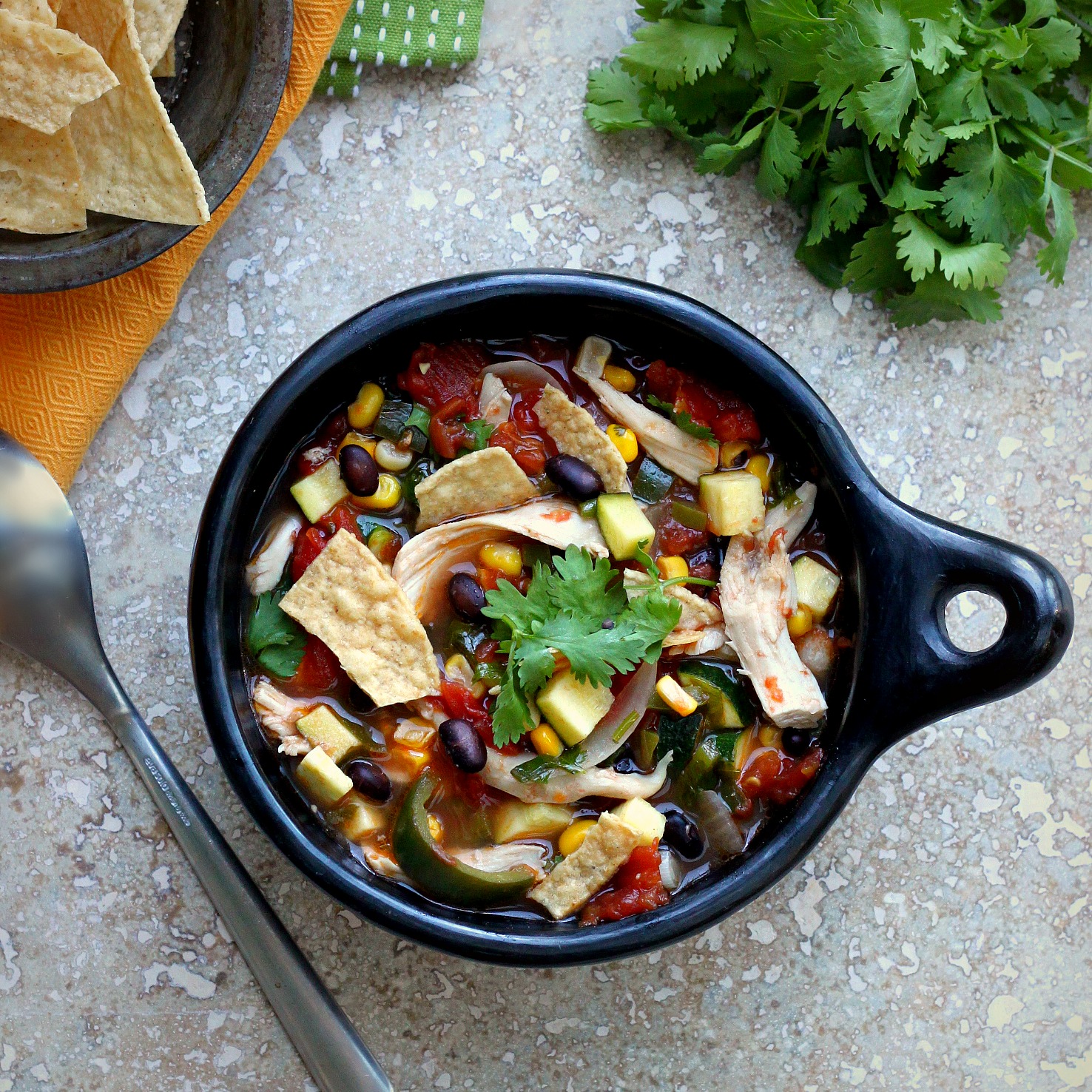
Harvest Chicken Tortilla Soup


~ Harvest Chicken Tortilla Soup ~

My inspiration for making soup is often a convergence of too many veggies in the refrigerator with homemade stock and leftovers from a roast chicken. Such was the case after a weekend of house guests and dinners involving carnitas, black bean salsa, lots of corn and the aforementioned roast chicken. This recipe is not an authentic tortilla soup, as I managed to empty most of the contents of my veggie drawer into it. It’s chock-a-block full of corn, beans, zucchini and peppers, which led me to call it a Harvest Chicken Tortilla Soup.

Harvest Chicken Tortilla Soup
Serves 4 to 6

1 tablespoon olive oil
1 medium yellow onion, chopped
1 poblano pepper, stemmed and seeded, diced
1 sweet red pepper, stemmed and seeded, diced
1 jalapeno pepper, stemmed and seeded, finely chopped
3 garlic cloves, minced
1 small zucchini, cut into 1/2 inch dice
4 cups chicken stock
1 (28-ounce) can Italian plum tomatoes, with juice
1/4 cup tomato paste
2 teaspoons ground cumin
1 teaspoon ground coriander
1 teaspoon salt
1/2 teaspoon freshly ground black pepper
1/4 teaspoon ground cayenne
1/4 teaspoon cloves
3/4 pound shredded cooked chicken
1 cup fresh corn kernels
1 cup cooked black beans
1/4 cup cilantro leaves, chopped

Tortilla chips, broken in pieces

Heat the oil in a soup pot over medium heat. Add the onion and sauté until softened, about 2 minutes. Add the peppers and continue to sauté 2 minutes. Stir in the garlic and zucchini and sauté briefly, about 1 minute. Add the chicken stock, plum tomatoes with juice, tomato paste, cumin, coriander, salt, pepper, cayenne, and cloves. Bring to a boil, then reduce the heat and simmer partially covered, about 20 minutes. Stir in the corn, beans, and chicken and simmer until piping hot. Taste and adjust the seasoning if desired. Stir in the cilantro leaves and ladle into bowls. Serve garnished with the tortilla chips. 

Homemade Bratwurst and a recipe for Beer Mustard

Homemade Bratwurst and a recipe for Beer Mustard


~ Homemade Bratwurst and a recipe for Beer Mustard ~

This month’s Charcutepalooza challenge had the whiff of Oktoberfest. Not only were we asked to make and stuff more sausages, we were asked to blend and emulsify the meat filling to a consistency found in a hot dog, bratwurst or weisswurst. I chose the bratwurst, partly for it’s happy collaboration with beer and partly for its relative ease compared to the hotdog. Baby steps, please!

As I embarked on this challenge over the July 4th weekend, I envisioned dirndls, sauerkraut and good strong mustard in my future. Somehow a trip to Europe has eluded us this summer, but, by golly, if we can’t make it back for a visit, then I will bring Europe home to my California kitchen. I spent the better part of a day on  this challenge, which provided much thoughtful time to reflect on how I would title this post. Here are a few of the contenders:

How to make a Danish family happy:
Yes, my husband is Danish and bratwurst is German. At the end of the day, they share a border, and, while their history may have been a tad testy, these 2 countries also share a culinary love for sausages. In Denmark, sausage is the fast food of choice, with carts distributed wherever people roam. While I may be hunting down a cup of coffee upon international arrival from the U.S., my husband will sidle up to the nearest airport sausage cart with both of our kids in tow, and order a flight of pølse with mustard, bacon and crispy onions. Apparently his gene pool is the strongest.

How to train a terrier:
Or, more specifically, the unflinching interest my dog is showing in me while making bratwurst is unsettling. I have never succeeded in getting our terrier to consistently obey me. Now I know how.

Why a power hose should be our next new kitchen gadget:
Sausage, sausage everywhere…on the counters, on the floor, in the sink, in the bowls, in the mixer, in the grinder, in my hair, under my nails, on my clothes and countless kitchen towels.  And did I mention that my dog is intently staring at me?

The difference between white pepper and black pepper: 
White pepper is traditionally used in dishes that should not show dark flecks of black pepper. But visuals are not the only difference. White pepper has a potent spiced flavor which, in large amounts, I don’t care for. Too bad I only figured that out after I added a heaping spoonful to the filling.

Familiarity breeds contempt:
I am 6 hours into the meat stuffing process, which includes handling, chopping, chilling, grinding, chilling, mixing, frying, tasting, chilling, stuffing, chilling, poaching, frying and tasting ground, blended meat. I think I’ll tuck these babies away in the freezer and take a time out.  Then I can rename this title to: Absence makes the heart grow fonder.

I could be watching Wimbledon and sipping Pimms right now:
But, no, I am blending and stuffing bratwurst in the company of my dog. Pass the sauerkraut and a beer, please.

Mustard makes everything taste better:
Especially when everything involves sausage. Truth be told, these were quite tasty, and my family gobbled them up (see title #1). I pan-fried the bratwurst and served them with thick slices of country-style bread, mustard and sauerkraut. As we ate the bratwurst, we watched Wimbledon highlights and enjoyed an ice cold Danish beer. The EU is alive and strong in Northern California.

Homemade Beer Mustard

Begin the mustard at least two days before serving. Makes 1/2 cup. (Recipe may be doubled.)

1/4 cup yellow mustard seeds
1/4 cup apple cider vinegar
1/4 cup dark beer
1 tablespoon dried mustard
1 tablespoon packed brown sugar
1 teaspoon kosher salt
1/4 teaspoon turmeric
1/8 teaspoon ground cloves

Combine mustard seeds, vinegar and beer together in a non-reactive bowl. Cover and refrigerate overnight.
Transfer mustard and liquid to a small saucepan. Bring to a boil; immediately remove from heat. Cool to room temperature. Transfer to a food processor or blender. Add remaining ingredients and purée. Transfer to a glass jar or container and refrigerate overnight. Mustard may be stored in refrigerator for up to two weeks.

What is Charcutepalooza?
An inspirational idea hatched by Cathy Barrow and Kim Foster and partnering with Food52 and Punk Domestics. It celebrates a Year in Meat, where participating foodies and bloggers will cure, smoke and salt their way through Michael Ruhlman’s bestselling cookbook Charcuterie.

Ratatouille Gratin

~ Ratatouille Gratin ~

It’s that time of year when the vegetables sneak up on you. A month ago, summer squash were elusive, appearing in the markets in small groups at a price. In the garden they were merely a hint of themselves peeking from their flowers. Purchases felt premature, tasting a little bitter, and costing too much for something you knew would soon be prolific.

~
Then, before you know it, a month has passed and squash are teeming everywhere. The garden is lobbing them to you like tennis balls, the market shelves are stacked with zucchini, crooknecks, and patty pans, ripe and ready for consumption. With the bounty, it’s time to get creative, because, ironically, it’s easy to tire of this abundance, and that is a shame.  So, yesterday I was determined to use my imagination to celebrate summer squash. Instead of a traditional ratatouille, I made a gratin. And before I made the gratin, I played a little bit with my food and made Ratatouille Stacks.

~ Ratatouille Stacks ~

The ingredients are identical, only the arrangement is different. Serve the gratins as side dishes or a light vegetarian meal. The stacks are fun appetizers.

Ratatouille Gratin with Goat Cheese and Basil

Try to choose squash and eggplant of a similar diameter. This recipe makes enough for an 8 to 9-inch square or round pan. Alternatively, you can arrange the vegetables in smaller individual gratin dishes.

Active Time: 30 minutes
Total Time: 45 minutes
Serves 4

1 narrow eggplant, about 10 ounces
1 medium zucchini, about 6 ounces
1 medium yellow squash, about 6 ounces
1 large red bell pepper, quartered and seeded
Olive oil
Salt and freshly ground black pepper
1/2 cup basil leaves, torn into 1/2-inch pieces, plus extra for garnish
3 ounces soft fresh goat cheese

1. Preheat the oven broiler.
2. Slice the eggplant, zucchini, and yellow squash crosswise about 1/3 inch thick. (If the eggplant is much wider than the squash, quarter lengthwise and slice 1/3 inch thick.)
3. Arrange the eggplant, zucchini, squash, and peppers in one layer on an oiled baking tray. Brush the tops with additional oil and lightly season with salt and black pepper. Broil on the top shelf of the oven until the vegetables are tender, but not mushy, and brown in spots, 8 to 10 minutes, turning once. Remove and cool to the touch.
4. Preheat the oven to 350°F. Lightly oil an 8 or 9-inch square or round gratin dish. Arrange the vegetables, alternating and slightly overlapping, in rows or a circular pattern. Tuck the basil between the vegetables in a random pattern so that it is evenly distributed. Scatter grape-size amounts of the goat cheese evenly over the vegetables.
5. Bake the gratin in the oven until the cheese is soft and light golden in spots, about 15 minutes. Serve warm or at room temperature, garnished with extra basil if desired.

Homemade Italian Sausage and Broccolini Pasta (and the Search for the Elusive Casing)

Homemade Italian Sausage and Broccolini Pasta (and the Search for the Elusive Casing)


A recipe for Sausage and Broccolini Pasta and a tale of the Elusive Casing

Charcutepalooza Round #6
The Challenge: Homemade Italian Sausage

Should you choose to accept this Challenge, you must be prepared to traverse the county, futilely cold call farmer’s market purveyors, and face rejection at multiple Whole Foods stores and independent markets in search of the elusive casing a.k.a. pig intestines – or the sacred vessel that contains the cherished meat in the form of a sausage.

Should you choose to accept this Challenge, you shall be prepared to pay dearly for said casing when located, because either:

  • The local supermarket is flummoxed when it comes to charging for an empty casing, and, at the risk of compromising highly sensitive payment technologies, will charge you the price of a whole sausage. Yes, that’s right: You will be required to pay for a sausage without meat.
  • You belatedly order from the stalwart Charcutepalooza ally, D’Artagnan, thereby assuming full responsibility (and overnight shipping charges) due to your procrastination, in order to avert a last minute crisis and Charcutepalooza meltdown.
  • Or you flee your suburban confines for the lure and anonymity of the big city  – and the Ferry Building – which entails paying bridge tolls, parking fees, and extraneous charges in the form of lunch and shopping. (Hey, it’s the Ferry Building.)

If you succeed in obtaining the elusive casing you will be jubilant and nearly home free, until you unpack your brand new meat grinder and sausage stuffer and realize you must decipher a cryptic code to correctly assemble the tools to achieve your desired results. Your trusted assistant, a.k.a. spouse, will selflessly risk life, limb and marital conflict, while cautiously advising you on all matters of RTM (that’s code for Reading The Manual). You will soldier on and prevail, sausages and marriage in tact, another Chaructepalooza challenge met with glorious and grillable results.

~
Given the amount of effort required to find the sausage casing, it’s not without irony that many recipes including sausage in pasta or on pizza, recommend discarding the casings and crumbling the meat. Well, rest assured, this recipe requires no such thing.

Italian Sausage and Broccolini Pasta with Basil
Serves 4 

1 pound pasta, such as orecchiette, penne, pipette rigate
Extra-virgin olive oil
3/4 pound spicy Italian sausage links (see below)
2 garlic cloves, minced
1/2 teaspoon crushed red pepper flakes, or to taste
3/4 pound broccolini, cut in 1 inch pieces
1 (28-ounce) can Italian plum tomatoes with juice
Salt and freshly ground black pepper
1/2 cup basil leaves, torn in half, plus extra for garnish
1/3 cup finely grated Pecorino Romano cheese, plus extra for garnish

Bring a large pot of salted water to a boil. Add pasta and cook until al dente; drain. While the pasta is cooking, heat 1 tablespoon olive oil in a skillet over medium-high heat. Add sausages and brown on all sides. Remove from pan and transfer to a cutting board. When cool enough to handle, slice in 1/4 inch pieces.
Add 1 tablespoon olive oil to the same skillet and heat over medium heat. Add garlic and red pepper flakes. Sauté until fragrant, 1 minute. Add broccolini and continue to sauté until bright green but still crisp, 1 minute. Add tomatoes, salt and pepper. Simmer 3-4 minutes, breaking tomatoes apart with a spoon. Add pasta and sausages to the skillet. Toss to combine and thoroughly heat through. Remove from heat and stir in basil leaves and cheese. Serve immediately garnished with extra cheese and basil.

~
Homemade Italian Sausage
Makes about 3 1/2 pounds sausage, or 12 links

I followed Hank Shaw’s sausage making technique in this post from Simply Recipes  and used these ingredients  for the filling:

3 pounds pork shoulder
1/2 pound pork fat
4 garlic cloves, peeled and chopped
2 tablespoons paprika
1 tablespoon salt
1 tablespoon freshly ground black pepper
2 teaspoons dried oregano
2 teaspoons fennel seeds, toasted, finely ground
2 teaspoons crushed red pepper flakes
1/4 cup minced  fresh sage leaves
1/4 cup minced fresh parsley
1/2 cup dry red wine

What is Charcutepalooza?

An inspirational idea hatched by Cathy Barrow and Kim Foster and partnering with Food52 and Punk Domestics. It celebrates a Year in Meat, where participating foodies and bloggers will cure, smoke and salt their way through Michael Ruhlman’s bestselling cookbook Charcuterie.

Fregola Sarda with Asparagus and Lemon

fregola tastefood

If you have never tried Fregola Sarda, then you should. Fregola (also known as fregula) is a semolina pasta hailing from Sardinia, Italy. It’s quite similar to pearl couscous which is made of wheat. It consists of tiny rolled balls which have been sun-dried then toasted, lending a satisfying and unique nutty flavor and mottled texture. Fregola is delicious on its own, served simply with olive oil, sea salt and a dusting of cheese, in  soups, or combined with vegetables and fresh herbs as a side dish or light meal.

Fregola Sarda with Asparagus and Lemon

Serves 4

1 pound fregola
Extra-virgin olive oil
1 teaspoon finely grated lemon zest
Salt
1/2 pound thin asparagus
1 medium shallot, finely chopped
1 garlic clove, minced
1/4 teaspoon red chili flakes
Freshly ground black pepper
1/4 cup chicken stock
1/4 cup finely grated Pecorino cheese
1 teaspoon freshly ground black pepper

Bring a large pot of salted water to a rolling boil. Add the fregola and cook until al dente, about 10 minutes or per package instructions. Drain and transfer to a large bowl. Add 1 tablespoon olive oil, the lemon zest and 1/2 teaspoon salt and toss to coat.
Cut the stalks of the asparagus into 1/2-inch pieces while keeping the tips intact. Heat 1 tablespoon olive oil in a large skillet over medium heat. Add the shallot and saute until softened, about 2 minutes.  Add the garlic and chili flakes and saute until fragrant, about 30 seconds. Add the asparagus stalks and tips. Season with 1/2 teaspoon salt and 1/2 teaspoon black pepper. Saute until asparagus brightens in color, about 2 minutes. Add the chicken stock and continue to cook, stirring occasionally, until asparagus are crisp tender and most of the liquid has evaporated. Remove from heat and add to the fregola. Add the Pecorino and toss to combine. If the fregola are too sticky, add 1 tablespoon olive oil. Serve warm with additional black pepper. 

Homemade Merguez

Homemade Merguez

For this month’s Charcutepalooza event, we were challenged  to make our own bulk sausage, either as breakfast sausage, merguez or chorizo. This one had my full attention. If it’s possible to express sentiment over a sausage, then the merguez would be considered my first true love in the charcuterie department.

I first ate merguez when I lived in Paris.  They were unlike any sausage I ever tasted. Finger-thin, lean in fat and fiery red hot, these North African sausages were the wizened angry little men of sausages – taut, feisty and not to be underestimated. They were easily found in the myriad couscous restaurants sprinkled throughout the city, from street vendors and specialty markets. Eaten alone, with couscous, or in a bun with frites and sauce – merguez were the essence of Morocco. Fragrant with cumin, coriander and sumac, dry and hot like the desert heat, and fiery red with harissa – one bite and you were transported.

Since then, and following moves further north in Europe and to the U.S., those merguez have become a food memory, frequently reminisced at the dinner table and used as a point of comparison (without success) when encountering other sausages calling themselves merguez. So far, nothing I have eaten replicates the North African merguez I tasted in France.

So, this month’s Charcutepalooza challenge was particularly exciting. Why not try to make my own merguez? While I had no illusion of immediately recreating my distant memory of perfection, I would use the bulk sausage challenge as an opportunity to tinker with flavor, spice and heat before any fussing with stuffing the casings. I would form simple patties which I would stuff in pita bread. While the patties may be the lazy oafish cousin to the taut, skinny merguez sausage, the hope was that the taste would be undeniably related.

Merguez Bulk Sausage

I followed the technique for making bulk sausage from Charcuterie and formed the meat into small patties, or keftas. As for the spices, I concocted a heady mix of harissa, coriander, cumin, fennel and sumac. If needed, I planned to add lamb fat rather than pork fat, since the merguez I ate in France were Halaal. This proved unnecessary, however, since lamb shoulder provided enough fat for my taste.

1 teaspoon fennel seed
1 teaspoon coriander seed
1 teaspoon cumin seed
2 garlic cloves, minced
2 tablespoons harissa paste
2 teaspoons salt
1 teaspoon sumac
1/2 teaspoon cayenne
1/2 teaspoon black pepper
1 pound ground lamb shoulder
Olive oil

Toast fennel, coriander and cumin seeds in a small pan over medium heat until fragrant, 1 minute. Transfer to a mortar with pestle or spice grinder, and grind until fine. Combine in a bowl with all of the remaining ingredients except the lamb. Stir to form a paste. Add lamb and thoroughly mix together with your hands. Form into 1 1/2 inch patties. Cover and refrigerate at least 2 hours or overnight.
Heat 1 tablespoon olive oil in a skillet over medium high heat. Add patties, without overcrowding, in batches. Cook, turning once, until brown on both sides. Transfer to a plate lined with a paper towel and keep warm. Repeat with remaining patties.
Serve with pita bread, harissa sauce, Greek style yogurt and fresh mint leaves.

What is Charcutepalooza?
An inspirational idea hatched by Cathy Barrow and Kim Foster and partnering with Food52 and Punk Domestics. It celebrates a Year in Meat, where participating foodies and bloggers will cure, smoke and salt their way through Michael Ruhlman’s bestselling cookbook Charcuterie.