Dried Cherry and Pistachio Biscotti

Dried Cherry and Pistachio Biscotti

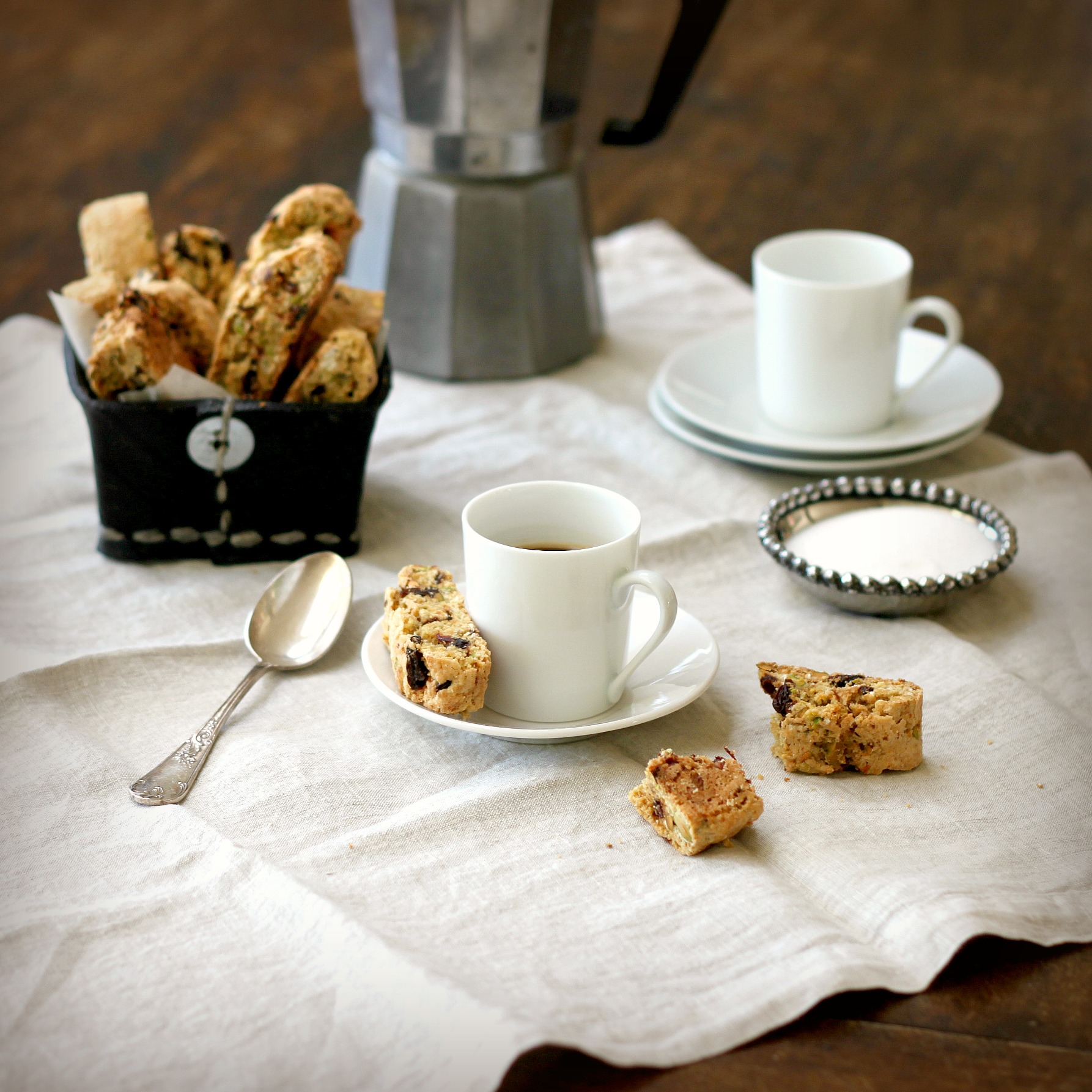
~ Dried Cherry and Pistachio Biscotti ~

In my never-ending quest to create new recipes to please my family and my readers, I rarely follow a published recipe to a “t”.  Instead I create, tweak and spin recipes to my taste, reading cookbooks and magazines for inspiration then casting them aside while I let my thoughts simmer and stew until a wisp of the season, a sudden craving or an irresistable market item presents itself as motivation. Except for these biscotti.

This recipe is nearly a direct re-production of a recipe from Bon Appetit. It follows the recipe almost to the “t”, and then a change I made was not my idea at all, but the idea of my friend, Pam, who brought these cookies to our annual Summer Solstice beach barbecue this summer. I knew I was in trouble when I found myself walking around the beach munching on 2 fistfuls of these cookies before we even started grilling.

These biscotti have everything that I like in a cookie: fruit, nuts, a restrained sweetness, and the perfume from orange zest. Pam’s idea was not to fully bake them to enamel-cracking crispness. Instead they were baked to a wonderful crumbly perfection, which begged for more tasting without breaking my teeth, enabling further eating – to which I happily complied.
~
Dried Cherry and Pistachio Biscotti
recipe adapted from Bon Appetit

Makes  approximately 30 biscotti

1 3/4 cups unbleached all-purpose flour
3/4 cup granulated sugar
1/2 cup old fashioned oats
1 teaspoon baking powder
1/2 teaspoon baking soda
1/2 teaspoon salt
2 large eggs
3 tablespoons vegetable oil
Zest from one orange
2 teaspoons lemon zest
1 1/2 teaspoons vanilla extract
1/2 teaspoon almond extract
1 cup dried cherries, coarsely chopped
1 cup unsalted, shelled pistachios

Preheat oven to 350 F. (180 C.)  Line a large baking sheet with parchment paper. Combine the first 6 ingredients in the bowl of an electric mixer with a paddle. Blend on low speed, 30 seconds. Whisk eggs, oil, zest, vanilla and almond extracts together in a separate bowl. Add the wet ingredients to the flour. Beat on medium speed until combined, 1 minute. Stir in cherries and pistachios.
Divide dough in half. Shape each dough half into a 16 inch log. Arrange on a baking sheet, spaced 5 inches apart. Flatten each log into a 2 inch wide strip. Bake until golden brown and set, about 30 minutes. Remove from oven and transfer to a rack. Cool 15 minutes.
Reduce oven to 250 F. (125 C.)  Transfer biscotti to a cutting board. Cut in 3/4 inch strips with a serrated knife. Return biscotti to the baking sheet and arrange cut side down. Bake until firm and golden, 25 minutes. Remove from oven and cool completely on racks.
Biscotti may be made up to 3 days in advance. Store at room temperature in an airtight container.

Rise and Shine: Yogurt, Plum and Granola Parfait

~ Spiced Plum Compote, Maple Granola, Greek Yogurt ~

If you need a reason to get up in the morning, then try this sumptuous breakfast parfait. A slick of stewed plums swirls through clouds of rich greek yogurt flecked with nuggets of granola. If it weren’t so early in the morning, you might be tempted to call this dessert.

Spiced Plum Compote
Not overly sweet, this rich plum stew is delicious with yogurt. If you are calling this dessert, do not hesitate to ladle some over a bowl of ice cream, too.
Makes about 1 1/2 cups.

1 pound plums, pitted, sliced
1/4 cup orange juice
2 tablespoons brown sugar
1/2 cinnamon stick
1/2 teaspoon ground cardamom
1/4 teaspoon salt

Combine all of the ingredients in a saucepan over medium heat. Bring to a boil, then reduce heat to a simmer. Cook until the plums soften and the compote thickens, about 20 minutes. Cool, cover and refrigerate until use. The flavors will develop with time. (May be refrigerated for up to 3 days.)

Granola
Feel free to fiddle with the ingredients. Substitute or add hazelnuts, pecans, flax, dried cranberries … you get the picture.
Makes about 2 cups.

1 cup old fashioned oats
1/2 cup shredded unsweetened coconut
1/2 cup chopped almonds
2 tablespoons wheat germ
1 tablespoon brown sugar
1 teaspoon ground cinnamon
1/2 teaspoon salt
2 tablespoons maple syrup
2 tablespoons vegetable oil
1/2 cup raisins

Preheat oven to 300°F (160°C). Combine the oats, coconut, almonds, wheat germ, sugar, cinnamon, and salt in a bowl. Whisk maple syrup and vegetable oil together in a small bowl. Drizzle over the oats and toss to combine. Spread in a baking pan lined with parchment paper. Bake until golden brown, about 30  minutes, stirring once or twice. Remove from oven and cool. Add the raisins. Store in an air-tight container for up to 1 week.

To assemble parfaits:
Alternate plum compote, granola and whole milk Greek-style yogurt in a bowl or glass. Serve for breakfast, lunch or whenever you please.

Caramelized Pineapple and Mango Napoleons


Reprinted from the TasteFood archives, because it’s on the menu this week. 

Expecting guests for dinner this weekend? In the mood for something fruity and stacked? Napoleons are fun to make and impressive to serve. They are also an elegant way to showcase the season’s fresh fruit. Don’t let the presentation intimidate you. With some planning Napoleons are also easy to prepare, since the components may be prepared in advance. All that’s required is some last minute assembly, which is fun to watch or, better yet, get your guests involved.

Caramelized Pineapple and Mango Napoleons
Makes 10

For the phyllo layers:
1 package frozen phyllo sheets, defrosted overnight in refrigerator
3/4 cup unsalted butter, melted
1/2 cup granulated sugar

For the filling:
2 mangoes, skin and pit removed, cut in 1/4″ dice
Juice of one lime, about 2 tablespoons
1 fresh pineapple, ends trimmed, rind removed, cut in quarters lengthwise and cored
1/2 cup brown sugar
2 cups heavy cream
2 tablespoons confectioners sugar, sifted
1 teaspoon vanilla extract
Shredded coconut
Runny honey for garnish

Prepare the phyllo dough:
Preheat oven to 350 F. (180 C.) Line 2 baking sheets with parchment paper. Unroll phyllo dough. Place one sheet on work surface. (Cover remaining dough with plastic wrap and damp kitchen towel to prevent drying.)
Lightly brush phyllo sheet with butter. Sprinkle lightly with granulated sugar. Place second phyllo sheet on buttered phyllo dough. Brush with butter and sprinkle with sugar. Repeat with 2 more sheets.
With a sharp chef’s knife cut stacked phyllo sheets in half lengthwise. Cut each half into 5 equal width rectangles. (5 across the sheets’ long side x 2 across the short side). With a spatula, transfer the squares to prepared baking sheets. Bake in oven until golden, about 8 minutes. Remove from oven and cool completely on racks.
Repeat this process 2 more times, so you will have a total of 30 rectangles. (Phyllo squares may be prepared one day in advance. Store in an airtight container at room temperature. Separate layers of phyllo dough with parchment paper.)

Prepare the filling:
Toss the diced mango with the lime juice in a bowl and set aside.
Cut each pineapple quarter in slices 1/4″ thick. Arrange slices in one layer in 2 skillets. Sprinkle brown sugar over pineapple. Cook over medium heat, turning pineapple, until caramelized. Transfer pineapple to a plate to cool completely.
Beat cream in bowl of electric mixer until traces from the whisk are visible in the cream. Add confectioners sugar and vanilla. Continue to beat until soft peaks form.

Assemble the napoleons:
Arrange 12 phyllo sheets on individual dessert plates or platter. Spread each sheet with one tablespoon whipped cream. Gently press diced mango into whipped cream in one layer. Top with a little more whipped cream (this will help the phyllo layers to stay put) and sprinkle with coconut. Top cream and mango with a second phyllo layer and repeat process with mango, whipped cream and coconut. Top with a third phyllo sheet. Spoon cream over the top. Gently lay 1-2 pineapple slices on the cream. Drizzle with honey. Sprinkle with coconut. Serve immediately.

Black and Blueberry Clafoutis

Black and Blueberry Clafoutis

~ Blackberry Clafoutis ~

Here’s a riddle: What do a basket of berries and 3 eggs have in common? A light and simple dessert called clafoutis. Clafoutis is a baked French dessert similar to flan, consisting of fresh fruit smothered in a lightly sweetened egg batter. The result is a pudding-like concoction redolent with seasonal fruit.

Berries are everywhere now, lining the tables at the farmers market and teetering on shelves at our local store. Never one to hold back, I pile them into my basket and head home, nibbling on my purchases while thoughts of tarts, jams and fools run through my mind. Sometimes, when time is short, I know I will make  a clafoutis.


~
Clafoutis is remarkably quick and easy to prepare with a short list of ingredients. The result is rustic yet elegant, generously showcasing the season’s fruit. Bake the clafoutis in a gratin dish or cast-iron skillet. If you would like to fiddle with presentation, divide the batter between individual ramekins. I had a little extra batter left over and filled asian soup spoons for a dessert inspired amuse-bouche.

~ Blueberry Clafoutis ~

Black and Blueberry Clafoutis

Active Time: 15 minutes
Total Time: 40 to 55 minutes
Makes 8 (6-ounce) or 1 (10-inch) clafoutis

Unsalted softened butter for greasing the pans
1 tablespoon plus 1/3 cup granulated sugar
6 ounces fresh blueberries
6 ounces fresh blackberries
3 large eggs, room temperature
1 1/4 cups half and half
1/3 cup all-purpose flour
1 teaspoon finely grated lemon zest, plus extra for garnish
1/2 teaspoon vanilla extract
1/4 teaspoon almond extract
1/8 teaspoon salt
Powdered sugar for garnish

1. Preheat the oven to 350°F. Butter 8 (6-ounce) shallow ramekins (or 1 (10-inch) ceramic tart pan). Sprinkle the ramekins with the 1 tablespoon granulated sugar and tap out any excess. Place the ramekins on a baking tray. Arrange the berries in one layer in the ramekins.
2. Beat the eggs and sugar in a bowl until light and fluffy, about 3 minutes. On low speed, mix in the half and half, flour, lemon zest, vanilla extract, almond extract, and salt until just combined.
3. Pour the mixture over fruit. Transfer the clafoutis to the oven and bake until the top is tinged golden brown and the custard is set, about 25 minutes for the ramekins (or 35 to 40 minutes for the tart pan). Remove from the oven and cool on a rack.
4. Before serving, sprinkle the clafoutis with powdered sugar and garnish with additional lemon zest. Serve slightly warm or at room temperature.

Fig and Raspberry Upside-Down Cake

Fig and Raspberry Upside-Down Cake


~
Upside-down baking is  irresistable to me, whether it’s in the form of a tarte tatin or a cake. The common denominator is a gorgeous, gooey caramelized bottom, which, once inverted, becomes the top. Nestled in the sticky caramel goodness are chunks of seasonal fruit, which release their juice and perfume the pastry, while studding the topping like jewels in a crown.

The other winning quality of upside-down desserts is that they are generously flexible with the seasons. In the fall, pears and apples are the fruit of choice. In the summer, stone fruit, figs and berries display their wonders. Mix and match to your taste. It’s impossible to go wrong.

~
Fig and Raspberry Upside-Down Cake

Serves 8 to 10

1/2 cup plus 3/4 cup unsalted butter, room temperature
3/4 cup light brown sugar
8 large figs, halved lengthwise
3 ounces raspberries
1 1/4 cups all purpose flour
1/2 cup almond flour (meal)
1 teaspoon baking powder
1/2 teaspoon baking soda
1/2 teaspoon salt
1/2 cup sour cream
1 teaspoon finely grated lemon zest
1/2 teaspoon vanilla extract
1/2 teaspoon almond extract
3/4 cup granulated sugar
3 large eggs

1. Preheat the oven to 350°F.  Butter a 9-inch springform pan. Line the bottom with parchment and butter the parchment. Tightly wrap the bottom of the pan with foil.
2. Melt the 1/2 cup butter and the light brown sugar together in a saucepan over medium heat, whisking to combine. Pour into the springform pan. Arrange the figs, cut side down in a circular pattern in the sugar. Fill in the gaps with the raspberries.
3. Mix the flour, almond flour, baking powder, baking soda, and salt in a medium bowl. Whisk the sour cream, lemon zest, vanilla and almond extracts in a small bowl.
4. Beat the 3/4 cup butter and the granulated sugar in a mixer with a paddle attachment until light and fluffy, about 3 minutes. Add the eggs one at a time, beating well after each addition. Mix in 1/4 of the flour mixture to blend. Add the sour cream mixture and mix to combine. Add the remaining flour mixture and mix to thoroughly combine without overmixing.
5. Drop the cake batter over the fruit in large spoonfuls, then carefully spread the batter to cover the fruit and caramel.
6. Bake the cake in the oven until a toothpick inserted in the center comes out clean, about 45 minutes. Cool on a rack for 10 minutes then invert onto a plate. Serve slightly warm or at room temperature.


Nectarine and Plum Tarte Tatin


~ Nectarine and Plum Tarte Tatin ~

Here’s another dessert post, making that two in a row. I am being greedy, but it’s summer, and the fruit is impossible to resist right now. The farmers’ markets are teeming with stone fruit. Their tables are stacked with teetering towers of peaches, nectarines, apricots and early plums. I bring home bags stuffed with fruit only to return with more the next day. It really isn’t a challenge to slurp through the bounty, but when there is a little too much, the older fruit is quickly transformed into a baked dessert.

Nectarine and Plum Tarte Tatin

Tarte Tatin (an upside down caramelized tart) is a beautiful way to showcase stone fruit. The fruits’ sweet tanginess melds beautifully with the caramel, while their orange and crimson mottled flesh intensifies in a vibrant, richly colored filling. I used a combination of nectarines and plums, because that’s what I had.

Serves 8-10.

For the Sour Cream Pastry:
1 1/2 cups all-purpose flour
3 tablespoons sugar
1/2 teaspoon salt
3/4 cup chilled unsalted butter, cut in pieces
1/3 cup full fat sour cream

Nectarine and Plum Filling:
1/2 cup unsalted butter, room temperature, cut in 4 pieces
1 cup plus 2 tablespoons granulated sugar, divided
4 large nectarines, quartered, pits removed
4 plums, halved, pits removed
1 egg, beaten to blend, for glaze

Prepare Pastry:
Combine flour, sugar and salt in bowl of food processor. Pulse to blend. Add butter and pulse until butter is size of peas. Add sour cream and pulse until moist clumps form. Gather dough into ball, flatten and wrap in plastic. Refrigerate at least 2 hours. (Can be made one day ahead; refrigerate until use. Pastry dough may also be frozen up to one month in freezer before rolling. Allow to defrost in refrigerator overnight.) Remove pastry from refrigerator and let sit at room temperature for 15 minutes before rolling out.

Prepare Tart:
Arrange butter in bottom of large oven-proof skillet with sloping sides (preferably cast iron.) Sprinkle 1 cup sugar evenly over butter and pan. Cook over medium heat until butter melts, the sugar is partially dissolved and the mixture is bubbling, about 2 minutes.  Arrange nectarines and plums closely together in an alternate fashion, cut-side up, in a circular pattern in the skillet. Sprinkle with 2 tablespoons sugar. Set skillet over medium-high heat. Boil until a deeply colored syrup forms, turning skillet to ensure even cooking, about 30 minutes. (Due to the juices from the fruit, the syrup will be more red than brown. Check for doneness by tasting a little of the syrup – be careful, because it will be very hot. If it has a caramel flavor, then it’s ready for the oven).
While the fruit is cooking on the stove, preheat oven to 425 F. Roll out pastry on floured surface or parchment paper to a round shape to fit size of skillet. Remove skillet from heat. Lay pastry over fruit. Cut 3-4 slits in pastry. Brush pastry with some of the egg glaze. Bake tart until pastry is deep golden brown and firm when tapped, about 30 minutes. Remove tart from oven and cool on rack one minute. Cut around edge of skillet to loosen pastry. Invert the tart onto a platter, using oven mitts. If any of the fruit is stuck in the pan, remove with a knife and arrange on top of tart. Cool tart slightly before serving. Serve warm or at room temperature with dollop of whipped cream or vanilla ice cream.

Summer Berry Tian

Summer Berry Tian

~ Strawberries, raspberries, blueberries: summer in a dish ~

This berry tian highlights the ease of summer in its simplicity of ingredients and preparation. The season’s best fruit – strawberries, blueberries and raspberries -are blanketed with a cardamom-infused custard and baked, resulting in a refreshing and delightful dessert. Tian is a french word for a shallow earthenware casserole, often gratineed, an appropriately simple and elegant name for this dish. Enjoy warm or chilled.

~
Summer Berry Tians (Clafoutis)

Active Time: 15 minutes
Total Time: 40 to 55 minutes
Makes 8 (6-ounce) tians

Unsalted softened butter for greasing the tians
1 tablespoon plus 1/3 cup granulated sugar
12 ounces mixed berries, such as blueberries, raspberries, quartered strawberries
3 large eggs, room temperature
1 1/4 cups half and half
1/3 cup all-purpose flour
1 teaspoon finely grated lemon zest, plus extra for garnish
1/2 teaspoon vanilla extract
1/4 teaspoon almond extract
1/8 teaspoon salt
Powdered sugar for garnish

1. Preheat the oven to 350°F. Butter 8 (6-ounce) shallow ramekins (or 1 (10-inch) ceramic tart pan). Sprinkle the ramekins with the 1 tablespoon granulated sugar and tap out any excess. Place the ramekins on a baking tray. Arrange the berries in one layer in the ramekins.
2. Beat the eggs and sugar in a bowl until light and fluffy, about 3 minutes. On low speed, mix in the half and half, flour, lemon zest, vanilla extract, almond extract, and salt until just combined.
3. Pour the mixture over fruit. Transfer the tians to the oven and bake until the tops are tinged golden brown and the custard is set, about 25 minutes for the ramekins (or 35 to 40 minutes for the tart pan). Remove from the oven and cool on a rack.
4. Before serving, sprinkle the tians with powdered sugar and garnish with additional lemon zest. Serve slightly warm or at room temperature.

Banana Chip Bars

Banana Chip Bars

Banana Chips, Coconut, Dark Chocolate

This time I blame the banana chips. Due to a last minute panic-induced purchase for a school event, I had a bucket of them sitting in my refrigerator. You might understand the situation which led to this:  Worried that (heaven forbid) not enough dessert would be provided for a tropical-based menu for a lunch at my daughter’s school,  I threw a few, er, many packages of banana chips into my shopping basket on the way to the lunch – just in case the mob inhaled all 47 other dishes represented in the school-wide buffet and were up in arms about not enough sugar to complete their smorgasbord. (As if banana chips would be sufficient to stave off an angry sugar-deprived crowd – what was I thinking?)  As it turned out, any testy unrest was avoided, since we (naturally) had too much food in the first place.  And so the banana chips came home with me and have been patiently waiting in my refrigerator to be put to use – until today.

It was a baking kind of day today, and I decided to throw together a simple bar cookie. Normally I include coconut and chocolate chips in my bars, and figured the banana chips would make a nice addition. I chopped a bunch up in my food processor (you may want ear plugs for this) and folded the chips into the batter. They added a wonderful chewy texture with a mild buttery flavor to the bars, without an overpowering banana flavor or excess sweetness. Toothsome and chewy, they almost made the bars feel…healthy? Ok, that may be pushing it.


Banana Chip Bars
Makes 24 – 2 inch bars

1 cup light brown sugar
1/2 cup granulated sugar
1 cup unsalted butter, melted and cooled
1 large egg
1 teaspoon vanilla extract
1 3/4 cup all-purpose flour
1/4 cup wheat germ
1 teaspoon baking soda
1 teaspoon salt
1 cup unsweetened coconut, plus extra for the topping
1 cup coarsely chopped banana chips
1 cup semi-sweet or dark chocolate chips

Preheat oven to 350 F. (180 C.) Butter a 9 by 13 inch baking pan. Line the bottom with parchment and butter the parchment. Whisk sugars and butter together in a large bowl. Add egg and vanilla and whisk until smooth. Combine flour, wheat germ, baking soda and salt together in a bowl. Add to the sugar and butter and mix well. Stir in coconut, banana chips and chocolate chips. Pour into the prepared baking pan and smooth the top with a spatula. Sprinkle evenly with additional coconut. Bake until golden brown and cooked through, about 30 minutes. Cool completely in pan.

Flourless Chocolate Cake

Flourless Chocolate Cake

~
Flourless chocolate cake is the little black dress of desserts. Minimal, simple and universally pleasing, this go-to recipe is a classic. With a short list of ingredients, minus any flour,  you can whip this cake up in an hour. It’s a lighter version of my Sinfully Rich Chocolate Cake, which makes it more of an every day cake and a guaranteed hit with children. Serve simply naked or adorned with a dusting of sugar and a scoop of whipped cream.

Flourless Chocolate Cake

With so few ingredients, quality makes a difference. If possible, use a European-style butter such as Lurpak or Plugra and a high quality dark chocolate. I prefer Valrhona or Lindt. Serves 12.

8 ounces dark chocolate, chopped
1/2 cup unsalted butter, room temperature
6 eggs, separated
1/2 cup granulated sugar

Preheat oven to 300 F. Butter a 9 inch springform pan. Line the bottom with parchment and butter the parchment. Melt the chocolate and butter together in a double boiler over just-simmering water, stirring until smooth. Remove from heat and transfer to a large bowl; cool to lukewarm. Whisk in the egg yolks.
Beat egg whites in a bowl of an electric mixer until soft peaks form. Add sugar and continue to beat until stiff glossy peaks form. Mix 1/4 of the egg whites into the chocolate. Gently fold in remaining egg whites. Pour into prepared pan and smooth with a spatula. Bake until edges pull away from the pan, and a toothpick inserted into the center comes clean, about 40 minutes. Remove from the oven and cool on a rack. Serve slightly warm or at room temperature.


Rhubarb and Rosemary Crème Brûlée

Rhubarb and rosemary are surprising bed fellows in this not-so-classic crème brûlée. Upright, brilliantly hued rhubarb is always the first to arrive to the spring party. Its astringency may be overwhelming, but with some sugar coating and frequent pairing with the indefatigable strawberry, rhubarb’s tartness is successfully tamed. For this dessert, however, I did not want to rely on the dependable strawberry, which would add further sweetness and more liquid to the rhubarb compote. I wanted a subtle background flavor that would tickle the tongue and ground the ethereal creaminess of the custard without approaching the sugar tipping point. I happened to have fresh rosemary sprigs lying on the kitchen counter as the rhubarb simmered on the stove. Their woody aroma mingled with the wafts of steam rising from the compote. It smelled magnificent. I tossed a sprig into the pot of rhubarb and another sprig into the cream to infuse the custard. The results were subtle but notable, producing a crème brûlée that is at once rich and creamy, sweet and tart, earthy and heavenly.

Rhubarb and Rosemary Crème Brûlée
Makes 6

2 cups diced rhubarb
1/2 cup plus 2/3 cup granulated sugar
2 (2-inch) rosemary sprigs
1 teaspoon finely grated lemon zest
2 cups heavy cream
6 egg yolks
1/4 teaspoon vanilla extract

Topping:
3 tablespoons granulated sugar
3 tablespoons light brown sugar

1. Combine the rhubarb, the 1/2 cup sugar, one rosemary sprig, and the lemon zest in a saucepan. Cook over medium heat until the rhubarb is soft but still retains its shape, about 15 minutes. Remove from heat and cool to room temperature. Discard the rosemary sprig.
2. Arrange 6 shallow (1/2 cup) ramekins in a baking dish. Divide rhubarb among ramekins.
3. Preheat the oven to 350 F (180 C).
4. Heat the cream and the remaining rosemary sprig in a large saucepan over medium heat just until it begins to boil. While the cream is heating, whisk the egg yolks and the 2/3 cup sugar in a heat-proof bowl until light. When the cream is ready, remove the rosemary sprig from the cream and then slowly pour the cream into the egg mixture, gently whisking constantly to prevent the eggs from curdling.
5.
Return the custard to the saucepan and cook over medium-low heat, stirring constantly with a wooden spoon, until the custard thickens slightly and coats the spoon. Ladle the cream mixture over the rhubarb in the ramekins.
6. Pour boiling water into the baking pan half way up the ramekins to make a bain marie. Transfer to the oven and bake until the custard is just set but still wobbly, about 30 minutes. Remove from oven and cool in the water for 15 minutes, then transfer the ramekins to a rack and cool completely. Cover with plastic wrap and refrigerate for at least 6 hours or overnight.
7. Before serving, mix the granulated and brown sugar together in a small bowl. Sprinkle each ramekin with 1 tablespoon  sugar, or enough to cover. Light a blowtorch and hold the flame 2 to 3 inches above the custard, slowly moving it back and forth until the sugar melts and turns deep golden brown. (Or place under an oven broiler. Carefully watch to prevent burning.)