Pomegranate Roasted Brussels Sprouts with Red Grapes and Farro

brussels sprouts grapes tastefood

~ Brussels Sprouts, Grapes, Farro, Walnuts, Pomegranate, Balsamic ~

I know that if I told some you I would be posting 2 brussels sprouts recipes in a row, you might have unsubscribed to this blog. Hopefully you gave the last recipe a chance and were sufficiently pleased by the winning combination of bacon and pasta with the humble sprout. Maybe even a few of you were converted. If not, I have another recipe for you that might win you over. This one includes roasted grapes, farro and a shellacking of pomegranate balsamic vinegar. The sugars in the vinegar caramelize the sprouts, removing the assertive flavor that many find unpleasant, while binding the remaining ingredients in this rich and rustic side dish.

Pomegranate Roasted Brussels Sprouts and Grapes with Farro

If you can’t find pomegranate balsamic vinegar, make your own by whisking together 2 tablespoons balsamic vinegar and 2 tablespoons pomegranate molasses. Serves 4 to 6 as a side dish.

1 pound brussels sprouts, halved (or quartered if large)
1 pound seedless red grapes
2 tablespoons extra-virgin olive oil
1 teaspoon salt, plus more to taste
1/2 teaspoon freshly ground black pepper
1/4 cup pomegranate balsamic vinegar
1 cup cooked farro
1/4 cup toasted walnuts (optional)

Preheat the oven to 425°F. Toss the brussels sprouts, grapes, oil, salt, and pepper in a large bowl. Spread on a rimmed baking sheet and roast 15 minutes. Remove from the oven and drizzle the pomegranate balsamic vinegar over, stirring to coat. Return to the oven and roast until the sprouts are tender and the grapes have begun to shrivel, about 15 minutes. Transfer to a serving bowl. Add the farro and walnuts and toss to combine. Add more salt and pepper to taste. Serve warm or at room temperature.

Spiced Pear Tarte Tatin

pear tarte tatin tastefood

~ Spiced Pear Tarte Tatin ~

I don’t know about you, but I’m in the mood for a tarte tatin. It’s my favorite dessert to make for weekend entertaining, especially during the winter when I crave homey rustic desserts. Tarte Tatins are delightfully simple, oozing caramel and fruit. Best of all they are beautifully imperfect, irregular and uneven in presentation – and all the more charming for that. While the upside-down tart bakes in the oven, the caramel from the fruit filling will bubble up in spots through the crust. Fear not: The crust will continue to bake, and when the tart is finished and cooling, the wayward caramel will harden and shellac  the crust like a candied apple – or in this case, pear.

Spiced Pear Tarte Tatin

Once you get the hang of making the caramel and the final turnout of the tart onto a plate, tarte tatins are an unfussy and reasonably quick dessert to prepare in advance of dinner. They taste best slightly warm or at room temperature.

Serves 8 to 10

Sour Cream Pastry:
1 1/2 cups all-purpose flour
3 tablespoons sugar
1/2 teaspoon salt
3/4 cup chilled unsalted butter, cut in pieces
1/3 cup full fat sour cream

Pear Filling:
1/2 cup unsalted butter, room temperature, cut in 4 pieces
1 cup plus 1 tablespoon granulated sugar, divided
6 large Bosc or Anjou pears, peeled, cored and halved
1/2 teaspoon ground cardamom
1/4 teaspoon cinnamon
1/4 teaspoon ground nutmeg
1 egg, beaten to blend, for glaze

Prepare Pastry:
Combine flour, sugar and salt in bowl of food processor. Pulse to blend. Add butter and pulse until butter is size of peas. Add sour cream and pulse until moist clumps form. Gather dough into ball, flatten and wrap in plastic. Refrigerate at least 2 hours. (Can be made one day ahead; refrigerate until use. Pastry dough may also be frozen up to one month in freezer before rolling. Allow to defrost in refrigerator overnight.) Remove pastry from refrigerator and let sit at room temperature for 15 minutes before rolling out.

Prepare Tart:
Arrange butter in bottom of a 10 to 12-inch oven-proof skillet with sloping sides (preferably cast iron.) Sprinkle 1 cup sugar evenly over butter and pan. Cook over medium heat until butter melts, the sugar is partially dissolved and the mixture is bubbling, about 2 minutes.

Arrange pears closely together, core-side up, in a circular pattern in the skillet. Cut any remaining pears in quarters to fill in the gaps. Mix 1 tablespoon sugar, cardamom, cinnamon and nutmeg together in a small bowl. Sprinkle evenly over the fruit. Increase temperature to medium-high heat. Boil until a thick amber coloured syrup forms, turning skillet to ensure even cooking, about 20 minutes.

While the fruit is cooking on stove, preheat oven to 425° F. Roll out pastry on  parchment paper to a round shape to fit size of skillet. Place in refrigerator while you wait for the filling to caramelize. When ready, remove skillet from heat. Lay pastry over fruit (work quickly because it will begin to melt from the heat of the pan.) Cut 3-4 slits in pastry. Brush pastry with some of the egg glaze.

Bake tart until pastry is deep golden brown and firm when tapped, about 30 minutes. Remove tart from oven and cool on rack one minute. Cut around edge of skillet with a knife or spatula to loosen pastry. Invert the tart onto a platter, using oven mitts. If any of the pears or caramel are stuck in the pan, remove with a knife and arrange on top of tart.

Cool tart slightly before serving. Serve warm or at room temperature with whipped cream.

Cheesy Cauliflower Potato Soup

Cauliflower Potato Soup TasteFood

~Cheesy Cauliflower Potato Soup ~

Making purée, er, soup doesn’t get simpler than this. It began as a purée. I made a light and fluffy Cauliflower and Potato purée to accompany a stew this week.  However there was so much purée left over, I thinned the remainder with extra chicken stock and renamed it soup. It’s clearly all about the cauliflower, thickened with potato and spiked with a little garlic and piquant Pecorino cheese. Add just a little stock and you’ll have a light and airy side dish. Add more stock and you’ll have a satisfying winter soup. And since it’s the holidays I fancified both purée and soup with a generous pinch of gifted truffle salt sprinkled over the top.

Cheesy Cauliflower Potato Soup
Serves 6

2 yukon gold potatoes, about 1 pound
1 medium head cauliflower
4 garlic cloves
3 tablespoons unsalted butter
1/2 cup finely grated Pecorino Romano cheese
1 quart chicken stock
Salt and freshly ground black pepper to taste
Fresh thyme leaves
Truffle salt (optional)

Peel the potatoes and cut in 1-inch chunks. Cut the cauliflower florets and core in 1-inch pieces. Peel garlic. Smash 3 of the cloves and mince 1 clove. Place potatoes, cauliflower and smashed garlic cloves in a large pot. Cover with water. Add 1 tablespoon salt. Bring to a boil, then reduce heat, cover and simmer until the vegetables are very tender, about 25  minutes. Drain. Transfer half of the vegetables and butter to the bowl of a food processor. Puree until smooth. Add remaining vegetables. Puree again. Return vegetables to soup pot. Add minced garlic. Add chicken enough chicken broth to achieve desired consistency (the soup should not be too thick). Bring to a simmer and add cheese, stirring to incorporate. Season to taste with salt and pepper. Serve with additional cheese and fresh thyme as a garnish. Optional: Sprinkle with truffle salt.

Beef Stew with Cognac and Red Wine

Beef Stew TasteFood 1

~ Spirited Beef Stew with Cognac and Red Wine ~

For many days I’ve been saying that it’s Beef Bourguignon weather, so I finally stopped the talk and got cooking. I made this stew over the weekend, and the weather did not relent, gifting us with a deluge of rain worthy of an ark – and a cognac and wine infused beef stew. If you have to experience a torrent of rain, I dare say this kind of food makes it enjoyable – especially when accompanied by a creamy potato gratin, a robust bottle of Zinfandel wine, and a crackling fire.

Beef Stew with Cognac and Red Wine

Ideally start the stew a day ahead of serving. Not only does the flavor improve with time, it allows the fat to rise to the top as it cools. The next day, lift off the solidified fat from the surface before you reheat the stew. Serves 6.

Stew:
Extra-virgin olive oil
3 pounds beef chuck, cut into 1 1/2-inch chunks
Salt and freshly ground black pepper
1/2 cup cognac
2 large carrots, chopped
1 large onion, chopped
4 garlic cloves, chopped
1 (750-ml) bottle full-bodied red wine
1 cup beef or chicken stock
4 thyme sprigs
2 bay leaves
1 (6-ounce) can tomato paste
1 tablespoon brown sugar

Vegetables:
10 ounces pearl onions
1/2 pound cremini mushrooms, ends trimmed, halved if large
2 to 3 large carrots, peeled, cut on the diagonal 1/2-inch thick
Fresh thyme sprigs

1. Pre-heat the oven to 300°F. Heat 2 tablespoons oil in a large dutch oven or oven-proof pot with a lid over medium-high heat. Season the beef with salt and pepper. Working in batches, add the beef to the pan in one layer without overcrowding. Brown on all sides. Transfer to a plate and repeat until all of the beef is browned.
2. Add the cognac to the pot and deglaze, stirring up any brown bits. Reduce by half, then pour the cognac over the reserved beef.
3. Add 1 tablespoon oil, the carrots, onion, and garlic to the pot. Saute over medium heat until the vegetables begin to soften without browning, about 4 minutes. Return the beef and cognac to the pot. Add the wine, stock, thyme, bay leaves, and tomato paste. Bring to a boil, then turn off the heat, cover the pot aand transfer to oven. Bake in oven until the meat is very tender, stirring occasionally, 2 1/2 to 3 hours.
4. Strain the liquid from the stew into a saucepan. Separate the chunks of meat from the vegetables and return to the Dutch oven. Press down on the remaining vegetables in the sieve to extract as much juice into the drained liquid as possible. Discard the vegetables.
5. Boil the liquid until the sauce is reduced by about 1/3 and somewhat thickened. As the sauce boils, skim the fat from the surface (if you are making the stew one day in advance, you may skip this step since the fat will be removed after refrigeration). Stir in the sugar and season to taste with the salt and pepper. Pour the sauce over the beef. (At this point the stew may be made one day in advance. Cool, then cover and refrigerate overnight. One hour before serving, remove from refrigerator and proceed with recipe).
6. One hour before serving the stew, prepare the vegetables. Blanch the onions in a pot of boiling water for 1 minute; drain. When cool enough to handle, remove the skins; set aside. Heat 1 tablespoon olive oil in a skillet over medium heat. Add the mushrooms and saute until light golden, about 3 minutes. Lightly season with salt and pepper and transfer to a bowl. Steam or saute the carrots until bright in color and al dente. Transfer to the bowl with the mushrooms.
7. Skim any collected fat from the surface of the stew. Heat over medium-low heat on the cooktop to loosen the stew. Add the onions, mushrooms and carrots. Continue to cook over medium-low heat until stew and vegetables are hot. To serve, ladle the stew into warm bowls and garnish with fresh thyme.

Spicy Butternut Squash (or Pumpkin) Soup

Spicy Butternut Squash (or Pumpkin) Soup

~ Spicy Butternut Squash Soup ~

One of my favorite ways to eat butternut squash is roasted then pureed in a soup. When the squash roasts, its flesh morphs into a squidgy paste, intensifying its nutty flavor and coaxing out its natural sugars. I pair it with fall fruit such as apple, pear or quince and balance the sweetness with a savory stock and a kick of spice and heat. While the soup is thick, it’s light in ingredients with no added cream, relying on the squash for body. This recipe includes apples and chicken stock, and for spice I’ve added a little southwestern flair with cumin, cayenne and cilantro. It’s a vibrant start to any meal, including Thanksgiving dinner. If you are entertaining a crowd, consider small servings in little cups or demi-tasse as an hors d’oeuvre. Pumpkin may be substituted for the squash – I prefer hokkaido pumpkins.

Spicy Butternut Squash Soup

Roasting the squash coaxes out its natural sugars and gives the best flavor to the soup. Serves 4 to 6.

1 small butternut squash, about 2 pounds
Extra-virgin olive oil
1 large onion, finely chopped
1 large Granny Smith apple, peeled, cored, diced
2 teaspoons cumin
1 teaspoon coriander
1/2 teaspoon cayenne, or to taste
3 cups chicken stock
1 cup apple cider
2 teaspoons brown sugar
1 to 2 teaspoons salt, to taste
1 teaspoon freshly ground black pepper
Fresh chopped cilantro or parsley leaves for garnish.

Preheat oven to 375 F. Cut squash in half, lengthwise. Scoop out seeds. Lightly brush the exposed flesh with olive oil. Place, cut-side-down, on a rimmed baking sheet. Bake until squash is fork tender, about 50 minutes. Remove from oven. When cool enough to handle, scoop out the flesh and set aside.

Heat 1 tablespoon oil in a large pot over medium heat. Add onions and cook, stirring, until softened, about 3 minutes. Add apple, cumin, coriander and cayenne.  Cook, stirring until fragrant, 1 minute. Add squash and chicken stock. (There should be just enough stock to cover the squash and apples. Add additional stock as necessary). Simmer, covered, until apples are very soft, about 20 minutes. Carefully puree soup in batches in a food processor (or with an immersion blender). Return to pot. The soup should be thick. Thin it to desired consistency with apple cider. Stir in brown sugar, salt and pepper. Heat over medium-low heat and taste for seasoning. Serve warm with fresh cilantro leaves.

Cranberry Fig Chutney

~ Cranberry, Fig & Rosemary Chutney ~

Thanksgiving dinner is simply not complete without a cranberry sauce. While I have nothing against the traditional cranberry-sugar combination, I often find missing an extra layer or kick of flavor – so I devised this chutney. Chutneys are concoctions of sweet and savory fruit, spices and herbs, resulting in a well-rounded mouthful that pops in your mouth. This recipe is not heavily weighed down by too many spices, so the humble cranberry shines through – which, of course, is a requisite for Thanksgiving.

Cranberry Fig Chutney

This chutney is not just for the Thanksgiving table. Use it as a condiment for roasted pork, duck and chicken. It’s also delicious when served as a condiment on a cheese board, or dabbed on crostini with soft goat cheese. Makes about 2 cups.

18 dried black mission figs, quartered
1/2 cup Port wine
12 ounces cranberries, fresh or frozen
1/2 cup granulated sugar
1 tablespoon finely grated ginger (I use a microplane)
Juice and zest from 1/2 orange
1/2 teaspoon freshly ground black pepper
1/4 teaspoon salt
1 (2-inch) rosemary sprig

Place the figs in a small bowl. Pour the Port wine over the figs. Set aside for 30 minutes. When the figs are ready, place the cranberries and sugar in a heavy medium saucepan. Heat over medium heat until sugar dissolves. Add the figs and Port wine, the ginger, orange juice and zest, pepper, salt, and rosemary sprig. Bring to a boil, then reduce heat to medium-low. Simmer, uncovered, until the cranberries burst and the chutney has thickened, stirring occasionally, about 20 minutes. Remove from the heat and cool completely. Discard the rosemary sprig. (The chutney may be made up to 2 days in advance. Cover and refrigerate. Serve at room temperature).

Clam Chowder

Clam Chowder

~ Clam Chowder with Root Vegetables and Thyme ~

I happened to have some left over clams this week. While you scratch your heads and think, who and why would anyone have left over clams, – I’ll just say that they were the delicious vestiges of the next round of the Lambs and Clams Contest, sponsored by the Charleston Food and Wine Festival. For more details on that, you will have to tune in next week for my official post and submission. Until then, let’s talk leftovers. More specifically, let’s talk chowder.

I don’t know about you but when the weather chills down, I can’t think of anything more comforting than a bowl of piping hot, creamy chowder – blame it on my New England roots. So, this week, as the temperatures dropped and we had a deluge of rain, I found myself in the possession of some lovely clams,  and I made this chowder. Use the smallest clams you can get your hands on, such as little necks, middle necks, or, if you are on the U.S. west coast, manila clams. Typically, onions and potatoes accompany clams in a chowder. In this soup, I’ve also added leeks, celery root and turnips, which add flavor to the creamy broth, while maintaining a nice white color theme.

Clam Chowder
Serves 4 to 6

1 tablespoon extra-virgin olive oil
2 slices bacon, cut in 1/2-inch pieces
1 medium yellow onion, coarsely chopped
1 large leek, white part only, thinly sliced
2 large black radishes or 1 medium white turnip, peeled, cut in 1/2-inch dice
1/2 small celery root, peeled, cut in 1/2-inch dice
1/2 pound small fingerling potatoes, cut in 1/4-inch coins
1 1/2 cups whole milk
1 cup heavy cream
1/2 cup chicken stock
1 bay leaf
3 sprigs fresh thyme
12 manila or middle neck clams or 24 little neck clams
Salt and freshly ground black pepper

Heat oil in a large pot over medium heat. Add bacon and fry until fat is nearly rendered (it will continue to render as the vegetables cook). Add onion and leek and sauté until softened, about 2 minutes. Add turnip, celery root and potatoes. Sauté until vegetables soften, about 5 minutes.  Add milk, cream, stock, bay leaf and thyme. Bring to a boil then simmer until the vegetables are tender, 10 to 15 minutes. Add the clams. Reduce heat to medium-low, cover and cook until clams open, stirring occasionally, 8 to 10 minutes. Discard any unopened clam shells. Season to taste with salt and pepper. Serve hot garnished with fresh thyme sprigs.

Pear and Almond Clafoutis

~ Easy Pear and Almond Clafoutis ~

You’d think I slaved over this dessert, but I didn’t. And you won’t either. Clafoutis are an entertainer’s best friend. If you’re looking for an elegant dessert to finish a meal – something that’s comforting and rustic, but can hold it’s own on the finest china, following a fancy beef tenderloin dinner, than look no further than a clafoutis. Composed of the simplest of ingredients (sugar, eggs, cream) and showcasing the season’s peak fruit, clafoutis imply a heck of a lot more time and finesses than is actually required. In other words: they are an entertainer’s best friend. File this one the for holiday and party season.

Pear and Almond Clafoutis

This recipe is inspired by a recipe from Ina Garten (who, frankly, is another best friend when it comes to entertaining). Feel free to substitute other fruit, depending on the season, such as summer berries and cherries, plums and apricots. Serves 6.

1 tablespoon unsalted butter
3 extra-large eggs, at room temperature
1/2 cup granulated sugar
1/3 cup all-purpose flour
1 cup heavy cream
1/2 cup whole milk
1/2 teaspoon vanilla extract
1/2 teaspoon all natural almond extract
1/2 teaspoon kosher salt
1 tablespoon Pear brandy or Almond liqueur
3 to 4 ripe but firm Bartlett pears, peeled, cored, thinly sliced
1/4 cup sliced almonds
Confectioners sugar for dusting

Preheat oven to 375 F.  Butter a gratin dish or deep tart pan. Beat the eggs and sugar in the bowl of an electric mixer fitted with a paddle attachment until light and fluffy, about 3 minutes. Add flour, cream, milk, vanilla and almond extracts, salt and brandy. Stir on low speed to thoroughly combine. Arrange the pear slices, slightly overlapping, in the gratin dish. Pour the custard over the pears. Sprinkle with the sliced almonds. Bake until the top is golden and the custard is set, 25 to 35 minutes. Remove from oven and cool on a rack. Serve warm or at room temperature. Sprinkle with confectioner’s sugar and serve with whipped cream.

If you like this, you might enjoy these TasteFood desserts:
Chocolate Orange Pots de Creme with Fleur de Sel
Pear and Cardamom Tarte Tatin
Apple Cranberry Crisp

Spaghetti Bolognese

Spaghetti Bolognese


~ Spaghetti Bolognese ~

If you don’t have a recipe like this in your weeknight repertoire, then you should – especially in the winter. We refer to it as Spaghetti Bolognese in our house, and before someone writes to inform me that this is not an authentic bolognese sauce, I’ll save you the time and announce it right here: This is not an authentic bolognese sauce – but it’s our version, and somewhere along the way it was assigned the name “bolognese” (probably my fault) and since then it’s stuck. More importantly, my entire family loves this sauce, and we’ve become quite attached to it’s name, so we’re are standing by it.

Since we are on the topic of authentic vs. unauthentic Bolognese, let me explain:

Bolognese sauce is a meat ragu, often containing 2 to 3 kinds of meat (beef, pork, veal). My sauce calls for ground beef since it’s most readily available in organic, sustainable form in all of the markets I shop. If you wish, feel free to add pork, pancetta or veal to the mix.

Bolognese is typically not a tomato-rich sauce. The meat is the principal component, which is why it’s a ragu. My version is generous with the tomatoes, because, well, we like tomatoes, and we are happy to call our sauce a sauce.

Bolognese spices are minimal: salt, pepper, bay leaf, nutmeg – and no garlic (gasp). You can be sure there will be garlic in my sauce, along with a handful of my garden’s herbs, such as oregano and thyme.

Bolognese includes white wine and milk – yes milk.  Neither are in this sauce  – otherwise, at least one young family member would have rebelled years ago due to a mystifying bias against dairy. Instead, I add red wine, because it deepens flavor and acidity to meaty sauces, and (for some reason) there’s always red wine in our house.

Finally, bolognese is a hearty ragu, often served with thick hearty-type pasta such as pappardelle. We love pappardelle, but, unlike red wine, there’s rarely pappardelle in our house, so spaghetti is the go-to staple of choice.

The point here is this is a flexible sauce that tastes great no matter it’s name or its origin. More importantly, it’s a family staple that’s hugely popular, may be prepared in large quantities, easily frozen, and is unfussy in its use: Ladle it over pasta, between lasagna sheets or even call it a base for chili. It may be prepared within an hour for easy weeknight dining, and promises to make your kitchen smell like home.
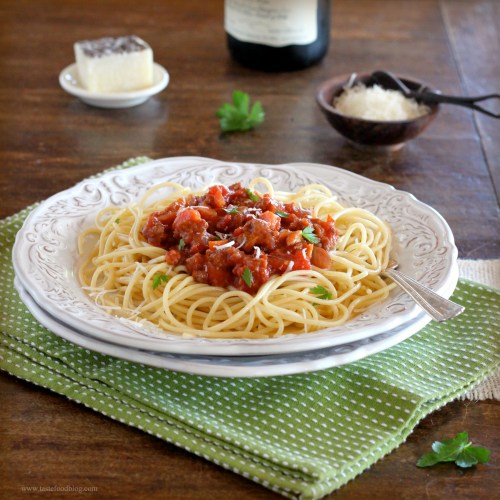
Spaghetti Bolognese

This recipe may be doubled. Freeze the extras for later use.
Serves 4  (or 1, if there is a 17 year-old boy at your table)

1 tablespoon extra-virgin olive oil, divided
1 pound ground beef
Salt
1 medium onion, finely chopped
1 small carrot, finely chopped
1/2 celery stalk, finely diced
1/2 sweet red pepper, finely chopped
2 large garlic cloves, minced
1/2 teaspoon crushed red pepper flakes
1/2 cup full-bodied red wine
1 28-ounce can Italian plum tomatoes with juice
1/4 cup tomato paste
1 bay leaf
1 teaspoons dried thyme
1 teaspoon dried oregano
1 teaspoon salt, or more to taste
1 teaspoon freshly ground black pepper
1 to 2 teaspoons sugar, to taste

1 pound pasta – cooked al dente
Grated Parmesan or Pecorino (they don’t do that in Bologna either) cheese

Heat 1 tablespoon olive oil in a large pot over medium-high heat. Add the beef, season with 1 teaspoon salt, and cook until nicely colored, 5 to 6 minutes, stirring often. Add the onion and continue to cook over medium heat until the onion is soft and translucent, 3 to 4 minutes more, stirring up any brown bits. Add the carrot, celery, red pepper, garlic, and red pepper flakes and cook until the vegetables soften and brighten in color, 3 to 4 minutes, stirring often. Pour in the wine and deglaze the pan, stirring up any brown bits. Add the tomatoes, tomato paste, bay leaf, thyme, oregano, black pepper, and 1 teaspoon salt. Bring to a simmer, partially cover the pot and continue to simmer for 30 to 40 minutes, stirring occasionally and breaking up any of the tomatoes with a wooden spoon. Taste for seasoning, and, if needed, add the sugar 1 teaspoon at a time to taste. Serve the sauce ladled over cooked pasta, such as spaghetti, pappardelle, rigatoni. Serve with grated cheese.

Autumn Salads: Spinach with Goat Cheese, Cranberries, Walnuts and Crispy Prosciutto

Spinach, Goat Cheese, Prosciutto, Walnuts, Cranberries, Orange Vinaigrette

Just because it’s cold outside doesn’t mean we can’t have a salad. In fact, when the temperature drops, it’s even more important to eat vitamin and nutrient-rich vegetables. We might be craving stews and braises in the warmth of the kitchen, yet there is still a place for a salad on the menu. Fall salads are more robust than their summer counterparts. What they might lack for in heat, they make up in substance. Sturdy earthy greens, such as spinach, chicories, kale or radicchio, move into the salad bowl. Nuts and seeds add nutrients and heft. Dried fruit or seasonal pears, apples, persimmons and pomegranates add sweetness and color. Dressings become more rich and intense, with mustard, aged balsamic vinegar and garlic. Cheese and salume crown the salad, bringing a satisfying umami quality, as well as salt and extra protein. The variations are numerous, but you can be sure the results will be delicious and perfectly in season.

Spinach Salad with Goat Cheese, Dried Cranberries, Walnuts and Crispy Prosciutto

Serves 2 to 4.

Vinaigrette:
2 tablespoons balsamic vinegar
1 tablespoon fresh orange juice
1 small garlic clove,  minced
1/2 teaspoon salt
1/2 teaspoon freshly ground black pepper
1/2 cup extra-virgin olive oil

Salad:
2 ounces prosciutto
8 ounces baby spinach leaves
1/3 cup walnut halves, lightly toasted, coarsely chopped
1/4 cup dried cranberries
2 ounces fresh goat cheese
1 teaspoon finely grated orange zest

Make the vinaigrette:
Whisk all of the ingredients except the olive oil in a small bowl. Add the oil in a steady stream, whisking constantly, until emulsified. Taste for seasoning.

Prepare the salad:
Heat oven to 350 F. Arrange the prosciutto in one layer on a baking sheet lined with parchment. Bake in oven until crisp, about 20 minutes. Remove and cool. Break in to shards.
Place the spinach, walnuts and cranberries in a large bowl. Drizzle with half of the dressing. Toss to combine. Add more dressing to desired taste and toss again. Arrange on serving plates. Crumble the goat cheese over the spinach, then scatter the prosciutto shards over the salad. Sprinkle with orange zest.

If you like this, you might enjoy these hearty salads:
Roasted Beets with Feta, Mint and Pistachios
Kale and Quinoa Salad
Mixed Greens with Roasted Beets, Wheat Berries and Goat Cheese