Winter Warmth: Celery Root and Parnsip Soup

Winter Warmth: Celery Root and Parnsip Soup

Celery root and parsnip team up in this soup with light yet luxurious results. The sweet earthiness of the parsnip grounds the subtle notes of the celeriac, adding depth without overpowering. The two root vegetables mingle and simmer in a simple concoction of chicken stock and thyme until they are soft enough to purée into a thick soup. You might find yourself tempted to call this soup creamy, but no cream is present – that is unless you feel like adding a splash for extra richness. (It’s the holiday season, after all!)

Celery Root and Parsnip Soup

Substitute a little cream for some of the chicken stock after puréeing for an even richer and more luxurious soup. Serves 4.

1 tablepoon olive oil
1 small celery root, about 1 pound, peeled, cut in 1/2 inch pieces
1 large parsnip, about 1/2 pound, peeled, cut in 1/2 inch pieces
1 garlic clove
3-4 cups chicken stock
1/2 teaspoon dried thyme
1 teaspoon freshly ground black pepper
1/2 teaspoon salt

Heat olive oil in a pot or deep skillet. Add celery root, parsnip and garlic clove. Sauté until fragrant and vegetables begin to soften without coloring, about 3 minutes. Add 3 cups chicken stock and thyme. Bring to a boil, then reduce heat to a simmer. Cover and cook until vegetables are very soft, about 30 minutes. Carefully transfer in batches to bowl of a food processor, or use an immersion blender, and purée soup until smooth. Return to pot. Add additional 1 cup chicken stock  or enough for desired consistency. (Optional: Replace 1/2 cup stock with heavy cream.) Stir in pepper and salt; heat through. Taste for seasoning. Serve hot.

Simply Tomato Soup

Simply Tomato Soup

~ Simply tomatoes … and a little sage, rosemary and Parmigiano ~

I purchased cherry tomatoes at the farmers’ market this afternoon. They were closing up for the day, so when I asked for 3 boxes for $5.00 as scribbled on the cardboard wedged between the heirlooms and cherries, I was handed 5 boxes of orange and red cherry tomatoes. 5 for the price of 3? That’s a farmers market bargain. But then I had to get creative. These tomatoes were super ripe, best eaten as soon as possible. So I made this with the 4 remaining pints – since one box was gobbled up in the car on the way home.

Simply Tomato Soup

There is no straining, seeding or skinning involved in this recipe. It’s all about the whole tomato. I was lucky to find ripe, sweet tomatoes in season – if your tomatoes are not at peak,  adding a spoonful of sugar to the soup works magic.

Makes 7-8 cups.

3 pounds cherry tomatoes
1/2 cup olive oil
4 garlic cloves, chopped
2 rosemary sprigs
2 sage sprigs
2 teaspoons salt, plus extra to taste
1 teaspoon freshly ground black pepper

Combine all of the ingredients in a large pot over medium-high heat. When the tomatoes begin to break down and the liquid is bubbling, reduce heat to a simmer. Cook uncovered until tomatoes release all of their juices, stirring occasionally, breaking up any whole tomatoes with a wooden spoon until mixture is thick yet soupy. Taste for salt. Serve with grated Parmigiano cheese.

Brussels Sprout Gratin


~ Brussels Sprout Gratin ~

If you have more than one child you may understand this tale: I have two children. One is an adventurous eater, and one is not. One loves fish, and the other can’t stand it (although I don’t really remember her tasting much of it.) One loves butter, while the other would prefer not to be seated at the same table with it. My highly unscientific theory is that this is nature’s way of ensuring that it’s offspring do not starve. If siblings have opposite tastes, then there is enough sustenance to feed the litter. After all, how would our species advance? At least this is how I console myself as a parent and a cook.

Which brings me to brussels sprouts. OK, I understand that you don’t have to be a child genetically predisposed to preserving the human race to dislike brussels sprouts. These little crucifers are enough to rile many a mature adult. But in our home, they are enjoyed – at least by most of us. My son likes them, and, therefore, my daughter does not. So, in a moment of inspiration and indefatigable hope I purchased a bag of firm pretty brussels sprouts at the market today with a plan. Instead of stir-frying or steaming them, I would gratinée them. While my daughter dislikes brussels sprouts, she loves gratins. Anything cheesy, creamy and crispy is right up her alley. Why not? I would give it a try. And you know what? She liked it. The problem is that my son, who dislikes rich and creamy food, did not.

Brussels Sprout Gratin
Serves 4

1 1/2 pounds brussels sprouts
2 tablespoons unsalted butter
1 small garlic clove, minced
2 tablespoons all-purpose flour
1 1/2 cups whole milk
1/3 cup finely grated Gruyère cheese
1 teaspoon salt
1/2 teaspoon freshly ground black pepper
1/4 teaspoon ground nutmeg
1/4 cup panko breadcrumbs
1/4 cup finely grated Parmigiano-Reggiano cheese

Preheat the oven to 350 F. (180 C.) Wash brussels sprouts. Trim outer leaves and bottoms, then cut in half. Steam brussels sprouts until crisp tender, about 3 minutes. Transfer to a large bowl.
Melt the butter over medium heat in a saucepan. Add the garlic and saute until fragrant, about 30 seconds. Add the flour and stir with a wooden spoon until well combined and light golden in color. Add the milk in a steady stream, whisking to incorporate, and bring to a boil. Reduce heat and simmer, stirring, until thickened. Stir in the Gruyere cheese, salt, pepper and nutmeg until smooth. Pour over the brussel sprouts and stir to thoroughly coat. Transfer to a gratin dish. Combine panko and Parmigiano in another small bowl. Sprinkle evenly over the brussels sprouts. Bake in oven until golden brown and heated through.

Roasted Provençal Vegetable Salad

~ Roasted Provençal Vegetable Salad with Couscous ~

Consider this as a deconstructed ratatouille – which happens to be oven roasted. The same cast of characters applies, only the method differs. An end of summer symphony of squash, eggplant, peppers and tomatoes are tossed together with olive oil and roasted in the oven until softened and gently charred, instead of simmered and thickened in a pot. The traditional ratatouille stew morphs into a roasted vegetable salad, freshened with a shower of fresh herbs and served over a bed of couscous for a light and healthy meal.

Roasted Provencal Vegetables Salad with Couscous

You may either roast the tomatoes with the vegetables or toss them in at the end for extra freshness. The salad is delicious as is or served over couscous, pasta, or quinoa. Serves 4 -6.

1 medium eggplant, cut in 1/2 inch slices, each slice quartered
2 small zucchini, cut in 1/2 inch slices
2 small yellow squash, cut in 1/2 inch slices
1 large red onion, halved horizontally, each half cut lengthwise in 4 thick chunks
6 baby sweet peppers, stemmed, seeded halved
1/4 cup extra-virgin olive oil
Salt
Freshly ground black pepper
1 cup cherry or grape tomatoes
1 large garlic clove, minced
1/2 cup Italian parsley sprigs, coarsely chopped
1/2 cup fresh basil leaves, shredded
Optional: Crumbled goat or feta cheese as garnish

Heat oven to 375 F. (190 C.) Place all of the eggplant, zucchini, squash and onion in a large bowl. Drizzle with olive oil. Sprinkle with 2 teaspoons salt and 1 teaspoon freshly ground black pepper. Toss to coat. Arrange on 2 rimmed baking sheets in one layer. Place in oven. Bake until vegetables are tender and turning golden brown, rotating baking pans, to ensure even roasting. Remove from oven and cool. Transfer vegetables to a large bowl. Add tomatoes, garlic and fresh herbs. Toss. Season to taste with additional salt and pepper. Serve over couscous. Sprinkle with crumbled cheese if using.

Ratatouille Gratin

~ Ratatouille Gratin ~

It’s that time of year when the vegetables sneak up on you. A month ago, summer squash were elusive, appearing in the markets in small groups at a price. In the garden they were merely a hint of themselves peeking from their flowers. Purchases felt premature, tasting a little bitter, and costing too much for something you knew would soon be prolific.

~
Then, before you know it, a month has passed and squash are teeming everywhere. The garden is lobbing them to you like tennis balls, the market shelves are stacked with zucchini, crooknecks, and patty pans, ripe and ready for consumption. With the bounty, it’s time to get creative, because, ironically, it’s easy to tire of this abundance, and that is a shame.  So, yesterday I was determined to use my imagination to celebrate summer squash. Instead of a traditional ratatouille, I made a gratin. And before I made the gratin, I played a little bit with my food and made Ratatouille Stacks.

~ Ratatouille Stacks ~

The ingredients are identical, only the arrangement is different. Serve the gratins as side dishes or a light vegetarian meal. The stacks are fun appetizers.

Ratatouille Gratin with Goat Cheese and Basil

Try to choose squash and eggplant of a similar diameter. This recipe makes enough for an 8 to 9-inch square or round pan. Alternatively, you can arrange the vegetables in smaller individual gratin dishes.

Active Time: 30 minutes
Total Time: 45 minutes
Serves 4

1 narrow eggplant, about 10 ounces
1 medium zucchini, about 6 ounces
1 medium yellow squash, about 6 ounces
1 large red bell pepper, quartered and seeded
Olive oil
Salt and freshly ground black pepper
1/2 cup basil leaves, torn into 1/2-inch pieces, plus extra for garnish
3 ounces soft fresh goat cheese

1. Preheat the oven broiler.
2. Slice the eggplant, zucchini, and yellow squash crosswise about 1/3 inch thick. (If the eggplant is much wider than the squash, quarter lengthwise and slice 1/3 inch thick.)
3. Arrange the eggplant, zucchini, squash, and peppers in one layer on an oiled baking tray. Brush the tops with additional oil and lightly season with salt and black pepper. Broil on the top shelf of the oven until the vegetables are tender, but not mushy, and brown in spots, 8 to 10 minutes, turning once. Remove and cool to the touch.
4. Preheat the oven to 350°F. Lightly oil an 8 or 9-inch square or round gratin dish. Arrange the vegetables, alternating and slightly overlapping, in rows or a circular pattern. Tuck the basil between the vegetables in a random pattern so that it is evenly distributed. Scatter grape-size amounts of the goat cheese evenly over the vegetables.
5. Bake the gratin in the oven until the cheese is soft and light golden in spots, about 15 minutes. Serve warm or at room temperature, garnished with extra basil if desired.

Roasted Potatoes with Sea Salt and Thyme

Roasted Potatoes with Sea Salt and Thyme

~
Sometimes it’s necessary to state the obvious. These roasted potatoes are a simple side dish, a predictable accompaniment to meats and fish. An obvious choice, yes, but also an elegant reflection of simplicity and a delectable sum of its ingredients. Predictability can be reassuring. And these days it’s nice to have a little predictability to rely on – especially when it looks and tastes as good as this.

Roasted Potatoes with Sea Salt and Thyme
Serves 4 as a side dish

1 1/2 pounds small or new potatoes, with skin
1 garlic clove, minced
2 tablespoons extra-virgin olive oil
Sea salt
Freshly ground black pepper
3-4 thyme sprigs, plus extra for garnish

Preheat oven to 425 F. Quarter potatoes and place in a large bowl with the garlic. Drizzle with olive oil. Toss to coat potatoes. Sprinkle with salt and pepper. Toss again. Dump the potatoes on a rimmed baking sheet. Scatter the thyme sprigs around the potatoes. Place baking tray on lowest rack in the oven. Bake 30 minutes without disturbing. Move baking tray to top half of the oven and continue to bake another 30 minutes. Remove and transfer potatoes to a bowl. Garnish with additional sea salt and thyme sprigs.

Spring Chicken and Vegetable Soup

Spring Chicken and Vegetable Soup

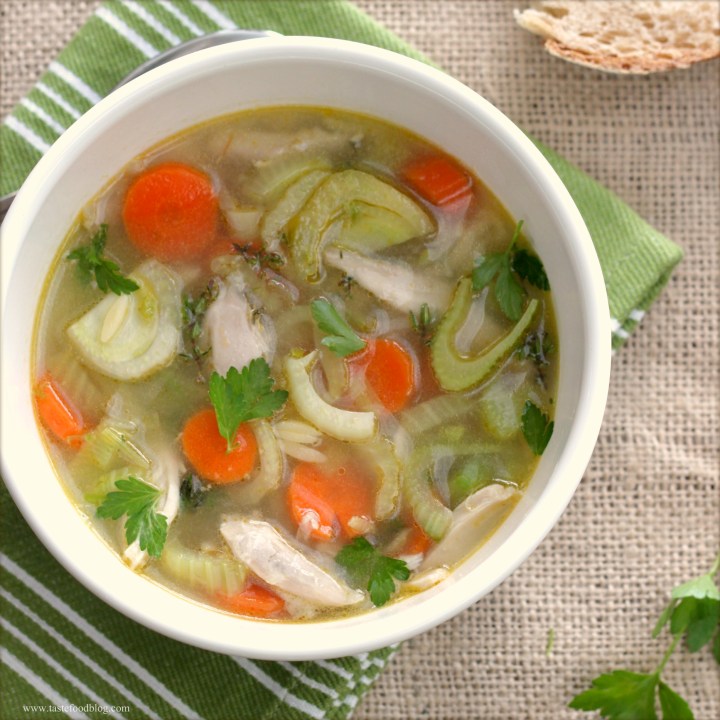
Here is another soup recipe that sings spring. Spring Chicken and Vegetable Soup is filled with seasonal vegetables including green garlic. Appearing in the markets right now, green garlic is the younger rendition of the ubiquitous papery garlic bulb. Like any youngster, this version  is sassy, sharp and full of swagger. But with a little heat, all of that bravado fades away. The green garlic softens, mellows and loses its pungency, resulting in a smooth aromatic backdrop to this light and healthy soup.

Spring Chicken and Vegetable Soup

Serves 4 to 6

1 tablespoon olive oil
1 cup chopped green garlic, white and pale green parts
Salt
1 large fennel bulb, thinly sliced
2 large carrots, thinly sliced
4 cups chicken stock
1 cup orzo
1 tablespoon fresh thyme or 1 teaspoon dried
1 1/2 cups shredded cooked chicken meat (optional)
1/4 cup chopped flat leaf parsley, coarsely chopped

Heat oil in a soup pot over medium heat. Add green garlic and 1 teaspoon salt. Sauté until garlic softens and its aroma loses its sharpness, 5 minutes. Add fennel and carrots and continue to sauté until the vegetables brighten in color and begin to soften, 2 minutes. Add stock, orzo and thyme. Bring to a boil, then reduce heat to a simmer. Simmer, partially covered until orzo is cooked through and vegetables are tender, 15 – 20 minutes. Taste for salt. Stir in chicken and parsley; continue to cook until the chicken is warmed through. Serve immediately in warm bowls.

Asparagus Soup

Asparagus Soup

Nothing says spring to me more than the arrival of asparagus in the markets. Their green stalks fill the shelves, upright and dignified, like silent soldiers adorned with purple-tinged crowns. I can’t help myself: I grab one bunch, then another, heaping them in my basket, while eyeing others for even firmer, taller, more deeply colored specimens. If I see them, I’ll take them.

Once home, they need to be put to use – steamed with lemon and olive oil, oven-roasted for a little char, shaved raw into salads, and, of course, in soup. This recipe is simple and relatively minimal, as an asparagus soup should be. Too many flavors will overpower their subtle grassy flavor. A little cream is added to the soup for body and richness, and a sprinkling of Pecorino cheese for garnish adds that extra umami quality, begging for seconds.

Asparagus Soup

Serves 4-6

1 pound asparagus spears
1 tablespoon unsalted butter
1 tablespoon olive oil
1 medium onion, chopped
Salt
4 cups chicken stock
1/2 cup heavy cream
Freshly ground black pepper
1/4 cup finely grated Pecorino Romano cheese

Trim and discard the woody ends of the asparagus. Cut and reserve 4-6 asparagus tips, 2 inches in length. Slice remaining spears in 1/4 inch pieces.
Melt butter with the oil in a soup pot over medium heat. Add onion and 1/2 teaspoon salt. Sauté onion until translucent without browning, about 2 minutes. Add asparagus pieces and sauté until brightened in color and beginning to soften, 2 minutes. Add stock; bring to a boil then reduce heat and simmer, partially covered, until asparagus are very tender, about 20 minutes.
While the soup is simmering, blanch the reserved asparagus tips in salted boiling water until bright in color, 30 seconds. Drain and rinse under cold water; set aside.
Purée soup with an immersion blender or carefully in batches in a food processor. Return to soup pot. Add cream and black pepper and heat through to serving temperature. Taste for seasoning. Serve in bowls or glasses, sprinkled with pecorino cheese. Garnish with asparagus spears.

Farrotto with Shiitake Mushrooms and Beets

You know, I could just call this Farro with Shiitake Mushrooms and Beets, but Farrotto sounds much more fun.  Farrotto?  Yes, if you switch out the rice from risotto with farro, then you end up with farrotto,  a grain steeped in stock – minus the requirement for non-stop stirring. Another difference from rice based risotto, is that farro has a pleasingly chewy texture, never succumbing to mushiness. Each nutty whole wheat grain maintains its shape,  exuding earthy wholesomeness. You can’t help feeling healthy when you eat it.

Farro has an ancient pedigree, originating in the Mediterranean and the Middle East. Also known as emmer, and compared to spelt, farro is a species of wheat, high in fiber and rich in protein and B vitamins. It’s delicious in salads, pilafs, breads, soups and stews. If you haven’t tried it, you should. It’s healthy, economical and delicious.

Farrotto with Shiitake Mushrooms and Yellow Beets

Active Time: about 1 hour
Total Time: about 1 hour
Serves 4

1 tablespoon unsalted butter
2 tablespoons olive oil, divided
1 small shallot, finely chopped, about 2 tablespoons
8 ounces shiitake mushrooms, sliced 1/4-inch thick
Sea salt
1 large garlic clove, minced
1 teaspoon thyme
1 cup semi-pearled farro, rinsed and drained
1/4 cup dry white wine
2 cups chicken stock (or mushroom stock for vegetarian version)
1 medium yellow beet, about 8 ounces, peeled and diced
2 tablespoons chopped Italian parsley, plus extra for garnish
1/2 teaspoon freshly ground black pepper
1/4 cup crumbled fresh goat cheese or feta, optional

1. Melt the butter with 1 tablespoon olive oil in a large saucepan over medium heat. Add the shallot and sauté until softened, about 2 minutes. Add the mushrooms, lightly season with salt, and cook until they begin to soften and release their juices, 3 to 4 minutes, stirring constantly. Add the garlic and thyme and sauté until fragrant, about 30 seconds. Add the farro and cook until slightly toasted, about 2 minutes, stirring constantly. Pour in the wine and stir until absorbed. Add the stock and 1/2 teaspoon salt and bring to a boil. Reduce the heat to low and cover the pot. Simmer until the farro is tender and the liquid has been absorbed, 30 to 40 minutes.
2. While the farro is cooking, heat the oven to 400°F. Toss the beets, 1 tablespoon oil, and 1/4 teaspoon salt in a bowl. Spread on a small rimmed baking sheet or in a baking pan and roast in the oven until the beets are tender and golden brown in spots, about 20 minutes.
3. When the farro is ready, stir in the beets, parsley, and black pepper. Serve garnished with additional parsley and crumbled fresh goat cheese, if using.

Roasted Yellow Beet and Ricotta Tian

I find it impossible to resist beets. Their colors are magnificent – it’s a miracle that nature can provide something edible that is so vibrantly hued. With the vivid color, of course, comes nutrients. Beets are a nutritional powerhouse, rich in antioxidants, vitamins, and beta-carotene. I purchased these beets at the farmers’ market, without knowing how I would prepare them. I was happy to simply look at them.

Prompted by a batch of fluffy ricotta in my fridge, I decided to layer the yellow beets with the cheese as a riff on lasagna, with the beet slices replacing the lasagna sheets. Yellow beets are milder in flavor than red beets, and their nutty, buttery flavor wouldn’t overpower the cheese. I also feared the red beets would completely saturate the dish with their magenta color, which, while lovely to look at, threatened to irrevocably tint my pristine ricotta. This is a visually motivated dish.

Roasted Yellow Beet and Ricotta Tian

Active Time: 20 minutes
Total Time: 1 hour and 10 minutes
Serves 4; Makes one (8-inch) tian or 4 individual ramekins

1 pound yellow beets (about 4 medium)
12 ounces whole milk fresh ricotta, drained of excess liquid
2 tablespoons finely grated Parmesan cheese, plus extra for sprinkling
2 tablespoons finely chopped fresh basil, plus extra for garnish
1 small garlic clove, minced
1 teaspoon finely grated lemon zest
1 teaspoon salt
1/2 teaspoon freshly ground black pepper
Extra-virgin olive oil

  1. Preheat the oven to 350°F.
  2. Trim the greens and ends of the beets and peel the skin. Thinly slice the beets, preferably with a mandoline, about 1/8-inch thick.
  3. Combine the ricotta, Parmesan, basil, garlic, lemon zest, salt, and the black pepper in a bowl and whisk to blend.
  4. Arrange the beets in one layer, slightly overlapping, in an 8-inch diameter gratin dish (or 4 individual ramekins). Lightly brush the beets with olive oil. Smear a layer of the ricotta over the beets. Repeat the layering process, finishing with a thin layer of ricotta on the top (some of the beets should be showing). There should be about 4 layers. Sprinkle 1 to 2 teaspoons Parmesan cheese over the tian.
  5. Transfer to the oven and cook until the beets are tender when pierced with a knife, about 50 minutes. If the top begins to brown before the beets are fully cooked, loosely cover with foil. Remove from the oven and let stand at least 15 minutes before serving.
  6. Serve warm or at room temperature garnished with fresh chopped basil.