Oatmeal Raisin Cookies

oatmeal raisin tastefood.jpg
This recipe is the closest I have come to my idea of a perfect oatmeal raisin cookie. It’s packed with oats and raisins with just a little flour to bind it all together, along with a blast of wheat germ for nutty crunch. The result is a crisp and chewy cookie that’s wholesome and rich at once. There is no white sugar in this recipe – only brown sugar which creates a deep caramel sweetness which dissolves in the mouth with every bite.

Oatmeal Raisin Cookies

Refrigerating the cookies before baking will ensure a thicker, chewier cookie. Makes about 30 (2-inch) cookies.

1 3/4 cups light brown sugar
1 cup unsalted butter, melted and cooled to room temperature
1 large egg
2 teaspoons vanilla extract
1/2 cup all-purpose flour
1 teaspoon ground cinnamon
1 teaspoon baking soda
1/2 teaspoon salt
3 cups old fashioned oats
1/2 cup wheat germ
1 1/2 cups raisins

Whisk the sugar, butter, egg and vanilla together in a large bowl until smooth. Mix the flour, cinnamon, baking soda and salt together in a small bowl. Stir the flour into the butter and sugar and thoroughly combine. Stir in the oats and wheat germ. Add the raisins. Refrigerate the dough for at least 30 minutes.
Preheat the oven to 375°F (190°C). Drop rounded tablespoons of the dough onto a baking sheet lined with parchment, leaving 2 inches between each cookie. Bake until the cookies are set in the middle and golden brown, 12 to 14 minutes. Remove from oven and cool on a rack.

Lamb, Bulgur and Chickpea Stew with Roasted Eggplant

lamb bulgur stew tastefood

The other day, for the first time I made kibbeh, the Lebanese version of kefta or croquettes. A key ingredient in kibbeh is bulgur (cracked wheat), which was a revelation to me. I was afraid the bulgur would add a mealiness to the croquettes, but in fact it remained firm, adding a satisfying bite (and crunch when pan fried) to the ground meat. I liked this combination so much I decided to try it in a stew with tomatoes, white wine and plenty of spices. The bulgur slurped up the liquid producing a thick and dense ragout. While it could easily have been served in bowls as a hearty stew, I spooned it over roasted eggplant to lighten it up a bit. The results resembled a deconstructed dolma or vegetable stuffed with ground meat and grains, typically served in Turkish and Middle Eastern cuisine. All that was needed was a bit of crumbled feta and fresh mint to freshen up this lovely dish, and I know I’ll be making it again.

Lamb, Bulgur and Chickpea Stew with Roasted Eggplant

Serves 4 to 6

1 tablespoon olive oil
1 medium onion, chopped
2 garlic cloves, minced
1/2 pound ground lamb
1/2 cup bulgur
1 cup white wine
1 (28-ounce) can Italian plum tomatoes with juices
1 cup chicken stock or water
1 teaspoon sweet paprika
1 teaspoon ground cumin
1 teaspoon ground cinnamon
1/2 teaspoon red chili flakes
1/2 teaspoon coriander
1 (15-ounce) can chickpeas (garbanzos) drained and rinsed
1 1/2 cups coarsely chopped green cabbage

1 medium eggplant, sliced crosswise 3/8-inch thick
Olive oil
Salt and freshly ground black pepper

Crumbled feta cheese
Fresh mint leaves, torn

Heat 1 tablespoon olive oil in a pot or Dutch oven. Add the onion, garlic and lamb. Cook until the onion softens and the lamb browns, stirring frequently, about 5 minutes. Add the wine and deglaze the pan, stirring up any brown bits with a wooden spoon. Add the tomatoes, stock, bulgur, paprika, cumin, cinnamon, and coriander. Simmer, partially covered, until the bulgur is tender, about 20 minutes. The stew will have thickened at this point. If desired, add more water or stock to thin to desired consistency. Add the salt and black pepper and taste for seasoning. Stir in the chickpeas and cabbage and cook over medium-low heat until the cabbage is wilted, 10 to 12 minutes.

While the stew is simmering, arrange the eggplant slices in one layer on a rimmed baking sheet. Brush on both sides with olive oil and season with salt and pepper. Broil on the top rack of the oven until golden brown on both sides, turning once.

To serve, spoon the ragout over the eggplant. Sprinkle with feta and garnish with mint. Serve warm.

Kale Gratin

kale gratins tastefood.jpg

Winter Greens Gratin

Gratins are a great way to eat your vegetables, especially in the winter. Who can resist bubbling pots of roasted vegetables and winter greens, crispy golden on the top and cheesy-creamy in the center? Hearty earthy greens, such as kale, spinach and chard, stand up exceedingly well to rich bechamel and melted cheese (what wouldn’t?) Serve in a large gratin dish for family style dining or spoon into individual ramekins for fancy serving. Either way, you can be sure that everyone will be eating their greens.

Kale Gratin
Feel free to add other greens or vegetables, such as chopped broccoli or cauliflower. Pecorino or Gruyere cheese may be substituted for the Parmigiano. Serves 4 to 6

1 tablespoon olive oil
1 large shallot, finely chopped, about 1/2 cup
1 to 2 bunches kale (Tuscan or curly), tough ribs removed, coarsely chopped (about 10 cups)
2 tablespoons unsalted butter
2 tablespoons all-purpose flour
1 cup whole milk
1 cup heavy cream
1/2 cup finely grated Parmigiano cheese, divided
1 teaspoon salt, or to taste
1 teaspoon freshly ground black pepper
1/4 teaspoon ground nutmeg

Preheat the oven to 350°F. Heat the oil in a deep skillet or wide saucepan over medium heat. Add the shallot and saute 1 minute. Add the kale and saute until slightly wilted, about 2 minutes. Remove from heat. In a medium saucepan, melt the butter over medium heat. Add the flour and cook, stirring, until light golden, about 2 minutes. Whisk in the milk and cream. Simmer, stirring, until thickened. Whisk in 1/4 cup cheese, the salt, pepper and nutmeg until the cheese melts and the sauce is smooth. Pour over the kale and stir to combine. Transfer to a buttered gratin dish or individual ramekins. Top with the remaining cheese. Transfer to oven and bake until the tops of the gratins are golden brown and bubbly, about 25 minutes. Serve warm.

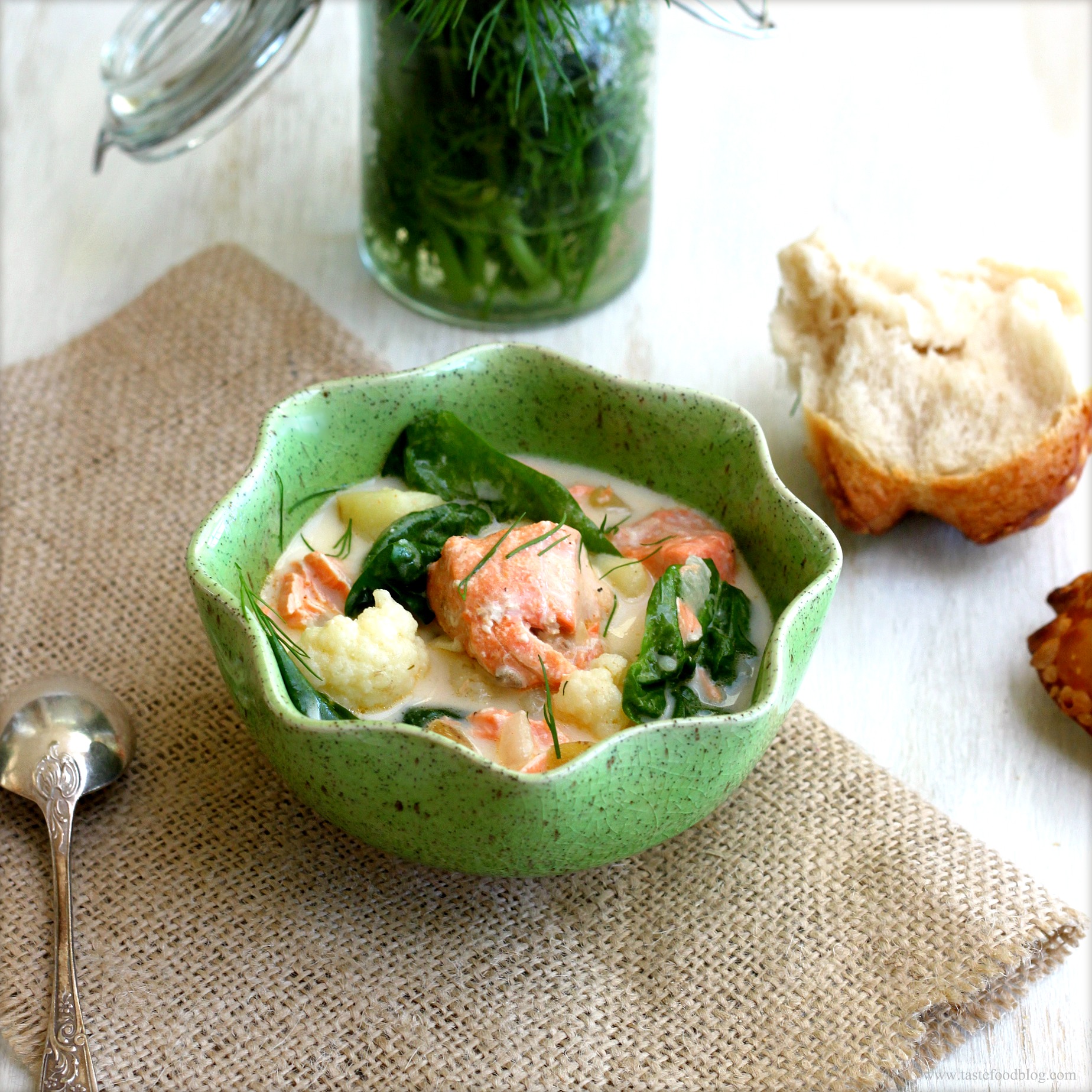
Salmon and Spinach Chowder

It’s the time of year for bowl-food. When the weather is grey, wintry and cold, there’s nothing more satisfying then a big bowl of dinner. Steaming hot and full of hearty healthy flavors and ingredients, it’s meant to be eaten with big spoons and napkins to catch the dribbles.

I love to eat chowders year round, especially in the winter when creamy dishes hit the spot. I often add a number of ingredients to my chowder in addition to the requisite fish. While most firm fleshed fish work in chowders, my favorite is salmon. Its buttery oil-rich flesh shines in a creamy stock and is a perfect accompaniment to earthy vegetables, crucifers and greens.

We don’t usually have left-over salmon in our house, since it’s often gobbled up the moment it hits our dinner plates. In the rare occurrence when there is some filets left, I’ll often add them to the next day’s chowder. While this recipe starts with the premise of using raw fish, pre-cooked leftovers work just as well. Considering how expensive salmon can be, this is a great way to get two fabulous meals from one purchase. You just need to be lucky enough to have the leftovers.

Salmon and Spinach Chowder

Feel free to improvise with your greens. Kale or chard may be substituted for the spinach. If you are cauliflower-averse, you can omit it and add extra spinach.

Serves 4

1 tablespoon unsalted butter
1 tablespoon olive oil
1 medium onion, chopped
2 tablespoons all-purpose flour
4 cups water
2 medium yukon gold potatoes, about 3/4 pound, cut into 1/2-inch dice
1 1/2 cups bite-sized cauliflower florets
1 teaspoon paprika
1 teaspoon Tabasco
1 cup heavy cream
1 to 1 1/4 pounds salmon filet, skin and pin-bones removed, cut in 3/4-inch chunks
1 bunch fresh spinach leaves, stems removed, torn into large pieces
Salt
Freshly ground black pepper
Fresh chopped dill

Heat the oil and melt the butter in a large pot over medium heat. Add the onion and sauté until softened, about 2 minutes. Add the flour and cook, stirring, 1 to 2 minutes. Add the water and whisk to blend the flour. Add the potatoes and cauliflower. There should be enough water to cover the vegetables. If not, add more water to cover. Simmer, partially covered, until vegetables are tender, 15 to 20 minutes. Stir in the paprika, Tabasco, and cream. Bring to a simmer. Add the salmon and simmer until cooked (or heated) through. Stir in the spinach and briefly cook until bright green in color and wilted, about 1 minute. Season to taste with salt and pepper. Ladle into soup bowls. Garnish with fresh dill and serve immediately.

Valentine’s Chocolate


Flourless Chile Chocolate Cake

It’s no secret that I am a huge fan of dark chocolate, and my friends know it. So when I was recently gifted a box of Swiss chocolate from a longtime friend visiting from Geneva, I did the natural thing: I hid it. I could say it was under the guise of recipe research, but who would I be kidding?

My preferred chocolate is very dark with little bling. However, with that said, I do from time to time like to mess with my chocolate. My favorite embellishments are almonds, sea salt and chili. None of these additions detract from the richness of the chocolate, nor do they add any cloying sweetness. Rather they seem to amplify the deep chocolate flavor, while tickling the taste buds and hitting a few always-welcome umami notes.

bark balslev

Aztec Chocolate Bark

So for a little Valentines Day present, I have for you not one but two recipes with a version of spiced up chocolate. After all, there’s nothing wrong with spicing anything up around Valentine’s Day. The first recipe is for Aztec Chocolate Bark which you can find in a column I wrote for The Weiser Kitchen on Swiss chocolate (of course). And since love and chocolate go hand in hand with abundance (or at least they should), I will share with you below this recipe for Chile Spiced Flourless Chocolate Cake. Happy Valentine’s Day!

Flourless Chile-Chocolate Cake
Serves 10 to 12

1 cup unsalted butter, room temperature, cut into 6 pieces
12 ounces dark (70%) chocolate, finely chopped
6 large eggs, room temperature
1 cup granulated sugar
1 teaspoon vanilla extract
1 teaspoon chipotle chili powder
1/2 teaspoon ground cinnamon
1/2 teaspoon salt
1/4 teaspoon cayenne
Powder sugar

Preheat the oven to 350°F. Butter a 9-inch springform pan. Line the bottom of the pan with parchment paper and butter the parchment. Melt the butter and chocolate in a double boiler over barely simmering water making sure that the bottom of the bowl does not come in contact with the water, stirring occasionally. Whisk the eggs and sugar together in a large bowl. Add the melted chocolate, vanilla, chili powder, cinnamon, salt and cayenne. Stir to combine. Pour into the prepared springform. Bake until the cake is set and the top begins to crack, about 40 minutes. (The center will still be moist.) Cool completely on a rack. Remove the side of the pan and transfer to a serving plate. (Cake may be made up to one day in advance. Cover and refrigerate.) Serve sprinkled with powder sugar before serving.

Roasted Cauliflower with Chilies, Lemon and Mint

cauliflower tastefoodEat your vegetables – Roasted Cauliflower

It’s a hunch, but I would be willing to bet that you could persuade the most ardent veggie haters to try this cauliflower recipe. Roasting cauliflower magically transforms the snow white crucifer with cabbage-y notes into a tender yet crispy, caramelized treat, coaxing out its natural sweetness and nuttiness. Simple seasonings, such as paprika, salt and pepper gently enhance the flavor. You can serve it simply like that, or go the full Monty and toss it with chilies, lemon and mint.

Roasted Cauliflower with Chilies, Lemon and Mint

Sambal Olek is a Southeast Asian chili sauce. It’s Middle Eastern cousin, Harissa, may be substituted. Serves 4.

1 large head cauliflower
2 tablespoons extra-virgin olive oil, plus more for drizzling
1 garlic clove, minced
1 teaspoon sweet paprika
1 teaspoon salt
1/2 teaspoons freshly ground black pepper
Finely grated zest from 1/2 lemon
3 tablespoons chopped fresh mint
Harissa or Sambal Olek

Preheat the oven to 400°F. Slice the cauliflower, top to bottom into 3/4-inch slices. (Slicing the cauliflower will provide flat sides which will brown easily when roasting). Cut away the thick stems, and gently break the florets apart into large bite-sized pieces. Place in a large bowl. Add the garlic, 2 tablespoons olive oil, paprika, salt and pepper. Gently toss to coat, then spread onto a rimmed baking sheet. Some of the florets will break into small pieces, but that’s ok – the little bits will get nice and brown while roasting.

Roast on the bottom rack in the oven until the cauliflower turns brown on the bottom, about 20 minutes. Transfer the pan to the top third of the oven and continue to roast until golden brown on top and tender, about 20 minutes. Transfer to a serving platter. Drizzle with extra olive oil. Drop small spoonfuls of sambal olek over the cauliflower and garnish with lemon zest and mint. Serve warm or at room temperature with extra chile sauce on the side.

Simple Suppers: Pasta with Bacon and Arugula

bacon arugula pasta tastefood

This recipe takes inspiration from the simplest yet tastiest Italian pasta dishes. Aglio e Olio is a humble Napoli dish consisting of pasta, olive oil, cheese, and dried red chili flakes, glistening with reserved pasta water. If you haven’t added pasta water to your kitchen toolbox, then it’s time you did. The cooking water is loaded with starch and salt, and is a wonderful way to loosen a sauce or moisten noodles. This nifty, no-cost by-product of the cooking process is best added in the last few minutes of preparing the dish.

Another ingredient in this dish with humble Italian roots is breadcrumbs. Pasta con la mollica is a southern Italian dish where breadcrumbs were considered part of the cucina povera, and considered the “poor man’s cheese.” It may sound redundant to add bread to pasta, but well-toasted breadcrumbs are a fabulous flavor carrier, and a resourceful way to use not-so-fresh bread. And like most dishes born of modest origins, it translates to a timeless and comforting dinner classic.

To this recipe, I add fresh arugula, simply wilted by the heat of the cooked pasta, and bacon, arguably another resourceful and economical food. After all, who can say no to bacon?

Spaghetti with Bacon and Arugula

Active Time: 30 minutes
Total Time: 30 minutes
Serves 4

8 ounces thick cut bacon, coarsely chopped
1/2 cup breadcrumbs or Panko (Japanese breadcrumbs)
1/2 teaspoon salt
1/2 teaspoon freshly ground black pepper
1/4 cup plus 1 cup finely grated Parmesan or Pecorino Romano cheese
1 pound spaghetti
2 tablespoons extra-virgin olive oil
2 cloves garlic, minced
1/2 teaspoon dried red chili flakes, or more to taste
3 cups fresh arugula

  1. Heat a skillet over medium-high heat. Add the bacon and fry until the fat renders and the bacon is crisp, 6 to 8 minutes. With a slotted spoon, transfer the bacon to a plate lined with a paper towel.
  2. Pour off all but 1 tablespoon bacon fat from the skillet. Add the breadcrumbs and toast over medium heat until golden, about 30 seconds. Transfer to a bowl. Cool to room temperature and then stir in the 1/4 cup of the cheese, the salt, and black pepper and set aside.
  3. Bring a large pot of generously salted water to a rolling boil. Cook the pasta 1 minute less than the package instructions for al dente. Scoop out and reserve 1 cup cooking water and drain the pasta.
  4. Heat the oil in a large, deep skillet over medium heat. Add the garlic and chili flakes and sauté until aromatic, about 1 minute. Add the drained pasta, 1/2 cup of the reserved water and the remaining 1 cup cheese, stirring and tossing constantly to melt the cheese and evenly coat the pasta. (If the pasta is too sticky, add additional water to moisten.)
  5. Remove from the skillet from the heat and add the bacon, arugula, and half of the breadcrumb mixture. Stir to combine and slightly wilt the arugula. Serve immediately with the remaining breadcrumbs for sprinkling.

Parsnip and Celery Root Soup

root soup tastefood
Parsnip and Celery Root Soup

White root vegetables do the talking in this rich and velvety soup that will leave you guessing it’s laden with cream. Well, guess again. This humble soup is light and healthy, thickened by parsnips and celery root with a good splash of milk. The sweet and nutty root vegetables are tempered by garlic and thyme for a well rounded and slurp-worthy bowl of goodness that promises to keep you warm in the cold weather.

Parsnip and Celery Root Soup

Feel free to change the ratio of veggies and/or add Jerusalem artichokes to the mix. Just be sure to keep the total weight at 2 pounds. Serves 4 to 6.

1 tablespoon extra-virgin olive oil
1 medium onion, chopped, about 1 cup
1 pound parnsips, peeled, cut into 3/4-inch chunks
1 pound celery root, peeled, cut into 3/4-inch chunks
3 cloves garlic, chopped
4 cups chicken stock
2 sprigs thyme
1/2 cup whole milk plus more to taste
1 teaspoon salt, or more to taste
1/2 teaspoon freshly ground black pepper

Heat the oil in a soup pot over medium heat. Add the onion and sauté until translucent without coloring, about 3 minutes. Add the parsnips, celery root, and garlic. Sauté until the vegetables begin to soften, 2 to3 minutes. Add the chicken stock and thyme. Bring to a boil, then reduce heat to low. Cover and simmer until the vegetables are very soft, 25 to 30 minutes. Remove the thyme sprigs. Carefully transfer the soup to a food processor (or use an immersion blender) and purée until smooth. Return to the soup pot. Add the milk, salt and pepper.  If too thick, add more milk to your desired consistency and taste for seasoning. Serve warm.

Moroccan Lamb Stew with Figs and Chickpeas

It’s the time of year when I have an urge to travel. Call it cabin fever, restlessness, or simply the craving to be somewhere different, where it’s warm, spicy and balmy. The sights, smells and sounds of new cultures are revitalizing. Time slows down, and the smallest details are observed and savored  amidst a kaleidescope of impressions. It just so happens that this is also the time of year when my urge to travel collides with real life. It’s the middle of the school year, I have work deadlines, and the contents of my piggy bank were spent at Christmas. So I improvise, and my travels occur in the kitchen, where I replace my passport with the jars in my spice drawer and concoct recipes inspired by the exotic flavors, heat and aromas of far flung destinations.

Moroccan Lamb Stew with Chickpeas and Figs

The secret ingredient in this North African inspired stew is ras el hanout. Ras el hanout is a  spice blend which may include upwards of 50 spices, including cinnamon, cardamom, clove, turmeric and cayenne. The name, translated, means head of the shop, meaning the best on offer. Like many spice blends, there is no one way to make it, and variations exist from home to home, merchant to merchant. You can find ras el hanout in the spice section of your supermarket or specialty stores. If you cannot locate it, then I encourage you to try to make your own version. It’s easy to do, and I’ve included a recipe below.

Moroccan Lamb Stew with Chickpeas and Figs

Serves 6 to 8.

1/4 cup plus 2 tablespoons olive oil
2 teaspoons ground coriander
1 teaspoon ground cumin
1 teaspoon ground paprika
Salt
Freshly ground black pepper
2 1/2  to  3 pounds lamb shoulder or leg, cut in 1 1/2-inch chunks
1 large onion, chopped
1 large carrot, chopped
4 garlic cloves, chopped
1 tablespoon grated fresh ginger
1 (14 ounce) can Italian plum tomatoes with juice
2 cups chicken stock
12 dried Calimyrna or Turkish figs, halved
1 cinnamon stick
2 teaspoons ras el hanout (recipe below)
1 (14 ounce) can chickpeas, drained
1 tablespoon brown sugar

Harissa or red chili paste
Fresh cilantro sprigs

Combine 1/4 cup olive oil, the coriander, cumin, paprika, 2 teaspoons salt and 1 teaspoon black pepper in a small bowl. Mix to form a paste. Place the lamb in a large bowl and rub the paste all over the meat. Let stand at room temperature for 1 hour or refrigerate covered for up to 24 hours.
Preheat the oven to 325°F. Heat 2 tablespoons olive oil in a Dutch oven or oven proof pot with lid over medium-high heat. Add the lamb in batches and brown on all sides, taking care not to overcrowd the pan. Transfer the lamb to a plate or bowl.
Add the onion and carrot to the same pot. Saute until softened, about 2 minutes, stirring up any brown bits. Add the garlic and ginger and saute until fragrant, about 1 minute. Add the tomatoes, chicken stock, figs, cinnamon stick, ras el hanout, 1 teaspoon salt and 1 teaspoon black pepper.  Return the lamb and any collected juices to the pot, submerging it in the stock. (Add additional chicken stock to cover, if necessary.) Bring to a boil, then reduce heat to a simmer and cover pot. Transfer to oven and bake until lamb is falling apart tender, about 2 hours.
Transfer pot to stove. Remove lamb and vegetables with a slotted spoon and place in a bowl. Bring stock to a boil over medium-high heat. Boil uncovered until sauce is reduced by about half and thickened, skimming any fat.  Stir in the chickpeas and taste to check for seasoning. If necessary add a tablespoon of brown sugar to the stock. Return the lamb and vegetables to the pot. Serve warm spooned over couscous. Pass bowls of harissa and fresh cilantro around the table as condiments.

Ras El Hanout
adapted from The Food of Morocco by Tess Mallos

Be sure to use very fresh spices, or grind the whole dried spices.

3 teaspoons ground cinnamon
3 teaspoons ground coriander
3 teaspoons ground nutmeg
2 teaspoons allspice
2 teaspoons ground cumin
2 teaspoons ground ginger
2 teaspoons ground turmeric
2 teaspoons ground black pepper
2 teaspoons ground cardamom
1/2 teaspoon ground cloves
1/2 teaspoon ground cayenne

Combine all the spices together. Store in a glass jar in a cool, dark place.
(Recipe may be halved.)

Pork Stew with Prunes and Armagnac

Here is an in-your-face stew, which says to the cold winter season: Bring it on. Nothing is bashful about this stew. Fortified with wine and spirits, perfumed with rosemary and juniper, this is a hearty slow-cooked wonder and a perfect vehicle for pork. The key ingredient, of course, is the Armagnac, a French brandy derived from grapes, in which inky prunes macerate, before the whole lot is dumped into the stock. Just be sure to pour yourself a little to enjoy before and after this rich and warming meal.

Pork Stew with Prunes and Armagnac

Serves 6

20 prunes, pitted
3/4 cup Armagnac brandy
3 pounds pork shoulder, excess fat trimmed, meat cut into 2-inch chunks
Salt
Freshly ground black pepper
2 tablespoons olive oil
4 ounces bacon, coarsely chopped
2 large carrots, chopped
1 large yellow onion, chopped
3 garlic cloves, chopped
1 bottle full-bodied red wine
2 bay leaves
1 bouquet garni: 4 juniper berries, 3 rosemary sprigs, 2 thyme sprigs, and a handful of parsley leaves wrapped in cheesecloth and tied with a kitchen string

1. Combine the prunes and Armagnac in a bowl and let stand at least 1 hour.
2. Preheat the oven to 325°F.
3. Season the pork on all sides with salt and pepper. Heat the olive oil over medium-high heat in a Dutch oven or oven-proof pot with a lid. Add the pork in batches, without overcrowding, and brown on all sides. Transfer to a bowl and repeat with the remaining pork.
4. Pour off all but 1 tablespoon pork fat from the pan. Add the bacon and sauté until its fat renders. Add the carrots and onion and sauté until the onions soften and the carrots are crisp tender, 4 to 5 minutes. Add the garlic and sauté until fragrant, about 1 minute. Return the pork and any accumulated juices to the pan. Add the prunes and Armagnac, the wine, bay leaves, bouquet garni, 1 teaspoon salt, and 1 teaspoon black pepper. Bring to a boil, then reduce the heat to a simmer, cover the pan, and transfer to the oven. Cook until the meat is very tender, 2 1/2 to 3 hours.
5. Remove the stew from the oven, discard the bay leaves and bouquet garni, and taste for seasoning. Serve warm with mashed potatoes or polenta.
(The stew may be prepared up to two days in advance. Warm over low heat or in a 300 F. oven before serving.)