Braised Chicken in White Wine

Braised Chicken in White Wine

~ Braised Chicken in White Wine with Carrots, Mushrooms and Thyme ~

On the first day of the new year I make a stew. There are many reasons why I do this. Stews and braises are healthy and fortifying, a comforting antidote to holiday menus and festivities. Stews are reflective, incorporating humble ingredients with heat and time, yielding deeply flavorful results. Stews comfort and nourish us, while warming us on a cold winter day. This year I received a beautiful French oven for a gift, so I have another reason to make a delicious stew today.

Braised Chicken in White Wine

The chicken skin remains exposed while the chicken braises to maintain the color and crispness of its skin. Serves 4.

4 large chicken breast halves, with skin and ribs
Salt and freshly ground black pepper
2 tablespoons olive oil, divided
3 leeks, white parts only, thinly sliced
2 large carrots, sliced 1/4-inch thick
1 pound white or cremini mushrooms, sliced 1/2-inch thick
3 garlic cloves, chopped
1 bay leaf
1 tablespoon fresh thyme or 1 teaspoon dried thyme
1 cup dry white wine
2 to 3 cups chicken stock

Preheat the oven to 350°F. Season the chicken breasts all over with salt and pepper. Heat 1 tablespoon olive oil in an ovenproof pot or deep skillet over medium-high heat. Add the chicken, skin side down, in batches. Cook until the skin is brown and crispy, 4 to 5 minutes, then turn the chicken and cook 2 minutes. Transfer to a plate and repeat with remaining chicken.

Drain off all but 1 tablespoon fat from the pot and add 1 tablespoon oil. Add the leeks to the pot and saute over medium heat, about 1 minute. Add the carrots, mushrooms and garlic. Saute over medium heat until the vegetables begin to soften and brighten in color, 3 to 4 minutes. Add the white wine and bring to a boil, scraping up any brown bits in pan. Add the bay leaf and thyme. Return the chicken to the pot and nestle, skin-side up, into the vegetables. Pour in enough chicken stock, without splashing the skin, to nearly cover the chicken but not submerge it. The skin should remain exposed. Bring to a simmer. Cover and cook over low heat for 10 minutes. Uncover pot and transfer to oven. Bake until the chicken is cooked through, about 25 minutes. Serve in bowls with rice, farro or couscous.

Pork (or Boar) Stew with Prunes and Armagnac

I prepared this stew with boar meat, because boar reminds me of autumn in Europe when it’s the season of la chasse – or hunting season.  Like most game, boar is lean and has a slightly gamey flavor. It benefits from slow cooking and pairs well with powerful aromatics such as juniper, winter fruit and spirits, such as Calvados and Armagnac. If you cannot find boar meat, pork is a good substitute.

Pork (or Boar) Stew with Prunes and Armagnac

Serves 6

20 prunes, pitted
3/4 cup Armagnac brandy
3 pounds pork or boar shoulder, excess fat trimmed, meat cut into 2-inch chunks
Salt
Freshly ground black pepper
2 tablespoons olive oil
4 ounces bacon, coarsely chopped
2 large carrots, chopped
1 large yellow onion, chopped
3 garlic cloves, chopped
1 bottle full-bodied red wine
2 bay leaves
1 bouquet garni: 4 juniper berries, 3 rosemary sprigs, 2 thyme sprigs, and a handful of parsley leaves wrapped in cheesecloth and tied with a kitchen string

1. Combine the prunes and Armagnac in a bowl and let stand at least 1 hour.
2. Preheat the oven to 325°F.
3. Season the pork on all sides with salt and pepper. Heat the olive oil over medium-high heat in a Dutch oven or oven-proof pot with a lid. Add the pork in batches, without overcrowding, and brown on all sides. Transfer to a bowl and repeat with the remaining pork.
4. Pour off all but 1 tablespoon pork fat from the pan. Add the bacon and sauté until its fat renders. Add the carrots and onion and sauté until the onions soften and the carrots are crisp tender, 4 to 5 minutes. Add the garlic and sauté until fragrant, about 1 minute. Return the pork and any accumulated juices to the pan. Add the prunes and Armagnac, the wine, bay leaves, bouquet garni, 1 teaspoon salt, and 1 teaspoon black pepper. Bring to a boil, then reduce the heat to a simmer, cover the pan, and transfer to the oven. Cook until the meat is very tender, 2 1/2 to 3 hours.
5. Remove the stew from the oven, discard the bay leaves and bouquet garni, and taste for seasoning. Serve warm with mashed potatoes or polenta.
(The stew may be prepared up to two days in advance. Warm over low heat or in a 300 F. oven before serving.) 

Red Wine Braised Short Ribs

Red Wine Braised Short Ribs

~ Comfort in a bowl: Braised short ribs, celery root and red wine –

Rich meaty stews fortified with wine are the kitchen’s answer to wet and frosty weather. Simmered over hours, sometimes even days, the aromas of beef, wine and spice mix and mingle, concocting delicious aromas that fill the kitchen and soothe the soul. It draws us in to its embrace, tantalized by the warmth and promise of the meal to come. We are hungry yet content in the knowledge that the wait will be well worth it.

Red Wine Braised Short Ribs

Cold weather stews coincide with an abundance of of root vegetables and sturdy tubers, stalwart allies in the fall and winter season. Celery root is the secret ingredient in this recipe, adding depth to the stock with mellow celery notes. Serves 6-8.

5 pounds short ribs
Salt
Pepper
2 tablespoons olive oil
1 large onion, chopped
1 carrot, chopped
1 celery rib, chopped
1 cup diced celeriac (celery root) in 1/4 inch pieces
4 garlic cloves, crushed
1/3 cup whiskey
3 cups red wine
1 cup chicken stock
2 tablespoons tomato paste
2 bay leaves
2 teaspoons dried coriander
2 tablespoons brown sugar

Salt and pepper the short ribs. If you have time, refrigerate for a few hours or overnight before proceeding. (Remove from refrigerator 30 minutes before browning.)
Preheat oven to 325 F. Heat oil over medium high heat. Add short ribs in batches without overcrowding. Brown well on all sides, about 8 minutes. Transfer to plate. Repeat with remaining short ribs. Pour off all but 1 tablespoon fat from the pot. Add onion, carrot, celery, celeriac and garlic. Cook, stirring up any brown bits in the pan, until vegetables begin to soften, 3 minutes. Carefully add whiskey. Bring to a boil and cook until whiskey has nearly evaporated. Add wine, stock, tomato paste, bay leaves, coriander, brown sugar, 1 teaspoon salt and 1 teaspoon black pepper. Return the ribs to the pot with any collected juices. Bring to a boil. Cover pan and place in oven. Bake until the short ribs are very tender, about 3 hours. Remove from oven. Cool; refrigerate overnight.
One hour before serving, remove short ribs from refrigerator. Remove collected fat on surface of the stock. The stock will be congealed. Heat over low heat to liquify. Remove the short ribs and vegetables with a slotted spoon.* Separate the meat from the bones and discard the  bones. Bring stock to a boil and cook over medium-high heat until sauce has reduced by half. Return beef and vegetables to the stock and heat through.

*Note: If you wish to fancify the stew, remove only the beef from the reheated stock. Boil the stock with vegetables until reduced. Strain the stock through a fine meshed sieve, pressing down on solids to extract as much flavor as possible. Return beef to strained stock and discard solids.
Sauté additional carrots and rutabaga in olive oil until crisp tender. Add to the stew along with blanched and peeled pearl onions. Simmer until all the vegetables are cooked through.

Cioppino with a Twist

I would like to call this recipe a cioppino. Cioppino is a fish stew with a San Francisco pedigree reaching back to the 1800’s. The name is derived from the Italian term ciuppin, which means “to chop.”  It’s believed that the Italian and Portuguese fisherman would chop up leftovers from their daily catch to make this robust and flavorful soup. The reason why I hesitate slightly about labeling it a cioppino is that I have taken a liberty with this recipe that is neither Italian nor Portuguese at all. It’s French.

Wine is a key ingredient in the cioppino stock, and recipes gamely call for white or red, depending on the source. I usually use red wine, however in this recipe I tried white. The result was a lighter, more acidic broth that I felt needed a little oomph. Additional salt and extra pepper helped, as did a spoonful of sugar (which often works wonders in tomato-based stocks and sauces.) Still, something was missing. I looked no further than the fennel I had sautéed with the onion as a base for the stock, and I reached for the Pernod, an anise liqueur, in the back of the pantry. It was a perfect shot. The Pernod coaxed out the licorice flavor of the fennel, adding depth and roundness with subtle anise notes. So here you have it: Cioppino with a French twist.

Cioppino
Serves 6

2 tablespoons olive oil
1 large onion, finely chopped
1 fennel bulb, thinly sliced
3 garlic cloves, chopped
1 teaspoon dried oregano
1/2 teaspoon crushed red pepper flakes
1/4 cup tomato paste
1 (28-ounce) can Italian plum tomatoes, with juices
2 cups dry white wine
1 1/2 cups chicken stock
1/4 cup Ouzo or Pernod
1 bay leaf
1 teaspoon salt
1 teaspoon freshly ground black pepper
1 tablespoon granulated sugar (optional)
18 littleneck clams
18 medium shrimp, peeled, deveined
6 large sea scallops, about 3/4 pound
2 cooked crabs, legs cracked, flesh removed from bodies
1 pound firm fleshed white fish such as halibut or sea bass, cut in 2 inch chunks

Fresh Italian parsley

Heat the oil in a large soup pot over medium heat. Add the onion and fennel and cook, stirring, until vegetables are soft and onion is translucent without coloring, about 5 minutes. Add the garlic, oregano, and red pepper flakes and stir until fragrant. Stir in tomato paste to combine, and then add the tomatoes, wine, chicken stock, Pernod, bay leaf, salt, and pepper. Bring to a boil. Reduce heat and simmer, partially covered, 30 minutes. Taste for seasoning. If necessary add a spoonful of sugar. Add clams. Cook, stirring, until they open. (Discard any clams that do not open.) Add shrimp, sea scallops and white fish. Cook, partially covered, stirring occasionally, until all of the fish is cooked through. Add crab legs and meat. Simmer to heat through. Serve hot in bowls. Garnish with fresh parsley.

Farro, Kale and Butternut Squash Soup

~ Farro, Kale and Butternut Squash Soup with Parmigiano ~

Autumn in a bowl sums up this nourishing soup. Sweet butternut squash and sturdy kale team up with farro, an ancient Italian wheat grain, known as spelt in English. Farro is a hulled wheat, which means it retains its husk during harvest. The husk serves as a protective cloak, preserving nutrients and protecting the kernel from insects and pollutants, which permits the grower to avoid pesticides. Rich in protein, fiber and B vitamins, farro has a satisfying nutty flavor which adds heft with health to soups and stews. The final touch in this warming soup is a chunk of Parmesan cheese, which is nestled into the simmering stock, breaking down and releasing umami flavor while thickening the soup.

Farro, Kale and Butternut Squash Soup

Either curly green or lacinato kale may be used for the soup. Remove tough ribs from leaves before chopping.

Active Time: 45 minutes
Total Time: 45 minutes
Serves 4 to 6

1 tablespoon olive oil
1 medium yellow onion, chopped
2 cloves garlic, finely chopped
1 cup semi-pearled farro
6 cups chicken stock, plus additional stock as necessary
2 cups cubed butternut squash
1 (15-ounce) can Italian plum tomatoes with juice
1 (2-inch) chunk of rind of Parmesan cheese
1 bay leaf
2 teaspoons dried thyme
1 teaspoon salt, to taste
1/2 teaspoon freshly ground black pepper
2 to 3 cups coarsely chopped green kale leaves
Finely grated Parmesan cheese for garnsih

1. Heat the oil in a soup pot over medium heat. Add the onion and sauté until softened, 2 to 3 minutes. Add the garlic and sauté until fragrant, about 30 seconds. Add the farro and stir to coat.
2. Add the chicken stock, squash, tomatoes, cheese chunk, bay leaf, thyme, salt, and pepper. Bring to a boil, breaking up the tomatoes with a wooden spoon. Reduce the heat, partially cover the pot, and simmer until the squash is tender and farro is cooked, about 30 minutes. (Add more stock to desired consistency if soup is too thick.) Taste for seasoning and add more salt if desired.
3. Stir in the kale leaves and simmer until the kale brightens in color and wilts, 1 to 2 minutes. Discard Parmesan rind and the bay leaf. Ladle the soup into bowls and pass the cheese for sprinkling over the soup.

Salmon Chowder with Cauliflower and Spinach

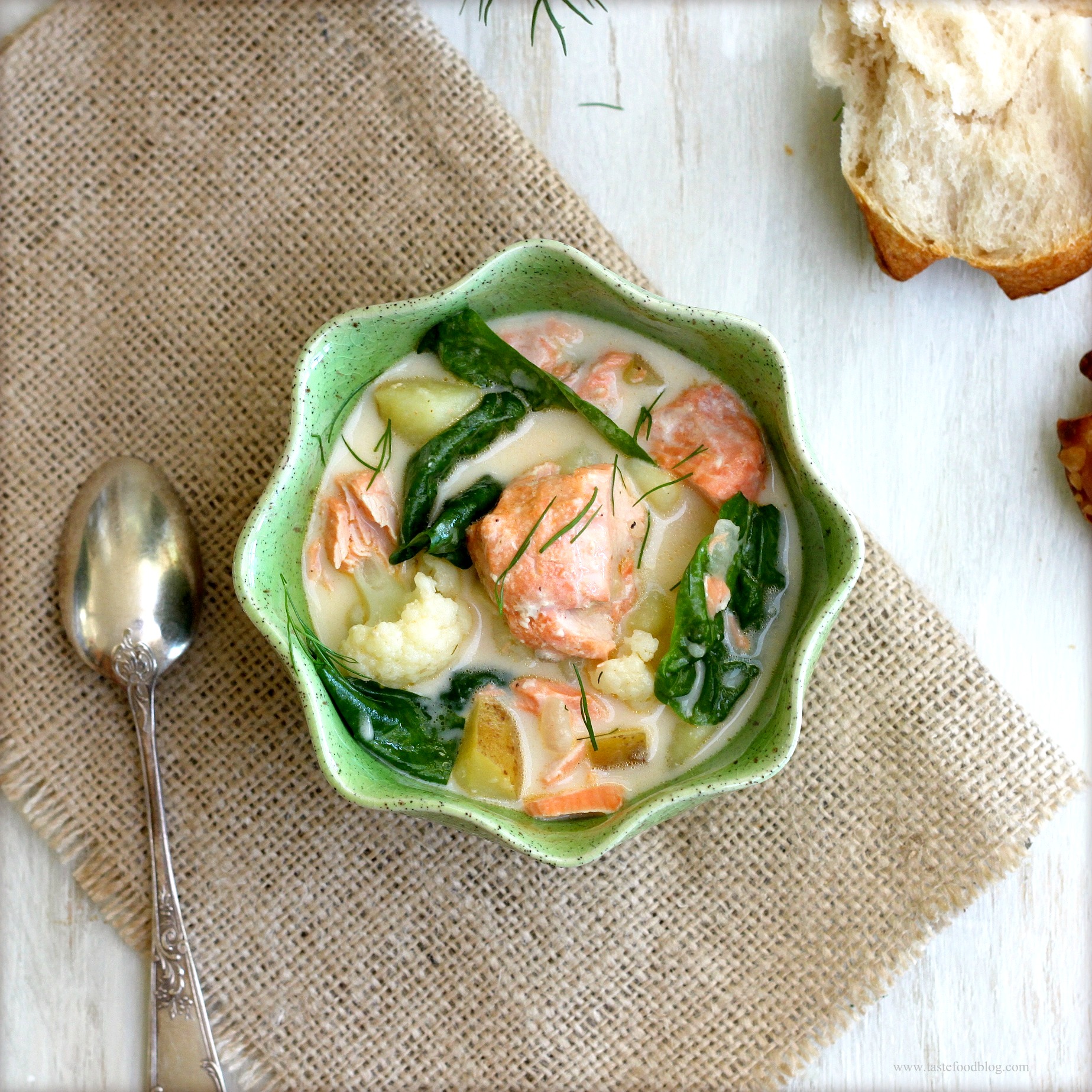
~ Salmon Chowder  with Cauliflower and Spinach ~

If I had to name one East Coast food I miss the most, it would be a good chowder. Chowder speaks New England to me. It speaks of summer with squeaky sandy beaches radiating heat and rainy days in a firelit pub, crowded fishing harbors with clanging boueys and circling seagulls, and the unmistakable smell of the ocean and seaweed suspended in fog. I moved away from New England 20 years ago, and still feel as though it’s in my bones – especially in the summer when I crave a clam or fish chowder. To satisfy this craving, I’ve learned to make my own. There is nothing more confirming that you are not-in-New-England-anymore, than when you order a “chowder”  in different corners of the world that you call your new home. The results can be dismaying. So, long ago I decided to just figure it out myself.

The fish has varied upon location. In Boston, of course, littleneck clams are the star ingredient. In France, I improvised with tiny vongoles, in England I dabbled with smoked cod, and in Denmark I relied on plentiful salmon. And now, in the Bay area, my favorite remains salmon.  The buttery richness of salmon permeates the broth, adding a pleasant and necessary dimension to the creamy soup. For extra smokiness, I might add a little smoked salmon, but simple salmon will do. I’ve been making chowder for so long now, it’s become a staple in our menu rotation and my kids have grown up eating it, wherever we’ve lived.

Salmon Chowder with Cauliflower and Spinach

Serves 4.

2 tablespoons olive oil or butter
1 medium onion, chopped
2 tablespoons all-purpose flour
4 cups water
2 medium yukon potatoes, cut into 3/4-inch dice
1 1/2 cups coarsely chopped cauliflower florets
2 teaspoons paprika
1 teaspoon Tabasco
1 cup whole milk
1/2 cup heavy cream
1 pound salmon filet, pin-bones removed, raw or pre-cooked
1 bunch fresh spinach leaves, stems removed
Salt
Freshly ground black pepper

Heat oil in a pot over medium heat. Add onion and sauté until translucent, 2 minutes. Add flour and cook, stirring, another 2 minutes. Add water and whisk to blend the flour. Add the potatoes and cauliflower. Simmer, partially covered, until potatoes are tender, about 15 minutes. Stir in paprika, Tabasco, milk and cream. Bring to a boil, and reduce heat. Add salmon and simmer until fish is cooked through if using raw salmon, or heated through if salmon is pre-cooked. Stir in spinach and briefly cook until bright green in color and wilted, 1 minute. Season to taste with salt and pepper. Ladle into soup bowls and serve immediately.

Harvest Chicken Tortilla Soup


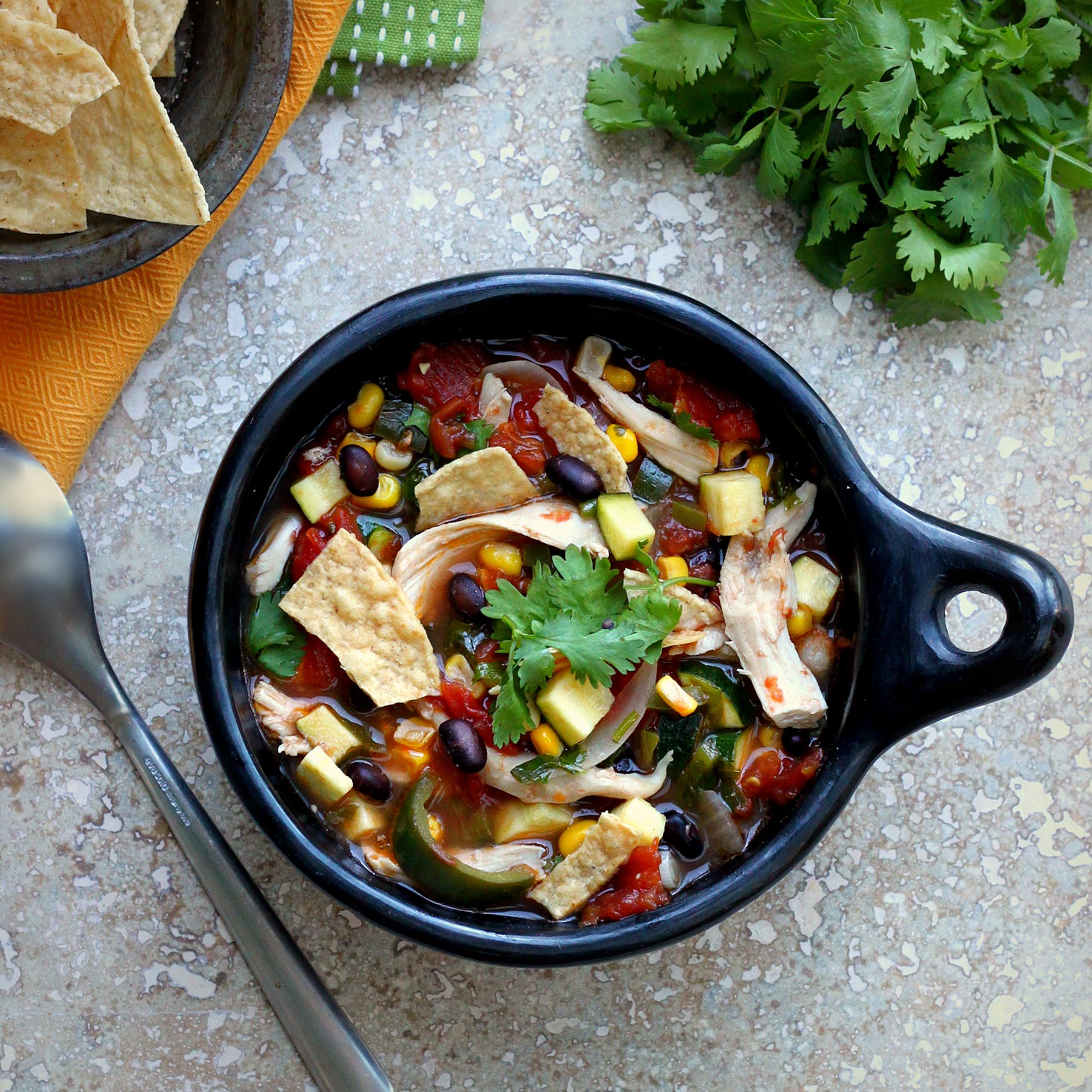
~ Harvest Chicken Tortilla Soup ~

My inspiration for making soup is often a convergence of too many veggies in the refrigerator with homemade stock and leftovers from a roast chicken. Such was the case after a weekend of house guests and dinners involving carnitas, black bean salsa, lots of corn and the aforementioned roast chicken. This recipe is not an authentic tortilla soup, as I managed to empty most of the contents of my veggie drawer into it. It’s chock-a-block full of corn, beans, zucchini and peppers, which led me to call it a Harvest Chicken Tortilla Soup.

Harvest Chicken Tortilla Soup
Serves 4 to 6

1 tablespoon olive oil
1 medium yellow onion, chopped
1 poblano pepper, stemmed and seeded, diced
1 sweet red pepper, stemmed and seeded, diced
1 jalapeno pepper, stemmed and seeded, finely chopped
3 garlic cloves, minced
1 small zucchini, cut into 1/2 inch dice
4 cups chicken stock
1 (28-ounce) can Italian plum tomatoes, with juice
1/4 cup tomato paste
2 teaspoons ground cumin
1 teaspoon ground coriander
1 teaspoon salt
1/2 teaspoon freshly ground black pepper
1/4 teaspoon ground cayenne
1/4 teaspoon cloves
3/4 pound shredded cooked chicken
1 cup fresh corn kernels
1 cup cooked black beans
1/4 cup cilantro leaves, chopped

Tortilla chips, broken in pieces

Heat the oil in a soup pot over medium heat. Add the onion and sauté until softened, about 2 minutes. Add the peppers and continue to sauté 2 minutes. Stir in the garlic and zucchini and sauté briefly, about 1 minute. Add the chicken stock, plum tomatoes with juice, tomato paste, cumin, coriander, salt, pepper, cayenne, and cloves. Bring to a boil, then reduce the heat and simmer partially covered, about 20 minutes. Stir in the corn, beans, and chicken and simmer until piping hot. Taste and adjust the seasoning if desired. Stir in the cilantro leaves and ladle into bowls. Serve garnished with the tortilla chips. 

Moroccan Lamb Stew and a recipe for Ras el Hanout

Still fixated on warming stews, I recently prepared this lamb stew which not only has heat but the heady aroma of exotic spice. Its secret ingredient is ras el hanout. Ras el hanout is a north African spice blend which may include upwards of 50 spices, including cinnamon, cardamom, clove, turmeric and cayenne. The name, translated, means head of the shop, meaning the best on offer. Like many spice blends, there is no one way to make it, and variations exist from home to home, merchant to merchant.

At first, I made a version of this stew without the addition of ras el hanout, and it was very good. When I added ras el hanout to the recipe, the stew was excellent. You can find ras el hanout in the spice section of your supermarket or specialty stores. If you cannot locate it, then I encourage you to try to make your own version – it’s easy to do.

Moroccan Lamb Stew with Chickpeas and Figs

The lamb is coated and marinated in a spice paste. As the meat browns in the pot, the spices will also brown and cook, adding a rich flavor and color to the stew.

Serves 6-8.

1/4 cup plus 2 tablespoons olive oil
2 teaspoons ground coriander
1 teaspoon ground cumin
1 teaspoon ground paprika
Salt
Freshly ground black pepper
2 1/2 – 3 pounds lamb shoulder or leg, cut in 2 inch chunks
1 large onion, chopped
1 large carrot, chopped
5 garlic cloves, chopped
1 tablespoon grated fresh ginger
1 – 14 ounce can Italian plum tomatoes with juice
2 cups chicken stock
12 dried Calimyrna or Turkish figs, halved
1 cinnamon stick
2 teaspoons ras el hanout (recipe below)
1 – 14 ounce can chickpeas, drained
1 tablespoon brown sugar

Harissa or red chili paste
Fresh cilantro sprigs

Combine 1/4 cup olive oil, coriander, cumin, paprika, 2 teaspoons salt and 1 teaspoon black pepper in a small bowl. Mix to form a paste. Place lamb in a large bowl. Rub paste all over lamb. Let sit at room temperature for 2 hours or refrigerate covered up to 24 hours.
Preheat oven to 325 F. Heat 2 tablespoons olive oil in a Dutch oven or oven proof pot with lid over medium-high heat. Add lamb in batches and brown on all sides, taking care not to overcrowd the pan. Transfer lamb to a plate or bowl.
Add onion and carrot to the same pot. Saute, stirring up the brown bits, for 2 minutes. Add garlic and ginger and continue to saute 1 minute. Add tomatoes, chicken stock, figs, cinnamon stick, ras el hanout, 1 teaspoon salt and 1 teaspoon black pepper.  Return lamb and any collected juices to the pot, submerging it in the stock. (Add additional chicken stock to cover, if necessary.) Bring to a boil, then reduce heat to a simmer and cover pot. Transfer to oven and bake until lamb is falling apart tender, about 2 hours.
Transfer pot to stove. Remove lamb and vegetables with a slotted spoon and place in a bowl. Bring stock to a boil over medium-high heat. Boil uncovered until sauce is reduced by about half and thickened, skimming fat.  Stir in chickpeas. Taste to check for seasoning. If necessary add a tablespoon of brown sugar to the stock. Return lamb and vegetables to pot. (May be prepared up to 24 hours in advance. Cover and refrigerate. To serve, skim any collected fat from surface. Rewarm over medium-low heat or in a 325 F. oven.)
Serve with prepared couscous. Pass bowls of harissa and fresh cilantro around the table as condiments.

Ras El Hanout
adapted from The Food of Morocco by Tess Mallos

Be sure to use very fresh spices, or grind the whole dried spices.

3 teaspoons ground cinnamon
3 teaspoons ground coriander
3 teaspoons ground nutmeg
2 teaspoons allspice
2 teaspoons ground cumin
2 teaspoons ground ginger
2 teaspoons ground turmeric
2 teaspoons ground black pepper
2 teaspoons ground cardamom
1/2 teaspoon ground cloves
1/2 teaspoon ground cayenne

Combine all the spices together. Store in a glass jar in a cool, dark place.
(Recipe may be halved.)

Black Bean, Sausage and Butternut Squash Chili

I can’t help myself. I am on a soup and stew bender, and this chili is my latest rendition. This chili is a hearty stew perfect for the winter weather. It’s chunky and sating, packed with black beans, brimming with peppers and butternut squash, and fortified with spicy sausage. If you can stand it, let it refrigerate overnight before serving, and it will taste even better. This will warm you in the cold weather, and is a festive snack option for Superbowl viewing.

Black Bean, Sausage and Butternut Squash Chili

Serves 6

1 tablespoon olive oil
3/4 pound chorizo or hot Italian sausage
1 large yellow onion, chopped
2 cups butternut squash cubes cut in 1/2″ square
4 garlic cloves, minced
1 poblano pepper, membranes and seeds removed, cut in 1/2″ pieces
2 jalapeno peppers, seeded, finely chopped
2 teaspoons ground cumin
2 teaspoons chili powder
1 teaspoon ground coriander
1 – 28 ounce can Italian plum tomatoes
1 1/2 cups chicken stock
2 tablespoons tomato paste
2 bay leaves
2 cups cooked black beans
2 teaspoons salt
1 teaspoon freshly ground black pepper
1/3 cup cilantro leaves, plus extra for garnish
2 scallions, white and green parts finely sliced
fresh avocado as garnish (optional)

Heat olive oil in a stock pot or deep skillet over medium heat. Add sausages and brown on all sides. Transfer to a plate lined with a paper towel. When cool enough to handle, cut in 1/4 inch slices.
Add onion to pot and saute until softened, 3-4 minutes. Add squash, garlic and peppers. Saute 3 minutes. Add dry spices and cook stirring, one minute. Add tomatoes, chicken stock, tomato paste and bay leaves. Simmer until squash is tender, about 20 minutes. Stir in black beans, sausage, salt and pepper. Simmer 10 more minutes. Taste to adjust seasoning.
Before serving add cilantro. Serve in bowls with with scallions, fresh avocado (if using) and additional cilantro.

Coconut Shrimp Curry

Coconut Shrimp Curry

It’s that time of year again: the holidays have passed, the reality of winter sets in, and I have a bout of  culinary wanderlust. Over-sated with the goodies of Christmas-past, it’s now time for comfort and heat. I crave stews and spice, at once hearty and exotic. The warmth of soup soothes the soul on a wintry night, while aromatic spices titillate the senses, hinting of sunny far flung destinations. Heady and satisfying, I can’t think of a better way to embrace the cold, grey January weather.

Coconut Shrimp Curry

This recipe may be easily prepared in 20 minutes – just enough time to cook the rice. Serves 4

1 tablespoon olive oil
1 medium onion, chopped
2 garlic cloves, minced
1 jalapeno pepper, stemmed and seeded, minced
1 tablespoon grated fresh ginger
1 tablespoon curry powder
1 – 28 ounce can Italian plum tomatoes
1 1/2 cups coconut milk
1 teaspoon salt
1 teaspoon freshly ground black pepper
1 pound shrimp, peeled and deveined
1/2 cup cilantro/coriander leaves, coarsely chopped

Heat oil in deep skillet or soup pot. Add onion and sauté until soft but not brown, 2-3 minutes. Add garlic, jalapeno, ginger and sauté until fragrant, 1 minute. Add curry powder and continue sautéing, 1 minute. Add tomatoes, coconut milk, salt and pepper; simmer 5 minutes. Stir in shrimp and cook until they turn pink and are just cooked through. Stir in cilantro. Taste to adjust seasoning. Serve immediately in bowls with basmati rice.