Quinoa Tabbouleh

Quinoa Tabbouleh

~ Quinoa Tabbouleh ~

I love a good tabbouleh. For the uninitiated, tabbouleh is a Middle Eastern salad chockablock full of grains tumbled together with fresh herbs and diced vegetables coated with olive oil and lemon juice. It’s infinitely satisfying – hearty and fresh at once. It’s also agreeably flexible, allowing for a variety of ingredients, including the choice of grain. Traditionally, tabbouleh is made with bulgur or couscous, but quinoa is a tasty and gluten-free alternative. I like to serve tabbouleh as a side to grilled meat and fish, or as a light vegetarian meal accompanied by pita bread and hummus.

Quinoa Tabbouleh

Quinoa is a South American grain, originating in the Andes. It is complete in protein, rich in phosphorous, magnesium and iron, with a nutty flavor. Quinoa is a healthy alternative to rice, couscous and bulgur – and it’s gluten-free. When cooking quinoa, be sure to cook it long enough for the germ or tiny tail to release from the grain. Serves 4.

1 cup quinoa (I used a combination of white and red quinoa)
1 1/4 cups water
2 tablespoons extra-virgin olive oil
1 teaspoons salt
1 teaspoons cumin
1 teaspoon freshly ground black pepper
3 scallions, white and green parts, thinly sliced
1 red or orange bell pepper, seeded, membranes removed, finely diced
1 jalapeno pepper, minced
1 red jalapeno or serrano chile pepper, minced
1 large garlic clove, minced
1/2 small red onion, finely chopped
Juice of one lemon
1/2 teaspoon Tabasco sauce, or to taste
1 bunch mint, chopped
1 bunch cilantro (or parsley), chopped

Combine quinoa and water in a medium saucepan. Bring to a boil. Reduce heat to a simmer and cook, covered, until liquid is absorbed and the germ, or tail, is released from the quinoa, about 15 minutes. Remove from heat and fluff with a fork. Stir in olive oil, cumin, salt and pepper. Cool to room temperature. Add remaining ingredients except for the mint and cilantro. Toss to combine. Taste to adjust seasoning. Cover and refrigerate at least one hour or up to 4 hours to allow flavors to develop. Before serving, stir in the mint and cilantro.

Shrimp and Feta Salad

~ Mixed Greens, Shrimp, Feta, Tomatoes, Cured Olives ~

Shrimp and feta cheese make a perfect couple. The sharp salty cheese is a perfect complement to the briny sweet shrimp. I like to combine these two friends in rice or orzo dishes. I also enjoy baking them in a gratin with tomatoes and olives, drizzled with ouzo – which was my original intention for dinner tonight. However, time got the best of me, and for a super quick fix I tossed the shrimp in this salad instead. What would have been a simple green salad graciously accommodated sautéed shrimp and chunks of feta, transforming itself into a light and fresh main course. As for the ouzo, it was hardly bypassed, but turned into an apertif to launch our dinner. A very acceptable compromise, indeed.

Shrimp and Feta Salad

I also added red corn kernels to the salad, because I had them – and they looked so pretty with the shrimp. Serves 4.

For the vinaigrette:
1 small garlic clove, minced
2 tablespoons freshly squeezed lemon juice
1 tablespoon red wine vinegar
1/2 teaspoon salt
1/2 teaspoon freshly ground black pepper
1/2 cup extra-virgin olive oil

Whisk all of the ingredients except the oil together in a small bowl. Slowly whisk in the olive oil in a steady stream to emulsify. Set aside.

For the salad:
1 tablespoon olive oil
1/2 teaspoon crushed red pepper flakes
16 medium shrimp, shelled with tails in tact, deveined
8 cups mixed greens, such as red oak, bibb, arugula
1 1/2 cups cherry tomatoes, halved if large
1/2 red pepper, seeded, membranes removed, thinly sliced
1/2 small red onion, thinly sliced
16 black olives (brine cured or kalamata)
6 ounces feta cheese, crumbled
Italian parsley leaves

Heat the oil and red pepper flakes in a skillet over medium-high heat. Add shrimp in one layer, without overcrowding the pan. Cook, turning once, until bright pink on both sides, about 1 minute each side. Transfer shrimp to a plate. Cool.
Combine the greens, tomatoes, red pepper and onion together in a large bowl. Drizzle 1/4 cup vinaigrette over the greens and toss to coat. Divide among plates. Scatter olives and feta over the salad. Arrange shrimp on top. Drizzle with additional vinaigrette to taste. Garnish with parsley. Serve with bread or pita.

The Cookiepedia and a recipe for Chocolate Crinkles

The Cookiepedia and a recipe for Chocolate Crinkles

~
I received a new cookbook today, and I am smitten. It’s called The Cookiepedia: Mixing, Baking and Reinventing the Classics, written by Stacy Adimando. I must confess that I was somewhat skeptical of what a classic cookie book could show me. I am a straightforward baker when it comes to cookies. I rely on a short list of traditional goodies, often made at the spur of the moment without much thought except to quell a craving for something sweet, buttery, chocolate and uncomplicated. I’ve been making my family’s favorite cookies for so long I rarely use a recipe, relying on memory and simple ratios. Why would I need another recipe for my tried and true favorites?

Well, maybe I don’t need another recipe, but perhaps I do need a kick in the butt. For so long I have been making cookies by rote, with a little tweaking here and there to shake things up. While I know what I am doing, I realize that I have forgotten why I am doing it. The Cookiepedia is the perfect reminder that instructs and informs in a bright and friendly manner – just like you were baking with a friend or sister who happens to know a lot about a cookie. It has all the usual suspects (nearly 50 in all, including mint thins, snickerdoodles, blondies, and meringues), doled out with a healthy measure of tips, facts, tweaks and variations. Just like a girlfriend who knows your dirty laundry, real life is taken into consideration with time constraints, picky eaters, potential mishaps, even weather glitches in its guidance. It takes your hand, keeps you company and strikes up a conversation, while you do what you love to do – bake cookies. Consider this a Betty Crocker Cooky Book for the modern family. In fact, I bet Betty would take a few notes.

Chocolate Crinkles

These plump chocolate morsels didn’t crinkle so much as poof for me. The results were a  fudgy, brownie, cake-like cookie which tasted fabulous. (Who can argue with a description like that?)  Makes about 30 – 1 inch cookies.

6 ounces bittersweet chocolate, finely chopped
1/4 cup plus 2 tablespoons unsalted butter, room temperature
1/2 cup granulated sugar
2 eggs
1 teaspoon vanilla extract
1 1/2 cups all-purpose flour
2 tablespoons cocoa powder
3/4 teaspoon baking powder
1/4 teaspoon salt
Powdered sugar for rolling

Combine chocolate and butter in the top of a double boiler over simmering water. (Be sure thhe bottom of the bowl does not touch the water.) Let the chocolate start to melt, then stir occasionally until it’s smooth. Remove from heat and set aside.
Beat the sugar and eggs in a bowl of an electric mixer until thick and smooth, 3 minutes. Add the vanilla extract and melted chocolate. Beat on medium-low speed until they’re combined.
Sift the flour, cocoa powder, baking powder and salt into a separate bowl. Add the mixture in 2 batches, beating each time until just combined. Cover bowl with plastic wrap and refrigerate until firm enough to scoop, about 2 hours.
Preheat oven to 325 F. (170 C.) Roll 1-inch balls of dough in a bowl of powdered sugar, coating them completely. Place them 1 1/2 inches apart on a cookie sheet lined with parchment paper. Bake 8-10 minutes until they just feel firm. (The cookies are best when slightly undercooked in the center.) Cool on sheets for 5 minutes, then transfer to a wire rack to finish cooling.
Note: I found that most of the powdered sugar melted while baking, so once the cookies were fully cooled, I rolled them again in the sugar.

Recipe reprinted with permission from The Cookiepedia. Written by Stacy Adimando and photographed by Tara Striano. Published by Quirk Books.
Full disclosure: I received a free copy of The Cookiepedia from Quirk Books. 

Skirt Steak with Chimichurri Sauce


~  Marinated Skirt Steak, Chimichurri Sauce and a Grill ~

I swore I was going to try to eat a little less meat. Well, I guess I shouldn’t swear. And I certainly couldn’t plan on a last minute summer trip to visit friends in the wild west earlier this month. As they say, never look a gift horse in the mouth, and when the gift is a generous invitation to visit not one family but two families at their respective homes in Wyoming and Idaho, you must seize the moment, thank the lucky stars for your friendships, and buy lots of wine as hostess gifts. And make that red wine, because, in the west, you will be eating copious quantities of delicious red meat.

~ Grand Teton National Park ~

I am convinced that the Rocky Mountains’ high altitude, dry air, and vast landscape will make anyone a carnivore. Bison, buffalo, elk and beef have a place on all menus. Prefer a whiter meat? There’s plenty of pork, chicken and turkey, too. (And no worries if you are not a meat eater. This is the land where the Snake River does it’s snaking – winding and looping its way along the border of Wyoming and Idaho, stocked full of bass and trout.). But this post is about the meat.  One day, we prepared this skirt steak recipe for our dinner. It was submerged in a marinade before we headed out for an afternoon of hiking and mountain biking. When we returned with a big appetite, sore muscles and a few bumps and bruises, all that we needed was a hot shower, a glass of some of that red wine, and to fire up the grill. Ingredients for a fresh, green chimichurri sauce were quickly blitzed in a food processor as a bright accompaniment to the meat. Then we sat and sipped our wine as we watched the sun set behind the mountains. This is living in the wild west.


~
Grilled Skirt Steak with Chimichurri Sauce

Serves 4-5

1/2 cup low sodium soy sauce
1/4 cup olive oil
3 garlic cloves, minced
1/4 cup freshly squeezed lime juice
2 tablespoons brown sugar
1 teaspoon cumin
1 teaspoon freshly ground black pepper
1/4 teaspoon cayenne
2 pounds skirt steak

Combine all of the marinade ingredients in a bowl and whisk together. Place skirt steak in a large container with lid or ziploc bag. Pour marinade over. Cover container or seal bag and refrigerate. Marinate for at least 3 hours or overnight. Remove from refrigerator 30 minutes before grilling to bring to room temperature.
Prepare grill for high heat (or preheat oven broiler). Remove meat from marinade; discard marinade. Grill over direct high heat, turning once, 3-4 minutes each side for medium-rare. (If using the oven, arrange meat on in one layer on a broiler pan. Broil, turning once, 4 minutes per side). Transfer meat to cutting board. Tent with foil and let rest 10 minutes. To serve, slice skirt steak against the grain on the diagonal in 3″ strips. Serve with Chimichurri Sauce.

Chimichurri Sauce:

Chimichurri is a traditional condiment from Argentina. It’s a great accompaniment to grilled meats and fish. There are many variations of chimichurri, but the common ingredient is parsley.  The flavors will develop when allowed to sit for an hour at room temperature.

1 cup Italian flat leaf parsley
1/2 cup cilantro
3 large garlic cloves
1/2 cup extra-virgin olive oil
2 tablespoons freshly squeezed lemon or lime juice
1 tablespoon red wine vinegar
1 teaspoon salt
1/2 teaspoon freshly ground black pepper
1/2 teaspoon red pepper flakes

Combine parsley, cilantro and garlic in a bowl of a food processor. Pulse to chop. Add remaining ingredients and pulse briefly to combine.

Rise and Shine: Yogurt, Plum and Granola Parfait

~ Spiced Plum Compote, Maple Granola, Greek Yogurt ~

If you need a reason to get up in the morning, then try this sumptuous breakfast parfait. A slick of stewed plums swirls through clouds of rich greek yogurt flecked with nuggets of granola. If it weren’t so early in the morning, you might be tempted to call this dessert.

Spiced Plum Compote
Not overly sweet, this rich plum stew is delicious with yogurt. If you are calling this dessert, do not hesitate to ladle some over a bowl of ice cream, too.
Makes about 1 1/2 cups.

1 pound plums, pitted, sliced
1/4 cup orange juice
2 tablespoons brown sugar
1/2 cinnamon stick
1/2 teaspoon ground cardamom
1/4 teaspoon salt

Combine all of the ingredients in a saucepan over medium heat. Bring to a boil, then reduce heat to a simmer. Cook until the plums soften and the compote thickens, about 20 minutes. Cool, cover and refrigerate until use. The flavors will develop with time. (May be refrigerated for up to 3 days.)

Granola
Feel free to fiddle with the ingredients. Substitute or add hazelnuts, pecans, flax, dried cranberries … you get the picture.
Makes about 2 cups.

1 cup old fashioned oats
1/2 cup shredded unsweetened coconut
1/2 cup chopped almonds
2 tablespoons wheat germ
1 tablespoon brown sugar
1 teaspoon ground cinnamon
1/2 teaspoon salt
2 tablespoons maple syrup
2 tablespoons vegetable oil
1/2 cup raisins

Preheat oven to 300°F (160°C). Combine the oats, coconut, almonds, wheat germ, sugar, cinnamon, and salt in a bowl. Whisk maple syrup and vegetable oil together in a small bowl. Drizzle over the oats and toss to combine. Spread in a baking pan lined with parchment paper. Bake until golden brown, about 30  minutes, stirring once or twice. Remove from oven and cool. Add the raisins. Store in an air-tight container for up to 1 week.

To assemble parfaits:
Alternate plum compote, granola and whole milk Greek-style yogurt in a bowl or glass. Serve for breakfast, lunch or whenever you please.

Olivada

~ Olivada ~

Got heat? Try this recipe for Olivada. When the weather is bleeping hot outside, and it’s too stifling to move, this salty, briny, more-ish concoction hits the spot.  Similar to a tapenade but much more simple, the star of this recipe is olives – 3 kinds, in fact.  I choose a variety of olives to balance their intensity and flavor and blitz them with toasted pinenuts and garlic. The flavors are sharp, inky, salty and addictive. While you may not have the energy to move in this heat, this recipe promises to get your taste buds dancing.

Olivada

Active Time: 10 minutes
Total Time: 10 minutes
Makes about 1 3/4 cups

1 cup oil-cured olives, about 5 ounces, pitted
1 cup pitted kalamata olives, about 4 ounces
1 cup pitted Castelvetrano olives, about 4 ounces
1/4 cup pine nuts, toasted golden
2 garlic cloves, chopped
2 tablespoons extra-virgin olive oil
1 teaspoon finely grated lemon zest
1/2 teaspoon freshly ground black pepper

  1. Combine all of the ingredients together in a bowl of a food processor. Pulse to finely chop, without making a paste.
  2. Transfer to a glass jar or container and refrigerate for at least one hour to let the flavors develop. Serve at room temperature. Store the olivada in the refrigerator for up to 5 days (the flavors will mellow over time).

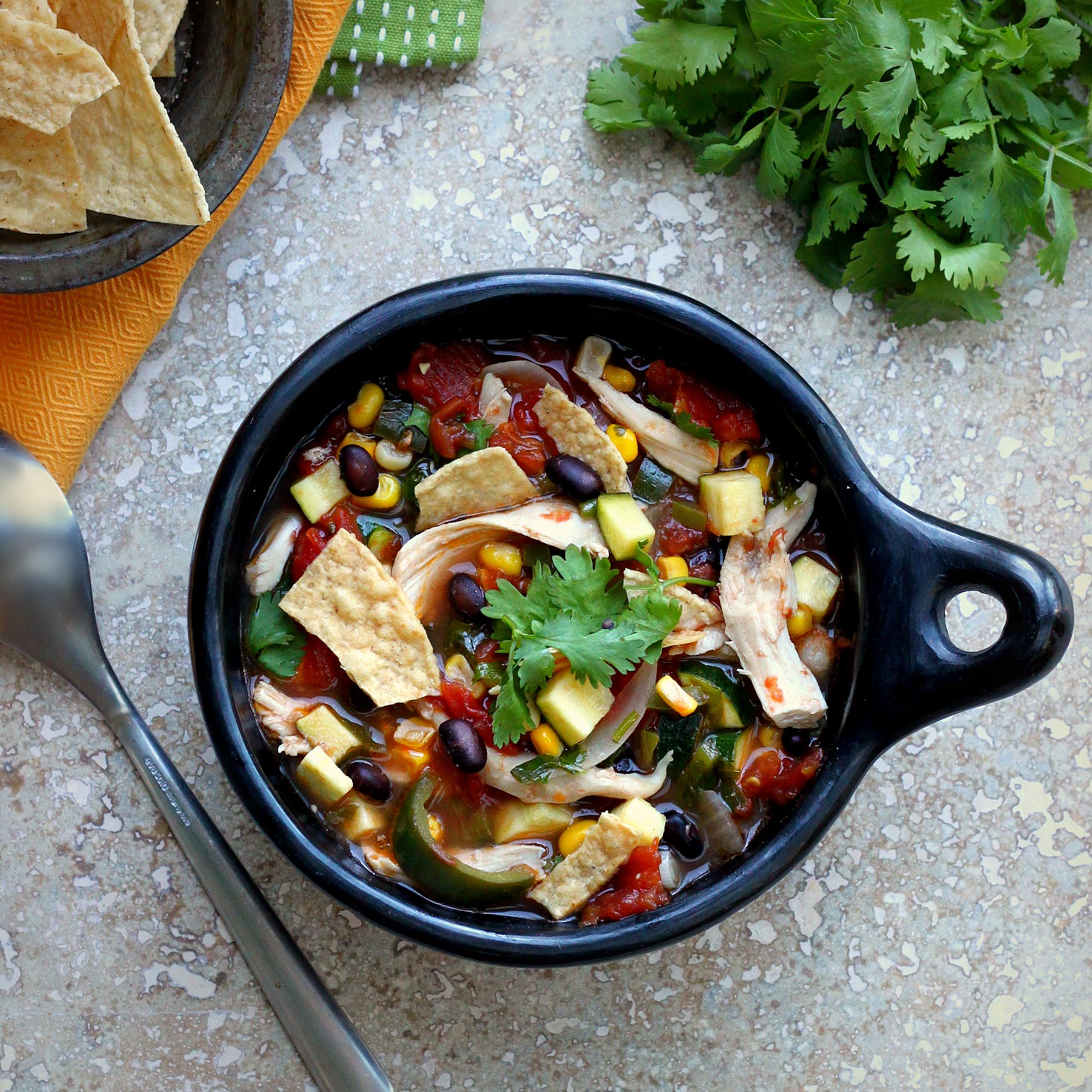
Harvest Chicken Tortilla Soup


~ Harvest Chicken Tortilla Soup ~

My inspiration for making soup is often a convergence of too many veggies in the refrigerator with homemade stock and leftovers from a roast chicken. Such was the case after a weekend of house guests and dinners involving carnitas, black bean salsa, lots of corn and the aforementioned roast chicken. This recipe is not an authentic tortilla soup, as I managed to empty most of the contents of my veggie drawer into it. It’s chock-a-block full of corn, beans, zucchini and peppers, which led me to call it a Harvest Chicken Tortilla Soup.

Harvest Chicken Tortilla Soup
Serves 4 to 6

1 tablespoon olive oil
1 medium yellow onion, chopped
1 poblano pepper, stemmed and seeded, diced
1 sweet red pepper, stemmed and seeded, diced
1 jalapeno pepper, stemmed and seeded, finely chopped
3 garlic cloves, minced
1 small zucchini, cut into 1/2 inch dice
4 cups chicken stock
1 (28-ounce) can Italian plum tomatoes, with juice
1/4 cup tomato paste
2 teaspoons ground cumin
1 teaspoon ground coriander
1 teaspoon salt
1/2 teaspoon freshly ground black pepper
1/4 teaspoon ground cayenne
1/4 teaspoon cloves
3/4 pound shredded cooked chicken
1 cup fresh corn kernels
1 cup cooked black beans
1/4 cup cilantro leaves, chopped

Tortilla chips, broken in pieces

Heat the oil in a soup pot over medium heat. Add the onion and sauté until softened, about 2 minutes. Add the peppers and continue to sauté 2 minutes. Stir in the garlic and zucchini and sauté briefly, about 1 minute. Add the chicken stock, plum tomatoes with juice, tomato paste, cumin, coriander, salt, pepper, cayenne, and cloves. Bring to a boil, then reduce the heat and simmer partially covered, about 20 minutes. Stir in the corn, beans, and chicken and simmer until piping hot. Taste and adjust the seasoning if desired. Stir in the cilantro leaves and ladle into bowls. Serve garnished with the tortilla chips. 

Homemade Bratwurst and a recipe for Beer Mustard

Homemade Bratwurst and a recipe for Beer Mustard


~ Homemade Bratwurst and a recipe for Beer Mustard ~

This month’s Charcutepalooza challenge had the whiff of Oktoberfest. Not only were we asked to make and stuff more sausages, we were asked to blend and emulsify the meat filling to a consistency found in a hot dog, bratwurst or weisswurst. I chose the bratwurst, partly for it’s happy collaboration with beer and partly for its relative ease compared to the hotdog. Baby steps, please!

As I embarked on this challenge over the July 4th weekend, I envisioned dirndls, sauerkraut and good strong mustard in my future. Somehow a trip to Europe has eluded us this summer, but, by golly, if we can’t make it back for a visit, then I will bring Europe home to my California kitchen. I spent the better part of a day on  this challenge, which provided much thoughtful time to reflect on how I would title this post. Here are a few of the contenders:

How to make a Danish family happy:
Yes, my husband is Danish and bratwurst is German. At the end of the day, they share a border, and, while their history may have been a tad testy, these 2 countries also share a culinary love for sausages. In Denmark, sausage is the fast food of choice, with carts distributed wherever people roam. While I may be hunting down a cup of coffee upon international arrival from the U.S., my husband will sidle up to the nearest airport sausage cart with both of our kids in tow, and order a flight of pølse with mustard, bacon and crispy onions. Apparently his gene pool is the strongest.

How to train a terrier:
Or, more specifically, the unflinching interest my dog is showing in me while making bratwurst is unsettling. I have never succeeded in getting our terrier to consistently obey me. Now I know how.

Why a power hose should be our next new kitchen gadget:
Sausage, sausage everywhere…on the counters, on the floor, in the sink, in the bowls, in the mixer, in the grinder, in my hair, under my nails, on my clothes and countless kitchen towels.  And did I mention that my dog is intently staring at me?

The difference between white pepper and black pepper: 
White pepper is traditionally used in dishes that should not show dark flecks of black pepper. But visuals are not the only difference. White pepper has a potent spiced flavor which, in large amounts, I don’t care for. Too bad I only figured that out after I added a heaping spoonful to the filling.

Familiarity breeds contempt:
I am 6 hours into the meat stuffing process, which includes handling, chopping, chilling, grinding, chilling, mixing, frying, tasting, chilling, stuffing, chilling, poaching, frying and tasting ground, blended meat. I think I’ll tuck these babies away in the freezer and take a time out.  Then I can rename this title to: Absence makes the heart grow fonder.

I could be watching Wimbledon and sipping Pimms right now:
But, no, I am blending and stuffing bratwurst in the company of my dog. Pass the sauerkraut and a beer, please.

Mustard makes everything taste better:
Especially when everything involves sausage. Truth be told, these were quite tasty, and my family gobbled them up (see title #1). I pan-fried the bratwurst and served them with thick slices of country-style bread, mustard and sauerkraut. As we ate the bratwurst, we watched Wimbledon highlights and enjoyed an ice cold Danish beer. The EU is alive and strong in Northern California.

Homemade Beer Mustard

Begin the mustard at least two days before serving. Makes 1/2 cup. (Recipe may be doubled.)

1/4 cup yellow mustard seeds
1/4 cup apple cider vinegar
1/4 cup dark beer
1 tablespoon dried mustard
1 tablespoon packed brown sugar
1 teaspoon kosher salt
1/4 teaspoon turmeric
1/8 teaspoon ground cloves

Combine mustard seeds, vinegar and beer together in a non-reactive bowl. Cover and refrigerate overnight.
Transfer mustard and liquid to a small saucepan. Bring to a boil; immediately remove from heat. Cool to room temperature. Transfer to a food processor or blender. Add remaining ingredients and purée. Transfer to a glass jar or container and refrigerate overnight. Mustard may be stored in refrigerator for up to two weeks.

What is Charcutepalooza?
An inspirational idea hatched by Cathy Barrow and Kim Foster and partnering with Food52 and Punk Domestics. It celebrates a Year in Meat, where participating foodies and bloggers will cure, smoke and salt their way through Michael Ruhlman’s bestselling cookbook Charcuterie.

Ratatouille Gratin

~ Ratatouille Gratin ~

It’s that time of year when the vegetables sneak up on you. A month ago, summer squash were elusive, appearing in the markets in small groups at a price. In the garden they were merely a hint of themselves peeking from their flowers. Purchases felt premature, tasting a little bitter, and costing too much for something you knew would soon be prolific.

~
Then, before you know it, a month has passed and squash are teeming everywhere. The garden is lobbing them to you like tennis balls, the market shelves are stacked with zucchini, crooknecks, and patty pans, ripe and ready for consumption. With the bounty, it’s time to get creative, because, ironically, it’s easy to tire of this abundance, and that is a shame.  So, yesterday I was determined to use my imagination to celebrate summer squash. Instead of a traditional ratatouille, I made a gratin. And before I made the gratin, I played a little bit with my food and made Ratatouille Stacks.

~ Ratatouille Stacks ~

The ingredients are identical, only the arrangement is different. Serve the gratins as side dishes or a light vegetarian meal. The stacks are fun appetizers.

Ratatouille Gratin with Goat Cheese and Basil

Try to choose squash and eggplant of a similar diameter. This recipe makes enough for an 8 to 9-inch square or round pan. Alternatively, you can arrange the vegetables in smaller individual gratin dishes.

Active Time: 30 minutes
Total Time: 45 minutes
Serves 4

1 narrow eggplant, about 10 ounces
1 medium zucchini, about 6 ounces
1 medium yellow squash, about 6 ounces
1 large red bell pepper, quartered and seeded
Olive oil
Salt and freshly ground black pepper
1/2 cup basil leaves, torn into 1/2-inch pieces, plus extra for garnish
3 ounces soft fresh goat cheese

1. Preheat the oven broiler.
2. Slice the eggplant, zucchini, and yellow squash crosswise about 1/3 inch thick. (If the eggplant is much wider than the squash, quarter lengthwise and slice 1/3 inch thick.)
3. Arrange the eggplant, zucchini, squash, and peppers in one layer on an oiled baking tray. Brush the tops with additional oil and lightly season with salt and black pepper. Broil on the top shelf of the oven until the vegetables are tender, but not mushy, and brown in spots, 8 to 10 minutes, turning once. Remove and cool to the touch.
4. Preheat the oven to 350°F. Lightly oil an 8 or 9-inch square or round gratin dish. Arrange the vegetables, alternating and slightly overlapping, in rows or a circular pattern. Tuck the basil between the vegetables in a random pattern so that it is evenly distributed. Scatter grape-size amounts of the goat cheese evenly over the vegetables.
5. Bake the gratin in the oven until the cheese is soft and light golden in spots, about 15 minutes. Serve warm or at room temperature, garnished with extra basil if desired.

Blackberry Spritzers and a Mojito

Blackberry Spritzers and a Mojito


~ Blackberry, Lime and Mint Spritzers~

It’s summertime and the living is easy. And what better way to enjoy the sultry season than with a refreshing, thirst-quenching drink? During this window of time when blackberries are prolific, I like to make a syrup which I add to drinks and use for desserts.  Depending on the mood or time of day, I’ll stir a few spoonfuls of the vibrant, tangy syrup into icy glasses of Prosecco or sparkling water. If we’re feeling extra festive, I’ll muddle a jigger-full with mint, lime and rum and call it a mojito. It’s all good. Just be sure to make extra to freeze as ice cubes to pop in drinks or thaw later in the year for a sip of summer.

Blackberry Syrup
Makes about 1 cup

12 ounces blackberries
1/2 cup freshly squeezed lime juice
1/2 cup granulated sugar

Combine all of the ingredients in a saucepan. Bring to a boil. Reduce heat and simmer until blackberries soften and release their juices, about 10 minutes. Cool. Purée in a food processor, then strain through a fine-meshed sieve. Discard the seeds.

Blackberry Spritzers
Makes 1 

Ice cubes
1 part blackberry syrup
2 parts sparkling water, white wine or Proscecco
Lime wedge and mint leaves for garnish

Fill a wine or cocktail glass with ice. Add syrup and sparkling water. Stir. Garnish with lime and mint.

Blackberry Mojito
Makes 1 

1/2 lime, cut in 4 wedges
2 sprigs mint, plus extra leaves for garnish
2 tablespoons (1 ounce) blackberry syrup
Crushed ice
1.5 ounces white rum
Sparkling water
1-2 blackberries for garnish

Muddle 2 lime wedges, mint sprigs and syrup together in a sturdy highball glass. Fill the glass with crushed ice. Pour rum over ice. Top with sparkling water to taste. Garnish with whole blackberries, remaining lime wedges and mint.