Salmon Wrapped in Kale Leaves with Harissa

Salmon Kale
~ Salmon Wrapped in Kale with Dill and Harissa ~

In this latest installment of Cooking for your Health, the focus is on promoting health and weight loss without sacrificing the pleasure of good food. Low-fat, nutrient-rich diets do not need to be boring or tasteless. This recipe for Salmon Wrapped in Kale Leaves with Dill and Harissa proves just that. It’s a healthy and delicious meal which will nourish your body and provide essential vitamins, nutrients and protein.  It’s also an easy recipe to prepare, yielding elegant, dinner-party results which will be enjoyed by all, whether they are on a diet or not.

Salmon is a top protein choice low in saturated fat, rich in vitamins B and D, minerals and Omega-3 amino acids. Teamed up with kale, a cruciferous superfood packed with cancer-fighting antioxidants, you have a dream meal that is a nutritional powerhouse and tastes great, too. The earthy kale leaves pair beautifully with rich and buttery salmon. A squirt of harissa and a few frizzy dill sprigs crown the wraps with vibrant heat, color and spice. Eating for your health doesn’t get any better than this.

Baked Salmon and Kale Wraps with Dill and Harissa

A spoonful of homemade harissa brightens this simple recipe. Sriracha may be substituted for the harissa. Serves 4 as a dinner course or 8 as a light lunch.

16 large kale leaves
Salt
Extra-virgin olive oil
1 large bunch dill sprigs with stems
1 lemon, halved
4 center-cut salmon fillets, each about 8 ounces and 1-inch thick, halved
Freshly ground black pepper

Harissa or Sriracha sauce

Remove and discard the tough stems and ribs from the kale, leaving the leaves intact. Bring a large pot of salted water to a boil. Add the kale leaves, and blanch to soften, about 15 seconds. Transfer the kale to an ice water bath to cool. Drain and dry thoroughly on a kitchen towel.
Preheat the oven to 350°F. Coat the bottom of a baking dish with 1 to 2 tablespoons of olive oil. Select 8 large dill sprigs without stems and set aside. Scatter the remaining dill sprigs with stems over the bottom of the pan.
Brush salmon filets with olive oil. Squeeze 1/2 lemon over the salmon and lightly season with salt and pepper. Place a piece of salmon on a kale leaf. Wrap the leaf around the salmon. If necessary, use another kale leaf to sufficiently cover.  Arrange the the kale-wrapped salmon over the dill in the baking pan, seam-side down. Repeat with the remaining salmon filets and kale leaves. Brush the kale leaves with olive oil and squeeze more lemon over the fish. Sprinkle with a little more salt and pepper. Bake in oven until salmon is cooked through, about 30 minutes. Serve warm, garnished with a spoonful of harissa.

Roasted Salmon with Green Olive and Almond Tapenade

I’ll be honest. The real star of this salmon dish is the green olive and almond tapenade. No offense to the salmon, which is sublime as always.  But, frankly, this tapenade is positively addictive, adding salty, briny brightness and crunch to the buttery salmon. So, if possible, make a double batch of the tapenade. Then you will have extra to smear on a slice of bread or swipe a carrot stick through. You might even find yourself eating it straight up from a bowl with a spoon. I’m speaking from experience.

Roasted Salmon with Green Olive Tapenade

Active Time: 10 minutes
Total Time: about 40 minutes
Serves 4; makes about 1 1/2 cups tapenade

Tapenade:
12 ounces pitted green olives
1/2 cup almonds, toasted
2 anchovies, drained
1 large garlic clove
2 teaspoons capers
1 teaspoon finely grated lemon zest
1/2 teaspoon freshly ground black pepper

Salmon:
4 (6 ounce) salmon fillets, pin bones removed
2 tablespoons extra-virgin olive oil, plus extra for garnish
Juice of 1/2 lemon, plus 4 lemon wedges for serving
Salt and freshly ground black pepper

1. Make the tapenade: Place all of the ingredients in the bowl of a food processor and process to a coarse paste, without letting it get mushy. (The tapenade may be stored in the refrigerator for up to three days.)
2. Heat the oven to 350°F. Arrange the salmon in one layer in a roasting pan, skin side down. Drizzle with 2 tablespoons oil and the lemon juice. Lightly season with salt and pepper. Bake in the oven until the salmon is just cooked through the center, about 25 minutes, depending on the thickness of the filets.
3. Transfer to serving plates and top each filet with about 2 tablespoons of the tapenade. Serve with a lemon wedge.

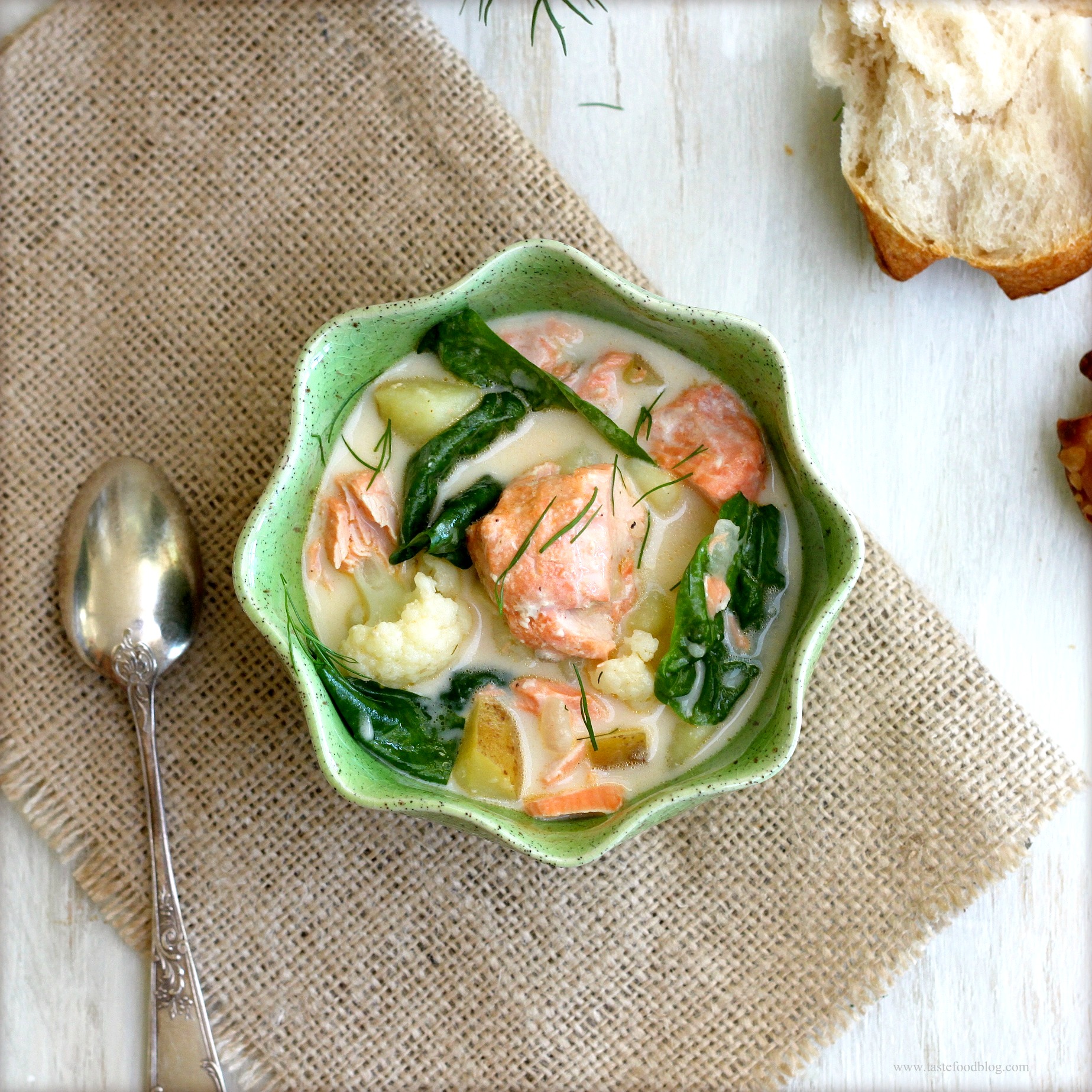
Salmon Chowder with Cauliflower and Spinach

~ Salmon Chowder  with Cauliflower and Spinach ~

If I had to name one East Coast food I miss the most, it would be a good chowder. Chowder speaks New England to me. It speaks of summer with squeaky sandy beaches radiating heat and rainy days in a firelit pub, crowded fishing harbors with clanging boueys and circling seagulls, and the unmistakable smell of the ocean and seaweed suspended in fog. I moved away from New England 20 years ago, and still feel as though it’s in my bones – especially in the summer when I crave a clam or fish chowder. To satisfy this craving, I’ve learned to make my own. There is nothing more confirming that you are not-in-New-England-anymore, than when you order a “chowder”  in different corners of the world that you call your new home. The results can be dismaying. So, long ago I decided to just figure it out myself.

The fish has varied upon location. In Boston, of course, littleneck clams are the star ingredient. In France, I improvised with tiny vongoles, in England I dabbled with smoked cod, and in Denmark I relied on plentiful salmon. And now, in the Bay area, my favorite remains salmon.  The buttery richness of salmon permeates the broth, adding a pleasant and necessary dimension to the creamy soup. For extra smokiness, I might add a little smoked salmon, but simple salmon will do. I’ve been making chowder for so long now, it’s become a staple in our menu rotation and my kids have grown up eating it, wherever we’ve lived.

Salmon Chowder with Cauliflower and Spinach

Serves 4.

2 tablespoons olive oil or butter
1 medium onion, chopped
2 tablespoons all-purpose flour
4 cups water
2 medium yukon potatoes, cut into 3/4-inch dice
1 1/2 cups coarsely chopped cauliflower florets
2 teaspoons paprika
1 teaspoon Tabasco
1 cup whole milk
1/2 cup heavy cream
1 pound salmon filet, pin-bones removed, raw or pre-cooked
1 bunch fresh spinach leaves, stems removed
Salt
Freshly ground black pepper

Heat oil in a pot over medium heat. Add onion and sauté until translucent, 2 minutes. Add flour and cook, stirring, another 2 minutes. Add water and whisk to blend the flour. Add the potatoes and cauliflower. Simmer, partially covered, until potatoes are tender, about 15 minutes. Stir in paprika, Tabasco, milk and cream. Bring to a boil, and reduce heat. Add salmon and simmer until fish is cooked through if using raw salmon, or heated through if salmon is pre-cooked. Stir in spinach and briefly cook until bright green in color and wilted, 1 minute. Season to taste with salt and pepper. Ladle into soup bowls and serve immediately.

Kale Wrapped Salmon and Scallop Mousseline with Tomato Coulis

Kale Wrapped Salmon and Scallop Mousseline with Tomato Coulis

~ Charcutepalooza Challenge #8: Mousseline (and Cinematic Musings) ~

Even Fred Flintstone needs a break from meat now and then. I’ve been eating lots of red meat lately, so I was pleased that this month’s Charcutepalooza challenge presented the option of making a fish or seafood mousseline. What a delightful break from all of the meatiness. If previous challenges invoked the Flintstones, then this challenge was akin to Bambi. As I embarked upon this challenge my vision shifted from a Quentin Tarantino blood and guts filled trailer to a dreamy, gauze-filtered Jane Austen period piece. I pictured a tea party, replete with platters of finger sandwiches and fluffy delicate mousseline, and birds and butterflies fluttering around the garden table.

Yet even Bambi has its dark side. In this case it was the absolute cyclone that hit my kitchen while making and photographing this recipe. (Come to think of it, this seems to happen with most Charcutepalooza challenges). If you saw The Sixth Sense, do you remember the scene where all of the kitchen cabinets are flung open in a moment of fearful suspense? That is the state of my kitchen at this moment – utter disarray, overturned pots and pans, rejected food props, gooey knives, soiled kitchen towels, flung open drawers and doors. I am sure the refrigerator is still ajar, and most likely a few 4-legged gremlins are lurking about. Mighty scary, indeed. So if you will excuse me, I have some cleaning and possible exorcising to do.  Then I will change my clothes and sit down for my Charcutepalooza-Jane Austen inspired tea party.

Kale Wrapped Salmon and Scallop Mousseline with Tomato Coulis

I love kale and frequently pair it with salmon, so I couldn’t resist creating a ribbon of kale to encase the mousseline. As a surprise, I nestled a scallop in the middle of the mousse, which is an optional step. (Note: If you add the scallop it will infuse the salmon mousseline with a lovely sweet and briny flavor).
To pull it all together on the plate I made a simple tomato coulis which adds a bright acidic note to the luxurious mousse. Makes 6.

6 large kale leaves, split in half lengthwise, stems and ribs removed
1 pound salmon filet, skin and pin bones removed, cut in 1 inch chunks
2 egg whites
2 tablespoons finely chopped shallots
2 tablespoons chopped fresh dill
1 teaspoon salt
1/2 teaspoon freshly ground black pepper
1 cup heavy cream
3 sea scallops, halved horizontally
Tomato Coulis (recipe below)

Bring a large pot of salted water to a rolling boil. Add kale leaves and blanch 15 seconds. Remove with tongs and shock under cold water. Lay flat on a kitchen towel and pat dry.
Combine salmon, egg whites, shallots, dill, salt and pepper in a bowl of a food processor. Process until completely smooth. Transfer salmon to a bowl and refrigerate 30 minutes.
Preheat oven to 300 F. (160 C.) Lightly oil (6) 3/4 cup ramekins. Carefully line the sides of the ramekins with the kale leaves. Remove salmon from refrigerator. Fold in 1/2 cup whipping cream. Return salmon to refrigerator. Whip remaining 1/2 cup cream in bowl of electric mixer until soft peaks form. Fold into salmon mixture. Spoon half of the salmon mixture into the ramekins. Nestle a scallop half in center of salmon. Top with remaining salmon.
Place ramekins in a baking pan. Fill the pan with enough boiling water to come halfway up sides of ramekins. Cover with buttered parchment. Bake in oven until puffed, firm and cooked through, about 35 minutes. (A toothpick will come clean when inserted in the middle).
Remove ramekins from oven and water bath. Invert onto a serving plate. Drizzle Tomato Coulis around the mousselines. Garnish with dill and lemon.

Tomato Coulis
Makes about 1 cup

1 pound ripe plum tomatoes
1 tablespoon extra-virgin olive oil
1/2 teaspoon salt, or to taste
1/2 teaspoon freshly ground black pepper

Make shallow incisions around the stem with a paring knife and scoop out the stem. With same knife, make a shallow X-incision in bottom of tomato. Bring a saucepan of water to a rolling boil.  Plunge tomato into water for 10 seconds.  Remove and submerge in a bowl of ice water. Remove the cooled tomato from the water.  Peel away skin. To seed the tomato, cut the tomato in half.  Use your fingers to scoop out seeds and remove the core.
Combine tomatoes and olive oil in bowl of food processor.  Process until smooth.  Add salt and pepper. Let stand at room temperature for one hour before serving.  (Can be made one day in advance.  Cover and refrigerate.)  Serve at room temperature.

Sriracha Baked Salmon and Cauliflower

Sriracha Baked Salmon and Cauliflower

Salmon, cauliflower, sriracha and a little parsley.

Salmon, cauliflower and sriracha come together beautifully in this easy
and healthy recipe. The heat of the sriracha is tamed by baking, while it amplifies the flavors of the salmon and cauliflower. It’s delicious as is, or serve it with a dollop of Roasted Pepper and Sriracha Sauce. Can you tell that I love sriracha?

Sriracha Salmon and Cauliflower
Serves 4

Salmon:
2 tablespoons olive oil
2 teaspoons sriracha
1 salmon filet, 1 1/2 – 2 pounds
1 small cauliflower, trimmed, broken into florets
Salt
Freshly ground black pepper
Fresh parsley for garnish

Roasted Pepper and Sriracha Sauce
1 large red bell pepper, roasted, skinned
1 tablespoon olive oil
2 teaspoons sriracha
1/4 teaspoon salt, or to taste

Preheat oven to 350 F. Whisk olive oil and sriracha together in a small bowl. Arrange salmon in a baking pan. Brush with the sriracha oil.
Slice cauliflower florets in 1/4 inch pieces and place in a bowl. Pour remaining oil over the cauliflower and toss to coat. Scatter the cauliflower around the salmon. Sprinkle salmon and cauliflower with salt and pepper.
Bake in oven until salmon is cooked through, about 30 minutes, depending on thickness of the fish. Garnish with parsley. Serve with Sriracha Roasted Pepper Sauce.

To make the sauce, combine all of the ingredients in a bowl of a food processor. Puree to form a smooth sauce.

Smoking Hot: Salmon and a Smoky Chowder Recipe

Smoking Hot: Salmon and a Smoky Chowder Recipe


Smoked Salmon Chowder

This month’s Charcutepalooza challenge is smoking hot, all right. The instructions? To hot smoke pork or salmon. Last month I wined and brined a pork rib roast, so I decided to go fish this month. After all, who can resist a slab of succulent, smoky salmon? In our home it’s considered it’s own food group.

I made several filets, knowing that if I didn’t look out, the smoked salmon would be gobbled straight up before I could embellish or create a recipe with it. My strategy was to centrally place a finished piece in the refrigerator for sacrificial consumption – a decoy, if you will – while I stashed another couple of hunks in the crisper for later creative use.

First things first, the hot and smoking method is simpler than you may think. Methods abound using smokers, weber grills, woks, stovetop smokers. I have a weber kettle grill, which I’ve often used for smoking, so chose that method. The salmon should be brined first, which may be done in as little as an hour or over several days. The longer brine time results in salmon gravlax, which produces saltier, more flavorful results – perfect if you wish to enjoy the fish au natural. I didn’t want to wait, opting for a 2 hour brine, followed by air-drying and smoking the fish, all of which I accomplished within an entire day.


Fast forward a day, and, as expected, the decoy fish was quickly consumed. It’s been raining lately, and I have had a hankering for a creamy, smoky chowder. I make chowders all the time, and always include a smoky component – either in the form of smoked fish or bacon. In this rendition, the only fish I used for the chowder was the hot smoked salmon. The results were wickedly good.

Smoked Salmon Chowder
Serves 4

1 tablespoon olive oil
1 tablespoon butter
1 medium onion, chopped
1 medium fennel bulb, fronds removed, cut in 1/2 inch pieces
Salt
2 tablespoons all-purpose flour
1/2 pound russet or yukon potatoes, peeled, cut in 1/2 inch pieces
4 cups water
2 pounds hot smoked salmon, broken in chunks (or 1 pound smoked salmon + 1 pound uncooked salmon filet)
1 cup heavy cream
1 teaspoon freshly ground black pepper

Heat oil and butter in a deep skillet or soup pot. Add onion, fennel and 1 teaspoon salt. Saute until the onion becomes translucent and the fennel softens, 3 minutes. Add flour and cook, stirring, 1 minute. Add potatoes and water. Bring to a boil, then reduce heat and cover. Simmer until potatoes are tender but not too soft, 15 minutes. Stir in salmon, cream and black pepper. Simmer 10 minutes.
Taste for salt – depending on how salty the salmon is, you may need more. Serve hot, garnished with fresh parsley or chopped fennel sprigs.

Holiday Entertaining: Salmon Gravlax

Holiday Entertaining: Salmon Gravlax

You say Christmas, and I say Gravlax. The holiday season is not complete without executing a recipe for home-cured salmon gravlax. Don’t be daunted. This is an entertainer’s dream. The salmon is easily prepared in advance and stowed in the refrigerator to cure for 2 days. All you need to do is unwrap and remove the spice cure, slice and serve. The results are the essence of Nordic cuisine: minimal and elegant. Fennel, dill and pepper fleck the meltingly soft salmon which tastes of the sea. How can you argue with that?

Gravlax (gravlaks in Danish and Norwegian or gravad lax in Swedish) literally means salmon in a grave or hole.  During the middle ages fisherman would salt salmon and let it ferment by burying it in a hole above high-tide line. Nowadays it’s not necessary to bury salmon in sand, but, rather in salt and sugar and banish it to the refrigerator.  The salmon will cure over several days, during which the salt and sugar will turn into liquid, creating a brine.

Salmon Gravlax

Serves a party.

Salt and sugar are necessary ingredients for curing, while fresh or dried herbs, peppercorns, citrus or spirits are frequently added to the brine for additional flavor. This recipe adds dill, fennel, peppercorns and akavit for flavor and spice. Choose a fish which is very fresh with a firm consistency. I use an Atlantic fish, such as Loch Duart Salmon.

One side of salmon, about 3 pounds (1.5 kg) with skin, pin bones removed
1 tablespoon white peppercorns
1 tablespoon black peppercorns
1 teaspoon fennel seeds
10 ounces (350 g) sea salt
1 cup granulated sugar
1/2 cup light brown sugar
1 cup fresh dill sprigs, chopped
1 cup fennel fronds, finely chopped
1/4 cup Akavit or vodka

Lightly toast the peppercorns and fennel seeds in a dry skillet over medium-high heat until aromatic, about 1 minute. Transfer to a mortar and finely ground to a powder. Transfer to a bowl and mix in the salt and sugars. Rub the fish all over with the spices mix.

Line a long baking pan or dish with plastic wrap.  Place half of the dill sprigs and half of the fennel fronds over the plastic wrap.  Arrange the salmon, skin-side down on the herbs.  Sprinkle the Akavit over the salmon. Top with the remaining dill and fennel. Cover with additional plastic wrap, sealing the fish.  Place a heavy pan or tray on the fish. Weigh down the pan with cans or bottles.  Refrigerate for 2 to 3 days.

To serve, remove the fish from refrigerator. Remove the plastic wrap. Pour off the collected juices and wipe off excess brine and dill.  Slice diagonally from one corner of the salmon towards the center of the fillet.

Fold a slice of gravlax on toasted brioche bread or white bread.  Squeeze a few drops of fresh lemon juice and smear a spoonful of Honey Dill Mustard on the fish.  Garnish with a dill sprig.

Honey Dill Mustard

1/4 cup honey mustard
3 tablespoons cider vinegar
1/2 cup grapeseed oil
1/4 cup chopped dill sprigs
1 teaspoon freshly ground black pepper
1/2 teaspoon salt

Whisk the mustard and vinegar together in a small bowl.  Slowly whisk in the oil to emulsify.  Stir in the dill, pepper and salt.

Grilled Soy and Mustard Marinated Fish Kebabs

Grilled Soy and Mustard Marinated Fish Kebabs

Fish Kebabs

This weekend we are hosting my husband’s extended family for a dinner. Whenever we visit Denmark we do this at least once. Each time, I try to make food that they may not ordinarily eat but I know they will enjoy. Danish cuisine is simple, reflecting Scandinavian understatement while influenced by long winters and finicky summer weather. As a result, menus are usually limited and repetitive, taking full advantage of fresh food on hand before its fleeting season disappears. When I cook in Denmark, I like to prepare equally simple and seasonal food, while introducing additional flavors, spices and combinations not usually served in Danish homes.

This recipe for Grilled Soy and Mustard Marinated Fish Kebabs is my go-to recipe for grilling fish. It’s easy to make and somewhat unusual with the addition of grated onion, which adds sweetness and texture to the marinade which is rounded out with salty soy sauce and sharp mustard. Simple, fresh and a little different – this will be perfect for the barbeque and entertaining this weekend.

Grilled Soy and Mustard Fish Kebabs

This marinade suits most firm-fleshed fish on the grill, such as swordfish, salmon, halibut, or tuna. Serves 6.

1 medium yellow onion, grated, with juices
1/4 cup extra-virgin olive oil
1/4 cup soy sauce
1/4 cup freshly squeezed lemon juice
2 tablespoons Dijon mustard
1 teaspoon freshly ground black pepper
2 1/2 pounds thick fleshed fish (salmon, halibut, swordfish, tuna) cut in 1 1/2″ chunks
Optional: 1 large red onion, 1 red and 1 yellow pepper, cut in 1 inch pieces
Italian flat leaf parsley for garnish

Pre-soak 12 bamboo skewers in hot water 30 minutes before using.
Combine onion, olive oil, soy sauce, lemon juice, mustard and pepper in a large bowl; whisk together. Add fish to marinade and toss gently to coat.  Refrigerate at least one hour and up to 3 hours.
Prepare grill for medium-hot heat or broiler. Thread 4 pieces of fish on each skewer, alternating with pepper and onion pieces if using. Discard marinade. Grill over direct heat, turning, until fish is charred and just cooked through, about 8 minutes. Arrange on a platter and garnish with parsley sprigs.

Baked Salmon and Kale Wraps with Dill and Harissa

Salmon Kale

Beautiful green Tuscan kale and fresh atlantic salmon from the market along with deliriously happy dill growing in the garden were the inspiration for this recipe. The salmon fillets are wrapped in kale leaves with a little lemon and dill and then baked on a bed of more dill. To top off the salmon, a spoonful of homemade Harissa is added as a garnish. This dish is simple, fresh, delicious and healthy.

Salmon Kale Baked

Baked Salmon and Kale Wraps with Dill and Harissa
Other herbs or a combination may be substituted for dill; try parsley, mint or coriander. Fennel is another good substitute. Makes 8.

8 large kale leaves
Salt
Extra-virgin olive oil
1 large bunch dill sprigs with stems
1 lemon
4 thick salmon fillets, halved
Freshly ground black pepper
Harissa (or sriracha)

Bring a large pot of salted water to a boil. Add kale leaves, and blanch briefly, 15 seconds. Transfer to ice water to cool. Drain and dry thoroughly on a kitchen towel.
Preheat oven to 350 F. Coat bottom of a baking pan with olive oil. Select 8 large dill sprigs without stems and set aside. Scatter remaining dill sprigs with stems over bottom of pan.
Cut lemon in half. Set one half aside. Remove the skin, pith and pits from the remaining half and cut in 4 slices. Cut each slice in half so there are 8 segments.
Brush salmon filets with olive oil. Sprinkle all over with salt and pepper. Top each filet half with a dill sprig and lemon slice. Place salmon on kale leaf. Wrap leave around salmon and place on dill in baking pan, seam side down. Repeat with remaining salmon and kale. Brush Salmon and Kale wraps with olive oil. Squeeze the reserved lemon half over each wrap. Sprinkle with a little salt and pepper.
Bake in preheated 350 oven until salmon is cooked through, about 30 minutes.
Garnish salmon with a spoonful of harissa. Serve with rice and additional sauce on the side.

Baked Salmon with Baby Fennel, Mustard and Tarragon

Salmon Fennel tf

I love it when I can go to the farmer’s market on a Sunday and come home with …. fish. And not just any fish, but fresh-off-the-boat fish that tastes of the sea. Call me provincial European or mentally land-locked, but fresh fish on a Sunday?  At a Farmer’s Market?

Mind you, this is no ordinary farmer’s market. The San Rafael Farmer’s Market is one of the largest open air markets in California.  Each Sunday, farmers, purveyors and artisans gather in the shadow of the Marin County Civic Center, a stunning Frank Lloyd Wright construction, and sell their goods. Open from 8 a.m. to 1 p.m. you can easily pack a full day into several hours. Arrive early before the crowds, and enjoy a cappuccino or latte with an authentic Belgian Waffle or flaky French croissant. Then wander through the stalls and purchase seasonal vegetables and fruit, local cheese, meat and, of course, fish. It’s easy to overload on purchases and nibbles, freely offered throughout the market. Feeling tired? Take a break and listen to live music and enjoy a mid-morning snack of dim sum or artisanal pastry. Kids antsy? Give them a pony ride or a jump on a bouncy castle. If that’s worked up another appetite, finish with pizza or grilled organic sausages, falafel or panini. Then head home with your goodies, and plan your dinner.

Dinner on Sunday is always fun. Inspired by our purchases, a meal is created, usually simple, always seasonal and fresh. Which brings me to the fish. In the past 2 weeks we have twice been served gorgeous salmon filets by friends who have also been to the farmer’s market. Each time it has been so delicious and fresh that this Sunday we craved more and made a beeline for the fish stall. The salmon we purchased was so pristine, I didn’t even want to grill it and introduce any charred flavor to its buttery flesh. When we came home, I decided to marinate and bake it with fresh tarragon and baby fennel, which I also bought at the market. So, yes, we can get fresh fish at the Sunday Farmer’s Market. And, yes, we are very lucky.


Baked Salmon with Fennel, Mustard and Tarragon

The licorice flavors of the tarragon and fennel combine beautifully with fresh salmon in this easy and elegant spring dish. This recipe can easily be expanded to feed a crowd. Serves 4-5.

1 garlic clove
1/4 cup tarragon leaves
1 teaspoon sea salt
3 tablespoons olive oil
2 tablespoons lemon juice
2 teaspoons Dijon mustard
1 teaspoon finely grated lemon zest

2 pounds salmon filets, pin bones removed
2 to 3 baby fennel, bulbs thinly sliced

Smash the garlic clove with the salt in a mortar with a pestle. Add the tarragon and bruise with the pestle. Whisk in the olive oil, lemon juice, mustard, zest and a small bunch of the reserved fennel fronds. Arrange salmon filets in one layer in a baking dish. Place fennel halves around the salmon. Pour the tarragon oil over the fish and fennel and spread to cover evenly. Cover and refrigerate 1-2 hours. Remove from refrigerator 20 minutes before baking. Bake in a preheated 350 F. (180 C.) oven until fish is just cooked through, about 25 minutes. Serve immediately.