Salmon Wrapped in Kale Leaves with Harissa

Salmon Kale
~ Salmon Wrapped in Kale with Dill and Harissa ~

In this latest installment of Cooking for your Health, the focus is on promoting health and weight loss without sacrificing the pleasure of good food. Low-fat, nutrient-rich diets do not need to be boring or tasteless. This recipe for Salmon Wrapped in Kale Leaves with Dill and Harissa proves just that. It’s a healthy and delicious meal which will nourish your body and provide essential vitamins, nutrients and protein.  It’s also an easy recipe to prepare, yielding elegant, dinner-party results which will be enjoyed by all, whether they are on a diet or not.

Salmon is a top protein choice low in saturated fat, rich in vitamins B and D, minerals and Omega-3 amino acids. Teamed up with kale, a cruciferous superfood packed with cancer-fighting antioxidants, you have a dream meal that is a nutritional powerhouse and tastes great, too. The earthy kale leaves pair beautifully with rich and buttery salmon. A squirt of harissa and a few frizzy dill sprigs crown the wraps with vibrant heat, color and spice. Eating for your health doesn’t get any better than this.

Baked Salmon and Kale Wraps with Dill and Harissa

A spoonful of homemade harissa brightens this simple recipe. Sriracha may be substituted for the harissa. Serves 4 as a dinner course or 8 as a light lunch.

16 large kale leaves
Salt
Extra-virgin olive oil
1 large bunch dill sprigs with stems
1 lemon, halved
4 center-cut salmon fillets, each about 8 ounces and 1-inch thick, halved
Freshly ground black pepper

Harissa or Sriracha sauce

Remove and discard the tough stems and ribs from the kale, leaving the leaves intact. Bring a large pot of salted water to a boil. Add the kale leaves, and blanch to soften, about 15 seconds. Transfer the kale to an ice water bath to cool. Drain and dry thoroughly on a kitchen towel.
Preheat the oven to 350°F. Coat the bottom of a baking dish with 1 to 2 tablespoons of olive oil. Select 8 large dill sprigs without stems and set aside. Scatter the remaining dill sprigs with stems over the bottom of the pan.
Brush salmon filets with olive oil. Squeeze 1/2 lemon over the salmon and lightly season with salt and pepper. Place a piece of salmon on a kale leaf. Wrap the leaf around the salmon. If necessary, use another kale leaf to sufficiently cover.  Arrange the the kale-wrapped salmon over the dill in the baking pan, seam-side down. Repeat with the remaining salmon filets and kale leaves. Brush the kale leaves with olive oil and squeeze more lemon over the fish. Sprinkle with a little more salt and pepper. Bake in oven until salmon is cooked through, about 30 minutes. Serve warm, garnished with a spoonful of harissa.

Low Sodium Love: Coconut Shrimp Curry

Coconut Shrimp Curry – who needs salt?

A year ago, I participated in a food blog event hosted by Jessica, the author of the wonderful blog Sodium Girl. The challenge was to make a favorite recipe and reduce the salt as much as possible. As a salt lover, I confess that this terrified me. What if the lack of sodium  led to bland and dull results? How would I put a positive spin on unsaltiness? Well, as you can see from that post, I couldn’t have been more surprised and pleased when my doctored chicken wing recipe resulted in finger-licking deliciousness.

So, this year when Jessica asked if I would participate in a repeat of the challenge, I had less trepidation. I decided to adapt one of the most viewed recipes on TasteFood – Coconut Shrimp Curry – and exorcise it of any added sodium without compromising on flavor. After all, if it’s such a popular recipe, why not make it available to anyone who is watching their sodium intake? In this contest, natural salt found in whole ingredients is acceptable, but no added or processed salt is allowed. Shrimp have a natural saltiness which would be a boost to the flavor. And, as I learned last year, a great way to compensate for reduced sodium is to ramp up the aromatics and spices, which I did with generous amounts of garlic, fresh ginger, chiles and curry powder – all the good stuff, if you ask me. A spoonful of sugar rounded out the stew and a squeeze of fresh lime juice added sharpness and acidity.

And gosh darn it, it happened again. Once again the results thoroughly impressed me. The curry was rich, bright and brimming with flavor. The extra squeeze of lime provided an extra kick and, dare I say, tricked me into thinking there was plenty of salt in the curry. I even cheated and added a pinch of salt to a small bowlful for comparison. And, guess what? I found the results a little too, well, salty. Go figure.

Thank you, Jessica, for inviting me to participate again this year. For more inspiring low sodium recipes that are heart healthy and delicious with a big spoonful of valuable information,  you can read Jessica’s blog here and find all of the recipe links for this Low Sodium Rally here.

Coconut Shrimp Curry

Feel free to add additional vegetables, such as carrots or cauliflower, to the stew. Depending on the heat of the chiles, adjust amounts to your taste. Serves 4 to 6.

1 tablespoon olive oil
1 large yellow onion, chopped, about 1 1/2 cups
2 garlic cloves, minced
1 green jalapeño pepper, stemmed and seeded, minced
1 red jalapeño or serrano pepper, stemmed and seeded, minced
2 tablespoons grated fresh ginger
1 medium zucchini, quartered lengthwise, each quarter sliced in 1/2-inch pieces
1 1/2 tablespoons curry powder
1 – 26 ounce package Pomi chopped tomatoes
1 1/2 cups coconut milk
1 1/2 tablespoons granulated sugar
1 pound frozen large shrimp, defrosted, peeled and deveined
1/2 cup cilantro/coriander leaves, coarsely chopped
1 lime, cut in wedges

Heat oil in deep skillet or soup pot. Add onion and sauté until soft but not brown, about 3 minutes. Add garlic, jalapeños and ginger. Sauté until fragrant, 1 minute. Add zucchini and curry powder; sauté 1 minute. Stir in tomatoes, coconut milk and sugar. Simmer 10 minutes. Add shrimp and cook until they turn pink and are just cooked through. Add cilantro. Taste for seasoning. Serve immediately in bowls with basmati rice and lime wedges for squeezing over the curry.

Roasted Salmon with Green Olive and Almond Tapenade

I’ll be honest. The real star of this salmon dish is the green olive and almond tapenade. No offense to the salmon, which is sublime as always.  But, frankly, this tapenade is positively addictive, adding salty, briny brightness and crunch to the buttery salmon. So, if possible, make a double batch of the tapenade. Then you will have extra to smear on a slice of bread or swipe a carrot stick through. You might even find yourself eating it straight up from a bowl with a spoon. I’m speaking from experience.

Roasted Salmon with Green Olive Tapenade

Active Time: 10 minutes
Total Time: about 40 minutes
Serves 4; makes about 1 1/2 cups tapenade

Tapenade:
12 ounces pitted green olives
1/2 cup almonds, toasted
2 anchovies, drained
1 large garlic clove
2 teaspoons capers
1 teaspoon finely grated lemon zest
1/2 teaspoon freshly ground black pepper

Salmon:
4 (6 ounce) salmon fillets, pin bones removed
2 tablespoons extra-virgin olive oil, plus extra for garnish
Juice of 1/2 lemon, plus 4 lemon wedges for serving
Salt and freshly ground black pepper

1. Make the tapenade: Place all of the ingredients in the bowl of a food processor and process to a coarse paste, without letting it get mushy. (The tapenade may be stored in the refrigerator for up to three days.)
2. Heat the oven to 350°F. Arrange the salmon in one layer in a roasting pan, skin side down. Drizzle with 2 tablespoons oil and the lemon juice. Lightly season with salt and pepper. Bake in the oven until the salmon is just cooked through the center, about 25 minutes, depending on the thickness of the filets.
3. Transfer to serving plates and top each filet with about 2 tablespoons of the tapenade. Serve with a lemon wedge.

Cioppino with a Twist

I would like to call this recipe a cioppino. Cioppino is a fish stew with a San Francisco pedigree reaching back to the 1800’s. The name is derived from the Italian term ciuppin, which means “to chop.”  It’s believed that the Italian and Portuguese fisherman would chop up leftovers from their daily catch to make this robust and flavorful soup. The reason why I hesitate slightly about labeling it a cioppino is that I have taken a liberty with this recipe that is neither Italian nor Portuguese at all. It’s French.

Wine is a key ingredient in the cioppino stock, and recipes gamely call for white or red, depending on the source. I usually use red wine, however in this recipe I tried white. The result was a lighter, more acidic broth that I felt needed a little oomph. Additional salt and extra pepper helped, as did a spoonful of sugar (which often works wonders in tomato-based stocks and sauces.) Still, something was missing. I looked no further than the fennel I had sautéed with the onion as a base for the stock, and I reached for the Pernod, an anise liqueur, in the back of the pantry. It was a perfect shot. The Pernod coaxed out the licorice flavor of the fennel, adding depth and roundness with subtle anise notes. So here you have it: Cioppino with a French twist.

Cioppino
Serves 6

2 tablespoons olive oil
1 large onion, finely chopped
1 fennel bulb, thinly sliced
3 garlic cloves, chopped
1 teaspoon dried oregano
1/2 teaspoon crushed red pepper flakes
1/4 cup tomato paste
1 (28-ounce) can Italian plum tomatoes, with juices
2 cups dry white wine
1 1/2 cups chicken stock
1/4 cup Ouzo or Pernod
1 bay leaf
1 teaspoon salt
1 teaspoon freshly ground black pepper
1 tablespoon granulated sugar (optional)
18 littleneck clams
18 medium shrimp, peeled, deveined
6 large sea scallops, about 3/4 pound
2 cooked crabs, legs cracked, flesh removed from bodies
1 pound firm fleshed white fish such as halibut or sea bass, cut in 2 inch chunks

Fresh Italian parsley

Heat the oil in a large soup pot over medium heat. Add the onion and fennel and cook, stirring, until vegetables are soft and onion is translucent without coloring, about 5 minutes. Add the garlic, oregano, and red pepper flakes and stir until fragrant. Stir in tomato paste to combine, and then add the tomatoes, wine, chicken stock, Pernod, bay leaf, salt, and pepper. Bring to a boil. Reduce heat and simmer, partially covered, 30 minutes. Taste for seasoning. If necessary add a spoonful of sugar. Add clams. Cook, stirring, until they open. (Discard any clams that do not open.) Add shrimp, sea scallops and white fish. Cook, partially covered, stirring occasionally, until all of the fish is cooked through. Add crab legs and meat. Simmer to heat through. Serve hot in bowls. Garnish with fresh parsley.

Shrimp and Feta Salad

~ Mixed Greens, Shrimp, Feta, Tomatoes, Cured Olives ~

Shrimp and feta cheese make a perfect couple. The sharp salty cheese is a perfect complement to the briny sweet shrimp. I like to combine these two friends in rice or orzo dishes. I also enjoy baking them in a gratin with tomatoes and olives, drizzled with ouzo – which was my original intention for dinner tonight. However, time got the best of me, and for a super quick fix I tossed the shrimp in this salad instead. What would have been a simple green salad graciously accommodated sautéed shrimp and chunks of feta, transforming itself into a light and fresh main course. As for the ouzo, it was hardly bypassed, but turned into an apertif to launch our dinner. A very acceptable compromise, indeed.

Shrimp and Feta Salad

I also added red corn kernels to the salad, because I had them – and they looked so pretty with the shrimp. Serves 4.

For the vinaigrette:
1 small garlic clove, minced
2 tablespoons freshly squeezed lemon juice
1 tablespoon red wine vinegar
1/2 teaspoon salt
1/2 teaspoon freshly ground black pepper
1/2 cup extra-virgin olive oil

Whisk all of the ingredients except the oil together in a small bowl. Slowly whisk in the olive oil in a steady stream to emulsify. Set aside.

For the salad:
1 tablespoon olive oil
1/2 teaspoon crushed red pepper flakes
16 medium shrimp, shelled with tails in tact, deveined
8 cups mixed greens, such as red oak, bibb, arugula
1 1/2 cups cherry tomatoes, halved if large
1/2 red pepper, seeded, membranes removed, thinly sliced
1/2 small red onion, thinly sliced
16 black olives (brine cured or kalamata)
6 ounces feta cheese, crumbled
Italian parsley leaves

Heat the oil and red pepper flakes in a skillet over medium-high heat. Add shrimp in one layer, without overcrowding the pan. Cook, turning once, until bright pink on both sides, about 1 minute each side. Transfer shrimp to a plate. Cool.
Combine the greens, tomatoes, red pepper and onion together in a large bowl. Drizzle 1/4 cup vinaigrette over the greens and toss to coat. Divide among plates. Scatter olives and feta over the salad. Arrange shrimp on top. Drizzle with additional vinaigrette to taste. Garnish with parsley. Serve with bread or pita.

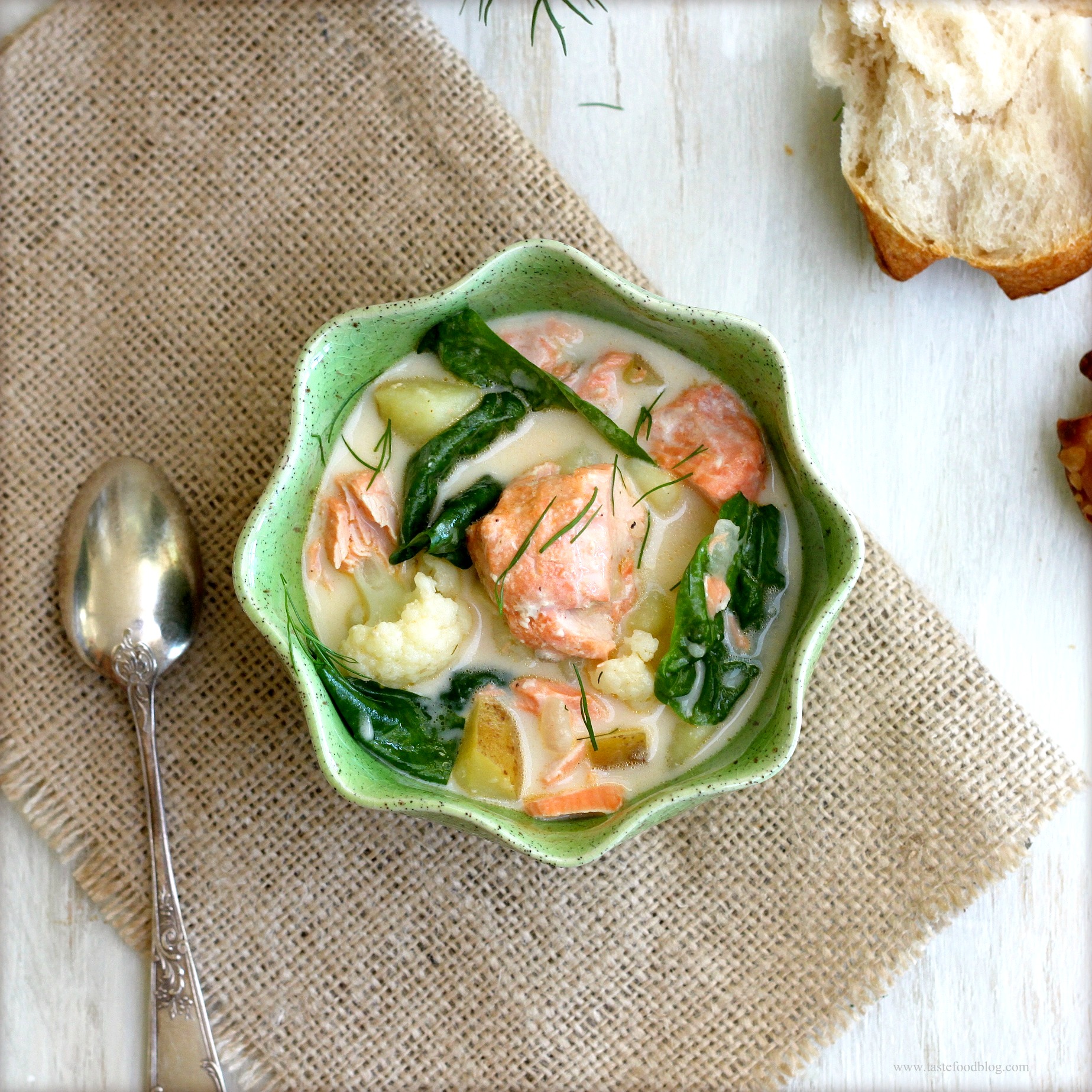
Salmon Chowder with Cauliflower and Spinach

~ Salmon Chowder  with Cauliflower and Spinach ~

If I had to name one East Coast food I miss the most, it would be a good chowder. Chowder speaks New England to me. It speaks of summer with squeaky sandy beaches radiating heat and rainy days in a firelit pub, crowded fishing harbors with clanging boueys and circling seagulls, and the unmistakable smell of the ocean and seaweed suspended in fog. I moved away from New England 20 years ago, and still feel as though it’s in my bones – especially in the summer when I crave a clam or fish chowder. To satisfy this craving, I’ve learned to make my own. There is nothing more confirming that you are not-in-New-England-anymore, than when you order a “chowder”  in different corners of the world that you call your new home. The results can be dismaying. So, long ago I decided to just figure it out myself.

The fish has varied upon location. In Boston, of course, littleneck clams are the star ingredient. In France, I improvised with tiny vongoles, in England I dabbled with smoked cod, and in Denmark I relied on plentiful salmon. And now, in the Bay area, my favorite remains salmon.  The buttery richness of salmon permeates the broth, adding a pleasant and necessary dimension to the creamy soup. For extra smokiness, I might add a little smoked salmon, but simple salmon will do. I’ve been making chowder for so long now, it’s become a staple in our menu rotation and my kids have grown up eating it, wherever we’ve lived.

Salmon Chowder with Cauliflower and Spinach

Serves 4.

2 tablespoons olive oil or butter
1 medium onion, chopped
2 tablespoons all-purpose flour
4 cups water
2 medium yukon potatoes, cut into 3/4-inch dice
1 1/2 cups coarsely chopped cauliflower florets
2 teaspoons paprika
1 teaspoon Tabasco
1 cup whole milk
1/2 cup heavy cream
1 pound salmon filet, pin-bones removed, raw or pre-cooked
1 bunch fresh spinach leaves, stems removed
Salt
Freshly ground black pepper

Heat oil in a pot over medium heat. Add onion and sauté until translucent, 2 minutes. Add flour and cook, stirring, another 2 minutes. Add water and whisk to blend the flour. Add the potatoes and cauliflower. Simmer, partially covered, until potatoes are tender, about 15 minutes. Stir in paprika, Tabasco, milk and cream. Bring to a boil, and reduce heat. Add salmon and simmer until fish is cooked through if using raw salmon, or heated through if salmon is pre-cooked. Stir in spinach and briefly cook until bright green in color and wilted, 1 minute. Season to taste with salt and pepper. Ladle into soup bowls and serve immediately.

Kale Wrapped Salmon and Scallop Mousseline with Tomato Coulis

Kale Wrapped Salmon and Scallop Mousseline with Tomato Coulis

~ Charcutepalooza Challenge #8: Mousseline (and Cinematic Musings) ~

Even Fred Flintstone needs a break from meat now and then. I’ve been eating lots of red meat lately, so I was pleased that this month’s Charcutepalooza challenge presented the option of making a fish or seafood mousseline. What a delightful break from all of the meatiness. If previous challenges invoked the Flintstones, then this challenge was akin to Bambi. As I embarked upon this challenge my vision shifted from a Quentin Tarantino blood and guts filled trailer to a dreamy, gauze-filtered Jane Austen period piece. I pictured a tea party, replete with platters of finger sandwiches and fluffy delicate mousseline, and birds and butterflies fluttering around the garden table.

Yet even Bambi has its dark side. In this case it was the absolute cyclone that hit my kitchen while making and photographing this recipe. (Come to think of it, this seems to happen with most Charcutepalooza challenges). If you saw The Sixth Sense, do you remember the scene where all of the kitchen cabinets are flung open in a moment of fearful suspense? That is the state of my kitchen at this moment – utter disarray, overturned pots and pans, rejected food props, gooey knives, soiled kitchen towels, flung open drawers and doors. I am sure the refrigerator is still ajar, and most likely a few 4-legged gremlins are lurking about. Mighty scary, indeed. So if you will excuse me, I have some cleaning and possible exorcising to do.  Then I will change my clothes and sit down for my Charcutepalooza-Jane Austen inspired tea party.

Kale Wrapped Salmon and Scallop Mousseline with Tomato Coulis

I love kale and frequently pair it with salmon, so I couldn’t resist creating a ribbon of kale to encase the mousseline. As a surprise, I nestled a scallop in the middle of the mousse, which is an optional step. (Note: If you add the scallop it will infuse the salmon mousseline with a lovely sweet and briny flavor).
To pull it all together on the plate I made a simple tomato coulis which adds a bright acidic note to the luxurious mousse. Makes 6.

6 large kale leaves, split in half lengthwise, stems and ribs removed
1 pound salmon filet, skin and pin bones removed, cut in 1 inch chunks
2 egg whites
2 tablespoons finely chopped shallots
2 tablespoons chopped fresh dill
1 teaspoon salt
1/2 teaspoon freshly ground black pepper
1 cup heavy cream
3 sea scallops, halved horizontally
Tomato Coulis (recipe below)

Bring a large pot of salted water to a rolling boil. Add kale leaves and blanch 15 seconds. Remove with tongs and shock under cold water. Lay flat on a kitchen towel and pat dry.
Combine salmon, egg whites, shallots, dill, salt and pepper in a bowl of a food processor. Process until completely smooth. Transfer salmon to a bowl and refrigerate 30 minutes.
Preheat oven to 300 F. (160 C.) Lightly oil (6) 3/4 cup ramekins. Carefully line the sides of the ramekins with the kale leaves. Remove salmon from refrigerator. Fold in 1/2 cup whipping cream. Return salmon to refrigerator. Whip remaining 1/2 cup cream in bowl of electric mixer until soft peaks form. Fold into salmon mixture. Spoon half of the salmon mixture into the ramekins. Nestle a scallop half in center of salmon. Top with remaining salmon.
Place ramekins in a baking pan. Fill the pan with enough boiling water to come halfway up sides of ramekins. Cover with buttered parchment. Bake in oven until puffed, firm and cooked through, about 35 minutes. (A toothpick will come clean when inserted in the middle).
Remove ramekins from oven and water bath. Invert onto a serving plate. Drizzle Tomato Coulis around the mousselines. Garnish with dill and lemon.

Tomato Coulis
Makes about 1 cup

1 pound ripe plum tomatoes
1 tablespoon extra-virgin olive oil
1/2 teaspoon salt, or to taste
1/2 teaspoon freshly ground black pepper

Make shallow incisions around the stem with a paring knife and scoop out the stem. With same knife, make a shallow X-incision in bottom of tomato. Bring a saucepan of water to a rolling boil.  Plunge tomato into water for 10 seconds.  Remove and submerge in a bowl of ice water. Remove the cooled tomato from the water.  Peel away skin. To seed the tomato, cut the tomato in half.  Use your fingers to scoop out seeds and remove the core.
Combine tomatoes and olive oil in bowl of food processor.  Process until smooth.  Add salt and pepper. Let stand at room temperature for one hour before serving.  (Can be made one day in advance.  Cover and refrigerate.)  Serve at room temperature.

Sriracha Baked Salmon and Cauliflower

Sriracha Baked Salmon and Cauliflower

Salmon, cauliflower, sriracha and a little parsley.

Salmon, cauliflower and sriracha come together beautifully in this easy
and healthy recipe. The heat of the sriracha is tamed by baking, while it amplifies the flavors of the salmon and cauliflower. It’s delicious as is, or serve it with a dollop of Roasted Pepper and Sriracha Sauce. Can you tell that I love sriracha?

Sriracha Salmon and Cauliflower
Serves 4

Salmon:
2 tablespoons olive oil
2 teaspoons sriracha
1 salmon filet, 1 1/2 – 2 pounds
1 small cauliflower, trimmed, broken into florets
Salt
Freshly ground black pepper
Fresh parsley for garnish

Roasted Pepper and Sriracha Sauce
1 large red bell pepper, roasted, skinned
1 tablespoon olive oil
2 teaspoons sriracha
1/4 teaspoon salt, or to taste

Preheat oven to 350 F. Whisk olive oil and sriracha together in a small bowl. Arrange salmon in a baking pan. Brush with the sriracha oil.
Slice cauliflower florets in 1/4 inch pieces and place in a bowl. Pour remaining oil over the cauliflower and toss to coat. Scatter the cauliflower around the salmon. Sprinkle salmon and cauliflower with salt and pepper.
Bake in oven until salmon is cooked through, about 30 minutes, depending on thickness of the fish. Garnish with parsley. Serve with Sriracha Roasted Pepper Sauce.

To make the sauce, combine all of the ingredients in a bowl of a food processor. Puree to form a smooth sauce.

Smoked Mackerel Paté with Horseradish and Dill

Smoked Mackerel Paté with Horseradish and Dill

Smoked Mackerel Paté with Horseradish and Dill

In the world of blogging I have discovered that there are certain recipes that are sure-fire winners in terms of traffic. Usually these recipes are familiar crowd pleasers, such as comfort food favorites and baked treats we remember from our childhood. Then there are other recipes which generate less traffic. These are recipes we eat in our home that are inspired by the countries in which we’ve lived and traveled. They are part of my family story and they represent this blog’s voice. Most importantly, while they may be exotic or obscure to some, they are equally delicious.

Smoked Mackerel Paté with Horseradish and Dill is a family favorite with a Scandinavian slant which will fall in the second category for some. It reminds me of the Nordic culture, which I think of as frugal, minimal and tasteful. This recipe is easy and economical to prepare, requiring a short list of readily available ingredients. It’s rich in smoky, salty flavor, smoothed with cream and brightened with lemon and dill. And it’s packed with nutrients – mackerel is an excellent source of Vitamin D, magnesium, selenium and heart healthy Omega-3 fatty acids. That’s a lot to say about a simple pot of smoked fish mousse. Oh, and I should mention that it’s addictively good. So, go ahead – try it, and let me know what you think.


Smoked Mackerel Paté with Horseradish and Dill

This pate tastes best smeared on country style bread or baguette. Makes about 1 1/2 cups.

8 ounces smoked mackerel or trout, skin and any pin bones removed
4 ounces cream cheese, room temperature
2 tablespoons freshly grated horseradish, plus extra for garnish
2 tablespoons freshly squeezed lemon juice
1 teaspoon freshly ground black pepper
2 tablespoons chopped fresh dill, plus extra for garnish

Baguette slices
Dill sprigs

Combine the mackerel, cream cheese, horseradish, lemon juice and black pepper in bowl of food processor.  Process until the consistency is light and smooth. If too thick, add additional lemon juice. (The pate may be prepared up to 6 hours in advance at this point. Cover and refrigerate.) Before serving, stir in chopped dill. Serve smeared on baguette slices. Sprinkle with fresh horseradish and garnish with extra dill.


Calamari, Fennel and White Bean Salad with Arugula

Calamari, Fennel and White Bean Salad with Arugula

This salad is the edible version of one-stop shopping. In one bowl, you will find some of the best ingredients and flavors of Italy: Cannellini beans tossed with garlic and lemon, crispy arugula and fennel, Parmesan shavings, and flash cooked calamari coated in olive oil and pepper. Put it all together and you have a light and healthy salad or a heaping topping for bruschetta worthy of a dinner party.

Calamari, Fennel and White Bean Salad with Arugula
Serves 4

For the vinaigrette:
1/2 cup extra virgin olive oil
3 tablespoons freshly squeezed lemon juice
1 garlic clove, minced
1/2 teaspoon finely grated lemon zest
1/2 teaspoon salt
1/4 teaspoon black pepper

2 cups cooked cannellini beans (or one can, drained and rinsed)
1 small fennel bulb, ends and fronds trimmed, thinly sliced

For the calamari:
1 tablespoon extra-virgin olive oil
1 garlic clove, minced
1/2 teaspoon red pepper flakes
1 pound calamari (body and tentacles), body sliced in 1/4 inch rings
1 teaspoon sea salt
1/2 teaspoon freshly ground black pepper

4 cups arugula leaves, washed and dried
2 ounces shaved Parmigiano-Reggiano cheese
Chopped fresh Italian parsley for garnish

Prepare the vinaigrette:
Whisk all of the ingredients together in a small bowl; set aside.

Combine the beans and fennel in a medium bowl. Pour 1/2 of the vinaigrette over the beans and toss to combine.

Prepare the calamari:
Heat one tablespoon olive oil in a skillet over medium-high heat. Add garlic and red pepper flakes and saute 30 seconds. Add calamari and saute 2 minutes. Sprinkle with salt and pepper. Transfer with a slotted spoon to the beans and mix together.

Arrange arugula in a serving bowl.  Spoon beans and calamari into the center of the arugula. Drizzle arugula with remaining vinaigrette. Garnish with Parmesan shavings and chopped parsley. Serve immediately.